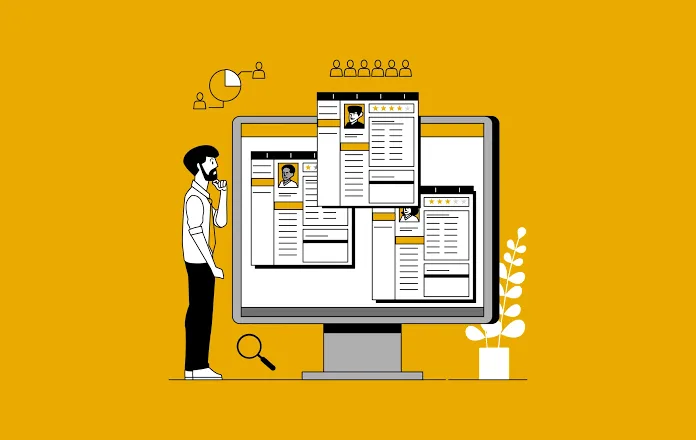
Talent acquisition has evolved far beyond posting vacancies, collecting resumes, and manually screening candidates. Organizations today manage large volumes of candidate information across career sites, job boards, recruiter inboxes, talent pools, and other sourcing channels. At the same time, candidates expect faster applications and more responsive hiring experiences.
This shift has increased the importance of connected recruiting technology, structured candidate data, automation, and artificial intelligence.
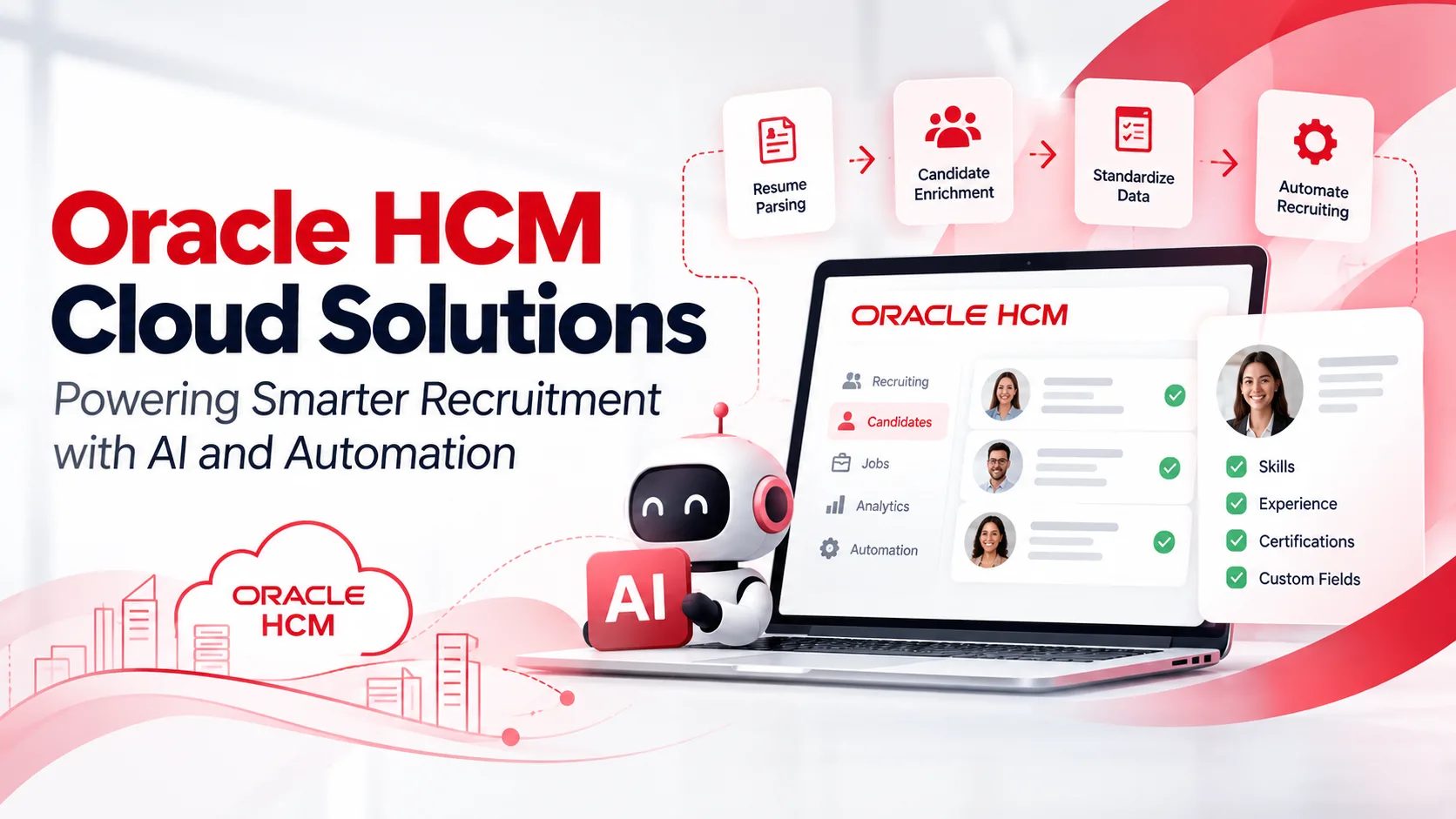
Oracle HCM Cloud solutions provide organizations with a connected environment for managing human capital processes, including recruiting and talent management. As AI becomes increasingly embedded within enterprise HR technology, organizations can combine Oracle's recruiting capabilities with specialized solutions that help automate candidate data processing, improve data quality, and reduce repetitive recruiter work.
For organizations using Oracle Recruiting Cloud, the next stage of talent acquisition is therefore not simply about collecting more candidates. It is about creating accurate candidate profiles, maintaining usable talent data, and applying automation at the right points throughout the recruiting workflow.
What Are Oracle HCM Cloud Solutions?
Oracle Fusion Cloud Human Capital Management provides organizations with cloud-based capabilities covering different stages of the employee lifecycle.
Within talent acquisition, Oracle Recruiting Cloud provides the environment organizations use to manage recruiting activities and candidate processes.
Oracle continues to expand AI capabilities across HCM. Its current HCM AI documentation includes recruiting capabilities involving AI agents, candidate experience, candidate outreach, sourcing, candidate screening, interview resources, smart search, job requisitions, and other recruiting activities.
The result is a recruiting environment that can increasingly combine three important components:
Data: Complete and structured information about candidates, jobs, skills, qualifications, and experience.
Automation: Workflows that reduce repetitive administrative activities.
AI: Capabilities that can use available information to assist recruiters and candidates with specific tasks.
However, the effectiveness of these capabilities depends heavily on the quality and structure of the underlying information.
Why Candidate Data Matters in Modern Talent Acquisition
Consider a recruiter receiving hundreds of applications for a single position.
Every resume can contain valuable information such as:
- Contact information
- Employment history
- Job titles
- Skills
- Education
- Certifications
- Languages
- Professional experience
When important information remains trapped inside resume documents instead of being converted into structured fields, recruiters and recruiting technology may not be able to use it efficiently.
The problem becomes larger as the candidate database grows.
For example, one candidate may list "Senior Software Engineer," another "Sr. Software Engineer," and another "Senior Developer." Similar inconsistencies can occur with skills, degrees, certifications, and other information.
Modern talent acquisition therefore requires more than resume storage. Organizations need candidate information that is structured, standardized, searchable, and consistently mapped.
This is one area where specialized Oracle HCM integrations can extend existing recruiting workflows.
Building Complete Candidate Profiles in Oracle HCM
An important part of recruitment automation is transforming resumes into structured candidate records.
RChilli's Oracle HCM candidate profile import capabilities are designed to convert resume information into structured profiles within Oracle Recruiting Cloud. Candidate information such as experience, education, skills, certifications, languages, and other relevant fields can be extracted and mapped into the recruiting environment.
This can reduce the amount of information candidates or recruiters need to enter manually.
RChilli's Enhanced Candidate Profile Import is also designed to capture Flexfield data, extract multiple skills from candidate resumes, normalize information, and map fields according to configured recruiting workflows.
For candidates, this can contribute to a simpler application experience because information available in their resume can be used to populate relevant profile fields.
For recruiters, structured profiles mean more candidate information is available for searching, filtering, screening, and other downstream recruiting activities.
Improving Candidate Data Quality
Importing candidate information is only the beginning.
Candidate databases naturally become less consistent over time. Candidates acquire new skills, change employers, complete certifications, move locations, and update their contact information.
At the same time, organizations may accumulate variations of the same skills and job titles.
For example:
"Project Manager"
"Project Mgr"
"PM"
"Senior Project Manager"
Some variations represent genuinely different roles, while others may simply be different ways of describing similar information.
Data standardization helps organizations establish a more consistent vocabulary.
RChilli provides data hygiene capabilities for Oracle HCM that include Full Database Reprocessing, List of Values mapping, and customizable taxonomy. These capabilities are intended to help organizations refresh candidate information and standardize skills, job titles, educational qualifications, and other data.
This becomes increasingly important when organizations want to use their existing candidate database for talent rediscovery, matching, analytics, or AI-assisted workflows.
The Growing Role of Oracle HCM AI Agents
Artificial intelligence is becoming a more visible component of enterprise recruiting.
Oracle HCM AI agents can support specific recruiting activities rather than requiring recruiters to perform every step manually.
Oracle's current Fusion Cloud HCM documentation lists recruiting AI capabilities across areas such as candidate sourcing, candidate experience, applicant screening, interview resources, job requisition content, candidate outreach, and workflow automation.
Oracle's 26C recruiting capabilities, for example, include the ability to automatically launch workflow agents when configured candidate-selection events or states occur.
This illustrates an important evolution in Oracle Recruiting automation.
Traditional recruiting automation generally follows predefined rules:
Event → Rule → Action
Agentic workflows can extend this concept by using context and AI capabilities to perform more sophisticated tasks within a controlled workflow.
The recruiter remains an important participant, particularly where human judgment, review, or approval is required.
How Oracle Fusion HCM AI Agents Can Support Recruiting
The potential value of Oracle Fusion HCM AI agents becomes clearer when looking at practical recruiting activities.
AI agents and AI-assisted capabilities can support areas such as:
Candidate sourcing: Helping initiate sourcing activities, campaigns, or candidate pools.
Application screening: Assisting with reviewing candidate information against job requirements.
Job requisitions: Supporting creation or improvement of job posting content.
Candidate experience: Providing AI-assisted functionality within candidate-facing experiences.
Interview preparation: Supporting recruiters with interview-related resources.
Workflow automation: Triggering defined AI-assisted actions as candidates move through recruiting processes.
Oracle's 26C documentation, for example, describes a recruiting sourcing agent that can create candidate pools or campaigns based on configured requisition activities.
These developments make the quality of the underlying candidate and requisition data even more important. AI systems can only work effectively with the information available to them.
Creating a Strong Data Foundation for AI-Powered Recruiting
Organizations adopting AI sometimes focus first on the intelligence layer.
A better starting question is:
Is our recruiting data ready for AI?
A modern recruiting technology stack should ideally provide a reliable flow:
Resume → Data Extraction → Standardization → Candidate Profile → Recruiting Workflow → AI Assistance
If candidate information is incomplete or inconsistent at the beginning of this process, every subsequent activity has to work with those limitations.
A structured data foundation can help organizations make candidate information easier to search, compare, analyze, and use across automated workflows.
This is why resume parsing, profile enrichment, taxonomy, List of Values mapping, and database reprocessing should be considered part of an AI-readiness strategy rather than isolated data-management activities.
Automating Candidate Intake from Multiple Sources
Candidates do not enter recruiting systems through a single channel.
Recruiters may receive resumes from:
- Career sites
- Professional networks
- Job boards
- Recruitment agencies
- Referrals
- Existing databases
- Bulk migration projects
Manually moving information from these sources into an HCM platform creates additional administrative work.
Recruiting connectors can help centralize these candidate-intake processes.
For Oracle users, RChilli provides tools including Browser Assistant, Email Importer, and Bulk Data Import.
Browser Assistant helps recruiters capture candidate information from online sources. Email Importer processes resumes received through email and moves extracted information into the recruiting environment. Bulk Data Import supports large-scale resume processing, which can be particularly useful during migrations or high-volume recruitment projects.
Together, these capabilities can reduce manual data entry and help candidate information enter Oracle in a more structured format.
Candidate Experience Is Part of Recruitment Automation
Recruitment technology should not only make life easier for recruiters.
It should also simplify the application experience.
Lengthy application forms can require candidates to manually reproduce information already contained in their resumes. Resume-driven profile creation can reduce this duplication by extracting information and populating appropriate fields.
A simpler process can mean candidates spend more time reviewing their information and less time repeatedly typing it.
This demonstrates an important principle for modern Oracle HCM Cloud solutions:
Automation should remove unnecessary friction rather than simply add more technology to the hiring process.
Using Existing Candidate Data More Effectively
Organizations can spend years building large candidate databases, yet recruiters frequently return to external sourcing when a new position opens.
One reason is data quality.
Old candidate profiles may contain outdated contact information, incomplete skills, inconsistent titles, or resumes that were processed using older technology.
Database reprocessing provides another approach.
Instead of treating historical candidates as static records, organizations can reprocess available resumes and refresh structured information. RChilli's Full Database Reprocessing capability is designed for this purpose within Oracle environments.
A cleaner existing database can potentially support talent rediscovery and help recruiters make greater use of candidates already available within their ecosystem.
Automation Should Support Recruiters, Not Remove Human Judgment
AI and recruitment automation are most useful when applied to repetitive and data-intensive activities.
Recruiters still provide capabilities technology cannot simply replace: relationship building, organizational context, nuanced assessment, stakeholder management, negotiation, and human judgment.
The objective of Oracle Recruiting automation should therefore be to reduce administrative friction around those activities.
If recruiters spend less time copying resume information, correcting candidate records, standardizing fields, or manually processing files, they can devote more attention to candidates and hiring managers.
The most practical model is not AI versus recruiters.
It is recruiters working with better data, automation, and AI assistance.
What Organizations Should Consider Before Expanding Recruitment Automation
Organizations considering additional automation around Oracle HCM should first evaluate their current recruiting environment.
Questions worth asking include:
- Are candidate profiles complete enough for effective search and screening?
- Are skills and job titles standardized?
- How much candidate information is still entered manually?
- Are recruiters processing resumes from email or job boards manually?
- Does the existing candidate database contain outdated records?
- Are custom Oracle fields being populated consistently?
- Can existing data support the AI capabilities the organization wants to introduce?
Answering these questions can help identify whether the immediate priority should be automation, integration, data hygiene, or a combination of all three.
Building a More Connected Oracle Recruiting Environment
Modern talent acquisition is increasingly becoming a connected data and workflow challenge.
Organizations need candidate information to move accurately from resumes and sourcing channels into their recruiting systems. That information then needs to remain structured and standardized so recruiters, analytics tools, automation, and AI capabilities can use it effectively.
Oracle continues to expand AI-assisted capabilities within Fusion Cloud HCM, while specialized technology providers can complement the ecosystem by addressing areas such as candidate data extraction, enrichment, standardization, and automated intake.
RChilli's Oracle HCM Cloud solutions are designed to work with Oracle Recruiting Cloud across candidate profile import, data hygiene, recruiter connectors, unbiased hiring, and AI-assisted recruiting workflows.
The opportunity is not simply to automate more steps.
It is to create a recruiting environment where accurate data moves smoothly between systems and workflows, repetitive tasks require less manual intervention, and recruiters have better information available when making hiring decisions.
Conclusion
Talent acquisition is moving toward a model built around structured data, connected workflows, automation, and artificial intelligence.
Organizations using Oracle HCM have an opportunity to strengthen this foundation by improving how candidate information enters, moves through, and remains within their recruiting ecosystem.
Complete candidate profiles can support better search and screening. Standardized skills and job titles can improve consistency. Recruitment connectors can reduce manual intake. AI agents can assist with increasingly sophisticated recruiting activities.
When these capabilities work together, Oracle HCM Cloud solutions can support a more efficient and data-driven approach to modern talent acquisition.
The goal is ultimately straightforward: reduce unnecessary administrative work, improve the quality and usability of recruiting data, and give recruiters more time and better information to focus on finding the right people.