Introduction
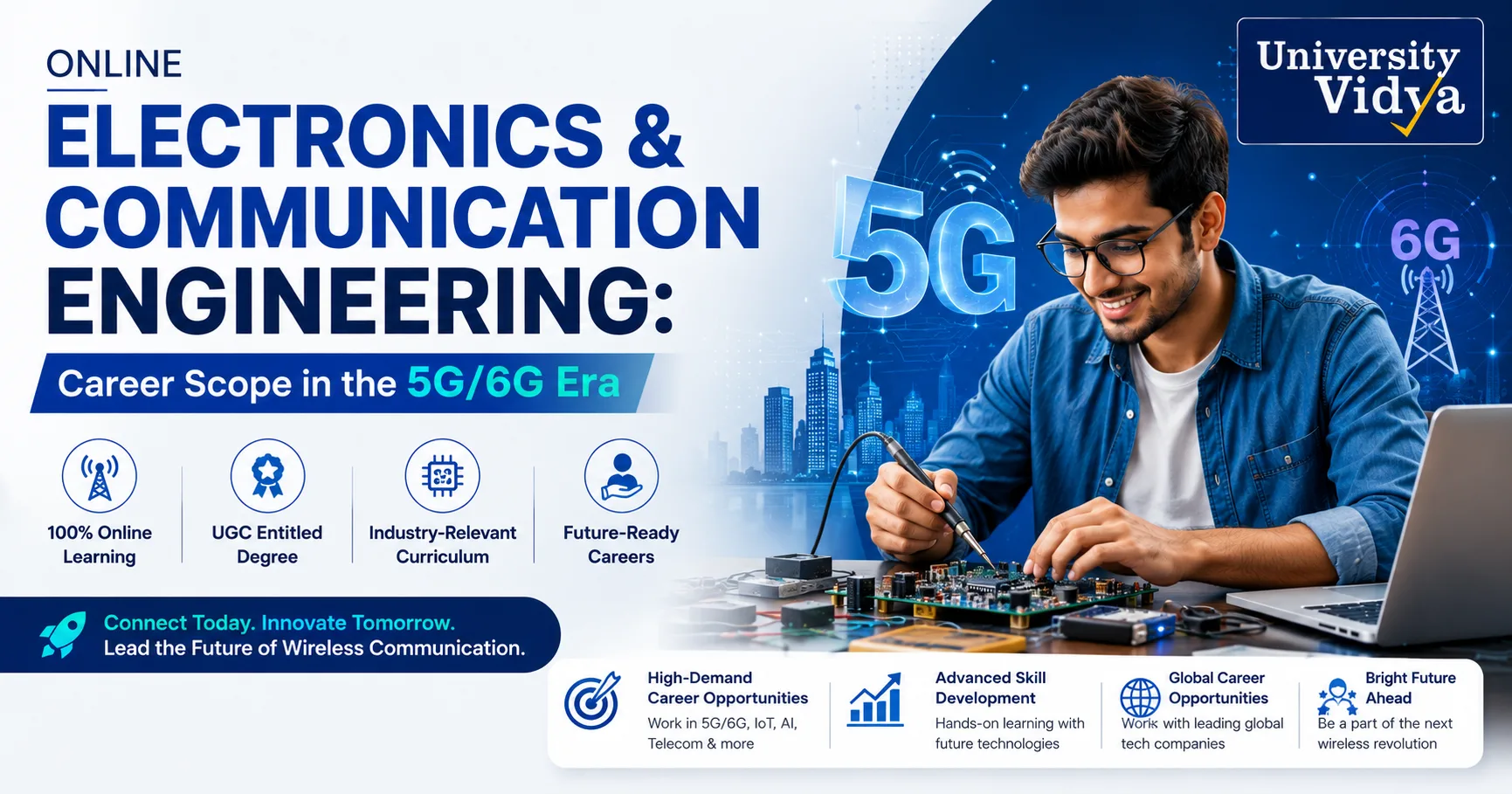
Every time a 5G tower transmits data to your smartphone, a radar system tracks an aircraft, a satellite relays navigation signals, or an embedded chip controls a medical device Electronics and Communication Engineering is at work. ECE is the discipline that literally keeps India connected, defended, and technologically advanced. In 2026, as India accelerates its 5G rollout, begins early-stage 6G research, and builds domestic semiconductor manufacturing capacity under the PLI scheme, the demand for skilled ECE professionals has never been higher. The online electronics and communication engineering pathway makes this high-growth career accessible without the constraints of a traditional campus. This blog is your complete guide.
What Makes ECE Uniquely Positioned in the 5G and 6G Era?
Online electronics and communication engineering is not just another engineering branch competing for jobs. It occupies a distinctive and strategic position in India's technology landscape for three reasons:
India's 5G Rollout and 6G Research India completed its 5G rollout across major cities and is in active pilot phases in smaller cities. Simultaneously, the Department of Telecommunications and IIT research centres are engaged in early 6G technology development. Both create sustained demand for ECE engineers in antenna design, RF engineering, signal processing, and network hardware.
Semiconductor Manufacturing Under PLI India's Production Linked Incentive scheme for semiconductor fabrication is bringing chip manufacturing long absent from India back into the domestic economy. ECE engineers are the primary technical workforce for semiconductor design, fab operations, and VLSI development.
Defense Electronics Under Make in India Radar systems, electronic warfare equipment, avionics, and military communication systems are being developed domestically at scale. DRDO, BEL, HAL, and their private sector ecosystem partners are active employers of ECE professionals with advanced credentials.
Online ECE vs CSE Choosing the Right Engineering Branch
One of the most frequently searched comparisons is online ECE vs CSE and it is worth addressing directly.
Computer Science Engineering (CSE):
- Focuses on software programming, algorithms, databases, AI, cloud systems
- Career paths: Software developer, data scientist, cloud engineer, cybersecurity analyst
- Higher volume of job openings in the Indian IT services sector
- Better suited for those whose primary interest is software development and IT
Electronics and Communication Engineering (ECE):
- Focuses on hardware and systems semiconductors, signal processing, RF engineering, embedded systems, communication networks
- Career paths: VLSI engineer, RF engineer, embedded systems developer, telecom engineer, defense electronics specialist
- Higher salaries in niche hardware and semiconductor roles
- Better suited for those interested in how hardware, signals, and communication networks are designed and built
In practice, ECE and CSE overlap significantly in areas like embedded software, IoT, and DSP but their foundations differ. ECE is the right choice if you are drawn to how physical systems transmit, process, and receive signals. CSE is right if your interest is in software and data.
Who Should Pursue an Online ECE Course in 2026?
The ECE online India pathway is most relevant for:
- Class 12 PCM students interested in how hardware, chips, and communication systems work
- Polytechnic diploma holders in ECE, Electronics, or Telecommunications seeking lateral B.Tech entry
- ITI certificate holders in electronics trades wanting a formal engineering degree
- Working professionals in telecom companies, defense electronics, consumer electronics manufacturing, or embedded product development
- Government engineers in BSNL, MTNL, BEL, DRDO, or state telecom departments needing degree upgrades
- Embedded systems and IoT developers wanting a formal ECE credential to go with their practical skills
- RF technicians and tower engineers in the telecom infrastructure sector
- Engineers in semiconductor or PCB design firms without a formal B.Tech ECE degree
The Honest Challenge: ECE Online Delivery
Before discussing programs, the same honest note that applies to electrical and mechanical engineering applies here: electronics and communication distance programs face delivery challenges that CSE does not.
ECE laboratory work oscilloscopes, spectrum analysers, signal generators, antenna testing equipment, PCB soldering, microcontroller kits cannot be fully replicated through software simulation alone. As a result:
- Pure fully-online B.Tech ECE with no physical lab component is approved by fewer UGC-DEB institutions than B.Tech CSE
- Most credible ECE programs in distance or hybrid mode include mandatory contact sessions at designated lab centres
- At the M.Tech level, ECE specialisations in signal processing, VLSI, and wireless communication are more available online than full B.Tech ECE
- The simulation component of ECE MATLAB, SPICE, Cadence, Xilinx Vivado is well-suited for online delivery and reduces (though does not eliminate) the physical lab dependency
For working ECE professionals, this hybrid structure is manageable and many have workplace access to relevant equipment that can supplement formal lab sessions.
Online B.Tech ECE Eligibility
Standard eligibility for the online B.Tech ECE hybrid program:
- Education: Class 12 with Physics, Chemistry, and Mathematics from a recognised board
- Minimum marks: 45% to 55% in PCM (varies by institution)
- Entrance requirement: JEE Main scores at AICTE-approved institutions; institutional entrance tests at others; direct merit admission at select programs
- Lateral entry: 3-year polytechnic diploma in ECE, Electronics, or Telecommunications directly enters Year 2 completing the B.Tech in 3 years
- ITI holders: Electronics or electrical ITI certificate holders accepted through bridge courses at select institutions
- Age limit: 17 to 23 years for fresh applicants; most hybrid and distance programs have no upper age restriction for working professionals
Online ECE Syllabus Four-Year Curriculum Structure
A typical online electronics and communication engineering B.Tech curriculum covers:
Year 1 Engineering Foundation
- Engineering Mathematics (Calculus, Linear Algebra, Complex Analysis)
- Basic Electronics and Electrical Engineering
- Engineering Physics and Materials Science
- Programming Fundamentals (C, Python)
- Engineering Drawing and Communication Skills
Year 2 Core ECE Subjects
- Electronic Devices and Circuits (Diodes, BJTs, MOSFETs, Op-Amps)
- Signals and Systems (Continuous and Discrete)
- Digital Electronics and Logic Design
- Network Analysis and Electromagnetic Fields
- Analog and Digital Communication Fundamentals
Year 3 Advanced ECE Subjects
- Microprocessors and Embedded Systems (ARM, AVR, 8051)
- Digital Signal Processing (DSP Algorithms, FFT, Filter Design)
- Communication Systems (AM, FM, OFDM, MIMO)
- Antennas and Wave Propagation
- VLSI Design and Fabrication Fundamentals
Year 4 Emerging Technologies and Specialisation
- RF and Microwave Engineering
- Wireless Communication Networks (4G, 5G Architecture)
- Internet of Things and Edge Computing
- Optical Fibre Communication Systems
- Major Project or Industry Dissertation
- Advanced Elective (6G Technology, Radar Systems, Embedded AI, Satellite Communication)
Online ECE Scope in the 5G and 6G Era Sector-by-Sector
The online ECE scope 5G/6G career landscape is one of the richest in Indian engineering in 2026:
Telecommunications 5G and Emerging 6G India's 5G infrastructure built on massive MIMO antennas, millimetre-wave spectrum, network slicing, and edge computing requires ECE engineers in:
- RF Planning and Optimization Engineer Plans, designs, and optimises 5G radio frequency networks across urban and semi-urban deployments
- Network Design Engineer Designs the hardware and software architecture of 5G base stations and core network elements
- Antenna and Propagation Engineer Designs multi-band antennas, beamforming systems, and propagation models for 5G coverage
- Telecom Testing and Validation Engineer Tests 5G equipment for performance, regulatory compliance, and interoperability
Major employers: Ericsson India, Nokia India, Samsung R&D India, Tata Communications, Airtel, Reliance Jio (network engineering teams), BSNL, and C-DoT.
Semiconductor and VLSI Design India's semiconductor push under PLI and IESA's industry roadmap is creating new demand for:
- VLSI Design Engineer Designs digital and analog integrated circuits using Verilog, VHDL, and Cadence/Synopsys tools
- Physical Design Engineer Handles chip floorplanning, placement, routing, and tape-out processes
- Verification Engineer Tests chip functionality before fabrication using UVM testbenches
- FPGA Engineer Implements digital systems on programmable hardware for prototyping and embedded applications
Major employers: Intel India, Qualcomm India, Texas Instruments India, Synopsys India, Cadence India, Mediatek, Samsung Semiconductor India.
Defense Electronics and Aerospace
- Radar Systems Engineer Designs pulse-Doppler radars, phased array antennas, and radar signal processing systems
- Electronic Warfare Engineer Designs jamming, counter-jamming, and spectrum monitoring systems
- Avionics Engineer Works on aircraft navigation, communication, and flight management electronics
- Satellite Communication Engineer Designs ground station systems, satellite payload electronics, and satellite link budgets
Major employers: DRDO laboratories, BEL (Bharat Electronics Limited), HAL, ISRO, Bharat Forge, and private defense manufacturers under Make in India.
Embedded Systems and IoT
- Embedded Software Engineer Writes firmware for microcontrollers, RTOSes, and hardware abstraction layers
- IoT Platform Engineer Designs end-to-end IoT systems from sensor hardware to cloud dashboards
- Medical Device Electronics Engineer Designs embedded systems for patient monitoring, imaging, and diagnostic devices
- Automotive Electronics Engineer Works on ADAS, infotainment, and vehicle communication systems
Consumer Electronics and PCB Design
- PCB Design Engineer Designs multi-layer circuit boards for consumer electronics, industrial equipment, and communication devices
- Hardware Design Engineer Designs power supply systems, high-speed interfaces, and signal integrity solutions
- Test and Measurement Engineer Develops automated test equipment for electronics manufacturing
Salary Outlook:
- Fresh B.Tech ECE graduate: ₹3 LPA to ₹6 LPA
- With 3 to 5 years experience and B.Tech ECE: ₹6 LPA to ₹14 LPA
- VLSI or RF engineer with M.Tech specialisation: ₹12 LPA to ₹25 LPA
- Senior roles at semiconductor OEMs, defense labs, or 5G equipment manufacturers: ₹20 LPA to ₹40 LPA
M.Tech ECE Specialisations Available Online and Distance
For working ECE professionals, these M.Tech specialisations are available in online or hybrid distance mode:
VLSI Design and Embedded Systems The most sought-after ECE postgraduate specialisation. Covers advanced CMOS design, RTL design and synthesis, physical design, verification methodologies (UVM), and SoC architecture. Direct pathway to semiconductor industry roles.
Signal Processing and Communication Covers advanced DSP algorithms, adaptive filtering, OFDM and MIMO systems, coding theory, and cognitive radio. Strongly aligned with 5G research and telecommunications product development.
Wireless and Mobile Communication Covers 5G NR standards, channel modelling, network planning, satellite communication, and early 6G technologies. Growing demand as India's wireless infrastructure expands.
Embedded Systems and IoT Covers RTOS programming, ARM Cortex architecture, IoT protocol stacks (MQTT, CoAP), edge AI, and industrial IoT. High demand across automotive, healthcare, and smart manufacturing sectors.
RF and Microwave Engineering Covers microwave circuit design, antenna arrays, radar systems, RF IC design, and satellite link engineering. Niche but premium-paying specialisation in defense and telecommunications.
Photonics and Optical Communication Covers optical fibre systems, WDM networks, photonic integrated circuits, and LiDAR systems. Emerging specialisation relevant to undersea cable infrastructure and LiDAR in autonomous vehicles.
ECE Online India Institutions to Consider
ECE online India programs with credible approvals and delivery infrastructure:
For B.Tech ECE (Hybrid Mode):
- BITS Pilani WILP Work-integrated programs; strong employer acceptance; ECE and related disciplines
- Manipal University Online B.Tech ECE in hybrid mode; UGC-DEB approved; national exam centres
- Amity University Online B.Tech Electronics and Communication Engineering; NAAC A+ accredited
- IGNOU School of Engineering B.Tech ECE programs; most affordable; government and PSU recognition
- LPU Online B.Tech ECE with specialisation options; exam centres across India
For M.Tech ECE Specialisations (Distance/Hybrid):
- IIT Part-Time Programs VLSI, Signal Processing, RF Engineering; sponsored category; GATE-based
- BITS Pilani WILP M.Tech ECE specialisations; no GATE required; strongest private brand
- Manipal University Online M.Tech ECE hybrid delivery; flexible timeline; good student support
- Jain University Online M.Tech ECE programs; good faculty access; South India presence
- Annamalai University Established distance ECE programs; regional acceptance
Key Certifications for Online ECE Professionals
Software and Design Tool Certifications:
- Cadence Certified Designer Digital and analog IC design; widely recognised in semiconductor industry
- Xilinx/AMD FPGA Designer Certification FPGA implementation; used in telecom and defense hardware
- MATLAB and Simulink Signal Processing Certification MathWorks; industry standard for DSP professionals
- Altium Designer PCB Certification PCB design; accepted across electronics manufacturing
Telecom and 5G Certifications:
- Ericsson Certified Technology 5G; professional telecom certification from leading equipment vendor
- Nokia Bell Labs 5G Network Architecture Recognised in telecom network engineering
- C-DoT 5G Technology Certification India's domestic telecom R&D centre; relevant for government telecom roles
Embedded Systems Certifications:
- ARM Accredited Engineer Microcontroller architecture and embedded programming
- FreeRTOS Certification (AWS) Real-time operating systems for embedded IoT devices
- Certified LabVIEW Developer (National Instruments) Instrumentation and test engineering
Professional Memberships:
- IEEE India Communications Society, Signal Processing Society, Circuits and Systems Society
- IETE (Institution of Electronics and Telecommunication Engineers) India's primary professional body for ECE engineers; AMIE membership pathway
Online ECE for Working Professionals Making It Work in Practice
For online ECE for working professionals, here are the most practical study strategies:
Use Simulation Before Contact Sessions: MATLAB, LTspice, Proteus, Cadence Virtuoso, and Xilinx Vivado allow you to complete circuit design and signal processing exercises at home before attending lab contact sessions. This preparation makes contact sessions more efficient and less dependent on in-person guidance.
Leverage Workplace Equipment: Telecom tower engineers, BEL employees, and DRDO staff often have workplace access to oscilloscopes, spectrum analysers, and RF test equipment. Document these workplace activities systematically some institutions accept structured workplace lab reports toward practical credit.
Target GATE Alongside Your Degree: GATE ECE is one of the most competitive papers but also one of the most rewarding. A GATE score opens IIT and NIT M.Tech seats, PSU recruitment (BHEL, ISRO, BEL, ONGC), and research fellowship applications making it a high-value parallel investment.
Align Your M.Tech With Your Industry Role: A telecom engineer in Airtel or Jio should pursue Wireless Communication M.Tech. A professional in BEL or DRDO benefits more from VLSI or RF Engineering. An IoT product developer is best served by Embedded Systems M.Tech. This alignment makes study feel relevant rather than abstract.
How University Vidya Helps ECE Professionals Find the Right Path
Navigating the hybrid delivery requirements, AICTE and UGC-DEB approvals, GATE versus non-GATE admission pathways, and the wide range of M.Tech ECE specialisations requires more research than most working professionals have time for.
University Vidya is a trusted education platform where ECE professionals and aspiring students across India can explore online ECE programs and courses, compare B.Tech and M.Tech options by specialisation and institution, verify approval status, understand lab requirements, and get personalised admission guidance all without the complexity of individual university research.
Whether you are a diploma-holding RF technician targeting lateral B.Tech entry, a telecom engineer seeking M.Tech in 5G Wireless Communication, or a VLSI aspirant exploring postgraduate options without GATE University Vidya helps you make the right decision efficiently.
Conclusion
Online electronics and communication engineering in 2026 stands at the confluence of India's most consequential technological investments 5G infrastructure, semiconductor manufacturing, defense electronics, and embedded systems innovation. ECE professionals who formalise their credentials with a recognised B.Tech or M.Tech are positioning themselves at the center of decades of sustained engineering demand. The hybrid delivery model makes this accessible without leaving your job or your city. The specialisations are deep, the salary ceilings are high, and the industry need is only growing. For every ECE professional who has been working without the credential to match their skills the time to close that gap is now.