Replacing a missing tooth involves more than choosing a replacement that looks natural. The type of dental implant, its design, the condition of the jawbone, and the patient's oral health can all influence the treatment plan. Ceramic dental implants have gained attention among patients who prefer metal-free restorative options and want a natural-looking smile.
However, ceramic implants are not all designed in the same way. One-piece and two-piece ceramic dental implants have different structural designs, particularly in how the implant and the component supporting the replacement tooth are connected. Understanding these differences can help patients have more informed discussions with their dentist.
If you are considering one-piece ceramic dental implants in Kothrud, learning about their design, placement requirements, and limitations can help you understand whether this option may suit your dental needs.
At the same time, two-piece ceramic dental implants in Kothrud offer a different approach to treatment planning and restoration. Let's explore how both systems work, their advantages, limitations, and the factors a dentist considers when recommending an appropriate option.
What Are Ceramic Dental Implants?
Ceramic dental implants are artificial tooth roots placed in the jawbone to support replacement teeth, such as crowns or bridges. They are commonly made from zirconia, a strong ceramic material used in modern dentistry.
After placement, the implant undergoes a healing process called osseointegration, during which bone forms a stable connection with the implant surface. Once adequate healing and stability are achieved, the implant can support a suitable dental restoration according to the treatment plan.
Ceramic implants may be considered by patients who prefer a metal-free alternative to conventional titanium implants. Their tooth-coloured appearance can also be beneficial in certain aesthetic situations, particularly where gum tissue is thin.
However, ceramic implants are not automatically better than titanium implants for every patient. The dentist must evaluate bone volume, gum health, bite forces, medical history, and the specific implant system before recommending treatment.
What Are One-piece Ceramic Dental Implants?
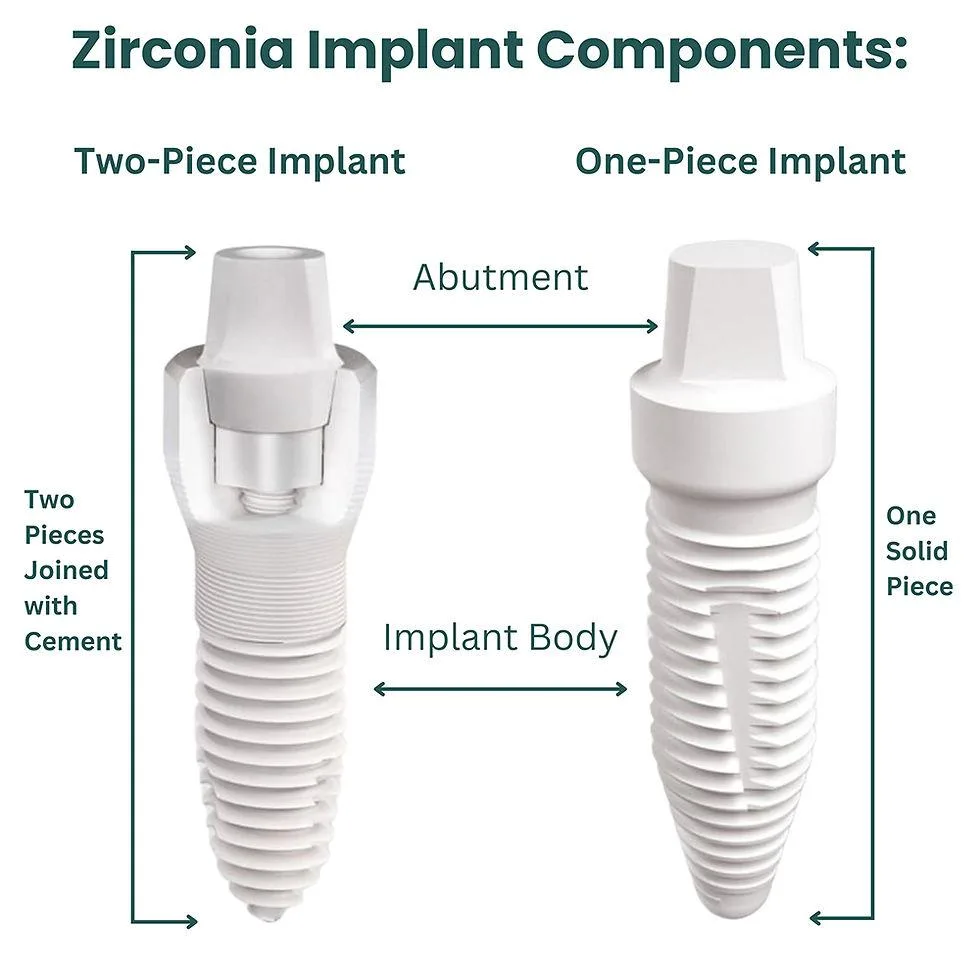
A one-piece ceramic implant is manufactured as a single integrated component. The implant portion that enters the jawbone and the abutment portion that supports the replacement tooth are connected as one structure.
Because these components are integrated, there is no separate implant-abutment junction within the system. The restoration is planned around the position and angulation of the implant itself.
Key Features of One-piece Implants
- Integrated design: The implant and abutment form a single unit.
- Fewer connecting components: The design eliminates the separate implant-abutment connection.
- Placement precision: Implant positioning and angulation require careful planning because the abutment cannot be independently repositioned.
- Restoration planning: The dentist must consider the final crown position before implant placement.
- Patient selection: Bone quality, available bone volume, gum condition, and bite forces influence suitability.
Potential Advantages
One-piece implants have a relatively straightforward component design. Their integrated structure removes the need for a separate abutment connection, which may simplify certain aspects of the restorative process.
They may be suitable in carefully selected cases where the implant can be placed in an ideal position and the planned restoration can be supported without compromising function or appearance.
Limitations to Consider
The integrated design also creates limitations. If the implant emerges at an unfavourable angle, correcting the final crown position may be more difficult. Treatment planning must therefore be particularly precise.
One-piece systems may also have specific requirements regarding loading and healing. Depending on the implant system and clinical circumstances, temporary restorations and bite forces may need careful management.
What Are Two-piece Ceramic Dental Implants?
A two-piece ceramic implant consists of two separate components: the implant body placed in the jawbone and an abutment attached to it to support the replacement tooth.
The separate components are connected using the mechanism specified by the implant manufacturer. This creates an implant abutment connection that must be properly designed, assembled, and maintained.
Key Features of Two-piece Implants
- Separate components: The implant body and abutment are distinct parts.
- Restorative flexibility: Compatible abutments and restorative components can provide additional options for positioning the crown.
- Treatment planning: The dentist can select compatible components according to the implant position and restoration requirements.
- Connection design: The specific junction and its mechanical properties depend on the implant system.
- Healing considerations: The timing of restoration and loading depends on implant stability, bone healing, and the clinical treatment plan.
Potential Advantages
Two-piece systems can provide greater flexibility when planning the final restoration. The availability of compatible abutments may help the dentist manage certain differences in implant position and crown design.
This flexibility can be useful in cases where the restoration requires careful adjustment to achieve an appropriate bite, natural appearance, and functional outcome.
Limitations to Consider
Two-piece systems have an additional component junction that must be considered during treatment planning. Depending on the system, the connection may require specific assembly procedures and maintenance.
Not all two-piece ceramic implant systems have the same mechanical characteristics. The strength of the components, connection design, restoration options, and clinical evidence can vary between manufacturers.
For this reason, patients should ask their dentist about the specific implant system being recommended rather than assuming all ceramic implants perform identically.
One-piece vs Two-piece Ceramic Dental Implants: A Comparison
Understanding the main implant design differences can help patients recognise why a dentist may recommend one system over another.
FeatureOne-piece ImplantsTwo-piece ImplantsBasic designImplant and abutment are integratedImplant and abutment are separateComponent connectionNo separate implant-abutment junctionSeparate connection between componentsCrown positioningDepends strongly on implant placementCompatible abutments may offer additional restorative flexibilityPlacement planningRequires precise implant angulationRequires precise placement and compatible restorative componentsRestoration optionsDepend on the specific systemMay offer more component choicesTreatment suitabilityDepends on bone, gums, bite and implant positionDepends on bone, gums, bite and implant systemHealing and loadingDetermined by clinical stability and protocolDetermined by clinical stability and protocolNeither design is universally superior. The appropriate choice depends on the patient's anatomy, the planned restoration, the implant system, and the dentist's clinical assessment.
Understanding Implant Placement Techniques
The success of ceramic implant treatment depends on more than the implant design. Implant placement techniques play an important role in achieving appropriate positioning, stability, and long-term function.
1. Clinical Examination and Digital Planning
Before implant placement, the dentist evaluates the missing tooth site, gum condition, bite, and available bone. Dental imaging, including cone-beam computed tomography (CBCT) when indicated, can help assess bone dimensions and important anatomical structures.
The dentist also considers the intended crown position. This is especially important for one-piece implants because the integrated abutment limits the ability to correct angulation through separate restorative components.
2. Evaluating Bone and Gum Health
Adequate bone support is essential for implant stability. If the patient has experienced bone loss, additional procedures may sometimes be considered before or alongside implant treatment.
Healthy gums and good oral hygiene are also important. Existing gum disease should be assessed and managed before implant placement whenever appropriate.
3. Implant Placement and Healing
The implant is placed according to the manufacturer's instructions and the clinician's treatment plan. The dentist evaluates primary stability and determines the appropriate healing and loading protocol.
Patients should not assume that a particular implant design always permits faster treatment. Healing time depends on multiple factors, including bone quality, implant stability, surgical conditions, and individual healing response.
4. Crown Placement and Follow-up
After sufficient healing, the dentist plans or completes the final restoration according to the selected system. The crown must be designed to provide appropriate function, appearance, and bite alignment.
Regular follow-up appointments help the dentist assess gum health, restoration condition, bite forces, and oral hygiene.
Why Is the Implant Abutment Connection Important?
The implant abutment connection is a key structural consideration in two-piece systems. It connects the implant body to the component that supports the replacement tooth.
The design of this connection varies across implant systems. Factors such as component fit, connection stability, material properties, and the forces generated during chewing can influence its performance.
A well-planned restoration should distribute chewing forces appropriately and minimise excessive stress on the implant components.
One-piece implants have no separate implant-abutment junction because the components are integrated. However, this does not mean they are free from mechanical complications or automatically more durable. Their performance still depends on correct placement, material properties, restoration design, and patient-specific factors.
Patients should discuss the expected lifespan of the restoration, maintenance requirements, and possible complications with their dentist before proceeding.
Which Type of Ceramic Dental Implant Is Right for You?
Choosing between one-piece and two-piece implants requires an individual assessment. A dentist may consider the following factors.
Bone Volume and Quality
The amount and quality of available bone influence implant stability and placement options. If bone volume is insufficient, additional treatment may be necessary.
Position of the Missing Tooth
The location of the missing tooth affects aesthetic requirements and chewing forces. Front teeth often require particular attention to appearance and gum contours, while back teeth experience substantial chewing forces.
Bite and Chewing Habits
Patients with heavy bite forces or habits such as teeth grinding may require additional evaluation. The dentist must ensure that the selected implant and restoration can withstand the expected functional demands.
Aesthetic Requirements
Both ceramic implant designs can support natural-looking restorations when appropriately planned. The final appearance depends on implant positioning, gum health, crown design, and the surrounding teeth.
Long-term Maintenance
Implants require ongoing care. Daily cleaning, regular dental check-ups, and professional maintenance are essential for monitoring the implant and the surrounding tissues.
Patients should also understand that the implant itself and the crown it supports are separate considerations when discussing durability, repair, and replacement.
Questions to Ask Before Choosing Ceramic Implants
Before beginning treatment, consider discussing these questions with your dentist:
- Which ceramic implant system do you recommend for my case, and why?
- Is a one-piece or two-piece design more appropriate for my missing tooth?
- Do I have sufficient bone for implant placement?
- Will I need bone grafting or another preparatory procedure?
- What is the expected healing period before the final crown is placed?
- What are the possible complications and alternative treatments?
- What maintenance and follow-up appointments will I need?
- What are the total treatment costs, including the implant, crown, imaging, and any additional procedures?
These questions help you understand the treatment plan and make an informed decision based on your individual dental needs.
Ceramic Dental Implant Treatment at SmyleXL Advanced Dental Clinic
If you are exploring ceramic implant treatment, a professional consultation can help you understand which option may be appropriate for your oral health and restoration goals.
At SmyleXL Advanced Dental Clinic, patients looking for a Dental Clinic in Pune Kothrud can discuss missing-tooth replacement options, implant planning, restorative requirements, and long-term oral care with the dental team.
During your consultation, ask about the available ceramic implant systems, the differences between one-piece and two-piece designs, the expected treatment timeline, and the maintenance required after treatment.
The final recommendation should be based on a clinical examination and appropriate diagnostic imaging rather than implant design alone. Your dentist can explain the benefits, limitations, expected outcomes, and alternative treatments relevant to your case.
Frequently Asked Questions
1. What is the main difference between one-piece and two-piece ceramic dental implants?
A one-piece implant integrates the implant body and abutment into a single component. A two-piece implant has a separate implant body and abutment connected during treatment.
2. Are one-piece ceramic dental implants better than two-piece implants?
Neither design is always better. The appropriate choice depends on the implant position, bone and gum condition, restoration requirements, and the characteristics of the implant system.
3. Are two-piece ceramic dental implants suitable for missing molars?
They may be suitable in selected cases. The dentist must evaluate bone support, chewing forces, implant dimensions, and the specific system's clinical indications before recommending treatment.
4. Do ceramic dental implants look natural?
Ceramic implants can support natural-looking replacement teeth. The final appearance depends on the crown, gum condition, implant positioning, and the surrounding teeth.
5. How long does ceramic dental implant treatment take?
Treatment may take several months, depending on the need for preparatory procedures, implant stability, healing, and restoration planning. The dentist can provide an individual timeline after examination.
6. How should I care for ceramic dental implants?
Brush twice daily, clean between your teeth and around the implant, follow your dentist's oral hygiene instructions, and attend regular dental check-ups. Avoiding tobacco and managing gum disease can also support long-term oral health.
7. Where can I learn about ceramic dental implants in Kothrud?
You can arrange a consultation at SmyleXL Advanced Dental Clinic in Kothrud to discuss available implant options, suitability, treatment planning, and expected costs.
Conclusion
Choosing between one-piece and two-piece ceramic dental implants involves understanding how each design supports the final replacement tooth. One-piece systems integrate the implant and abutment, while two-piece systems use separate components that may provide additional restorative flexibility.
Both approaches have potential benefits and limitations. The most suitable option depends on bone availability, gum health, implant positioning, bite forces, aesthetic requirements, and the specific implant system.
If you are considering one-piece ceramic dental implants in Kothrud or two-piece ceramic dental implants in Kothrud, consult SmyleXL Advanced Dental Clinic to discuss your options and receive an individualised treatment plan. A thorough clinical evaluation can help you make a well-informed decision about replacing missing teeth and maintaining your oral health.
Source : Smylexl.com