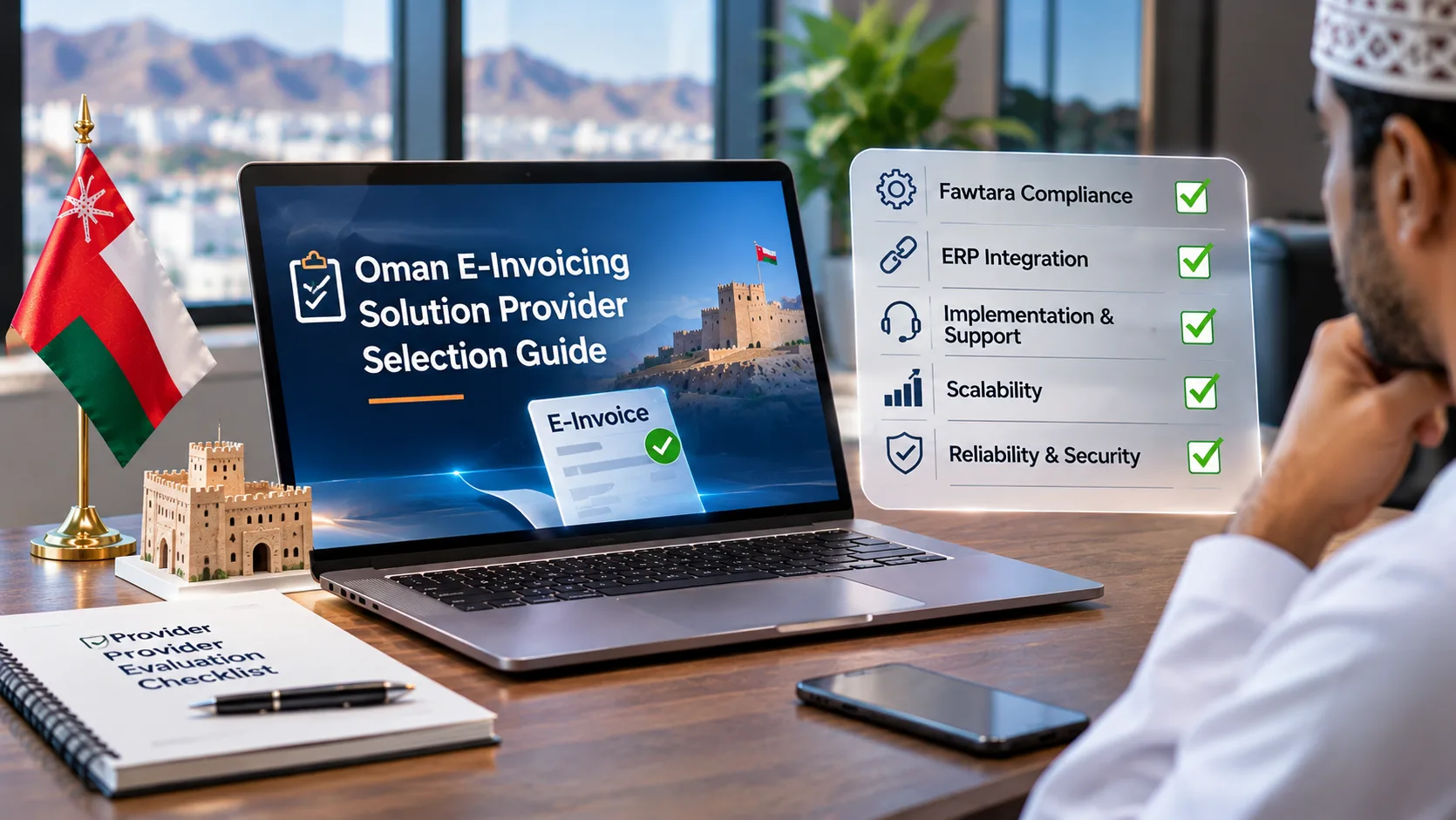
The phrase “Oman e-invoicing solution provider” now covers at least three quite different kinds of company. A sales page may use it for a firm the Oman Tax Authority has accredited to transmit invoices, for a software vendor that connects customers to someone else’s accreditation, or for a consultancy that configures your ERP. Each can be a sound choice. Problems start when a buyer assumes they are all the same thing.
Start with one plain question: who will actually transmit your invoices? Under Fawtara, only an accredited service provider can, because businesses cannot send invoices directly to the tax authority. Any Oman e-invoicing solution provider on your shortlist therefore either holds that accreditation itself or works through a partner that does, and the answer shapes your contract, your support line and your costs.
This guide separates the models, shows where scope gaps hide, and offers a simple way to score providers so the decision does not rest on whoever demos best.
Why Accreditation Is a Filter, Not a Finish Line
The Oman Tax Authority (OTA) publishes accreditation criteria covering legal incorporation, financial standing, technical capability, information security and readiness to operate as a Peppol access point. Applicants must also pass the authority’s test suites, including checks on PINT-OM invoices and message delivery. That makes accreditation a meaningful baseline: a provider on the list has been examined.
It does not tell you whether the provider suits your business. A firm built for large corporate groups may handle a small trader poorly, and the reverse is also true. Routing across the network is centralised, so every accredited provider reaches buyers the same way. What you are choosing between is service, not network access. Providers also describe their status in different ways, such as accredited or pre-approved, so check the current wording against the OTA’s list on the Fawtara portal rather than a logo on a website.
Four Types of Oman E-Invoicing Solution Provider
In practice, businesses end up with one of these arrangements.
ModelWhere it works wellWhat to watchAccredited provider offering the full serviceOne accountable party for generation, exchange and reportingCheck that your ERP is actually supported, not just called compatibleERP vendor bundling a providerTight fit with your existing systemThe provider may be a partner, so confirm who handles supportImplementation partner connecting you to a providerStrong on mapping and ERP customisationTwo contracts, and unclear ownership when invoices failBecoming your own accredited providerFull control over the processMeeting the OTA’s criteria and tests is a serious undertaking, so it usually suits only large, technically mature groupsConsider a hypothetical Nizwa trading company running a lightly customised accounting package with a two-person finance team. A full-service accredited provider is probably the best fit, because the team has no spare capacity to coordinate three parties. A multinational’s Oman branch, by contrast, may already have an ERP vendor relationship and an IT group able to manage a partner, which changes the calculation.
None of these is automatically best. The real test is which one gives you a single party to call on the last working day of the month, when a batch of invoices is rejected.
Scope Gaps Hiding Behind the Word “Compliant”
Providers often quote for transmission and reporting, which is the accredited part. Several adjacent jobs may sit outside that quote. Generation is the main one: if your ERP cannot produce a PINT-OM file, then Oman e-invoice generation, including credit and debit notes and validation before anything is sent, needs to be named as its own deliverable, whether it is built into the ERP, supplied by the provider or added by a partner.
Ask the same of the other jobs. Who builds and maintains the ERP connector? Who monitors rejections? Who answers a buyer who asks why their invoice failed? Where gaps exist, they usually land on the finance team by default, which is the most expensive place for them to land.
A Simple Scoring Sheet for Your Shortlist
Demos reward polish. A scoring sheet rewards fit. Pick five criteria, weight them by what matters to your business, and score each provider out of five after a live test. The weights below are purely illustrative, for a hypothetical Muscat wholesaler with a customised ERP and a small finance team.
- ERP fit (30%). Has the provider connected a system like yours before, and can it show the result?
- Support and escalation (25%). Named contacts, response times and what happens when rejections pile up.
- Scope clarity (20%). Every job from generation to archiving assigned to someone.
- Commercial clarity (15%). Pricing by invoice volume, document type or user, with no surprises for credit notes.
- Exit path (10%). How you leave, and what data you take with you.
A wholesaler with a heavily customised ERP might raise the first weight and cut the last. A business with a simple system and a tight budget would do the opposite. The value lies in agreeing the weights before the demos begin, and in scoring only what you have seen working on your own test invoices, not what appears on a slide.
Contract Points Worth Settling Before Go-Live
Three clauses deserve attention. First, volume and document types: confirm how credit notes, debit notes and rejected-and-resubmitted invoices are charged. Second, data access: you should be able to export your invoice history and status records in a usable form, because archiving remains the taxpayer’s responsibility under current guidance.
Third, specification changes: if the OTA updates technical requirements, the contract should say who adapts the connector and whether that is billed separately.
Choosing With the Calendar in Mind
Provider onboarding, ERP mapping and testing all take calendar time, and as of November 2026 the first mandatory date is 1 April 2027. A realistic selection process therefore finishes in weeks, not months. Shortlist two or three providers, run the same test invoices through each, score them on the sheet above and decide.
A provider that is accredited, clear about scope and honest about limits is worth more than one with the longest feature list. Check the OTA’s list and guidance again just before you sign, because accreditation progress and timelines have both moved during 2026.