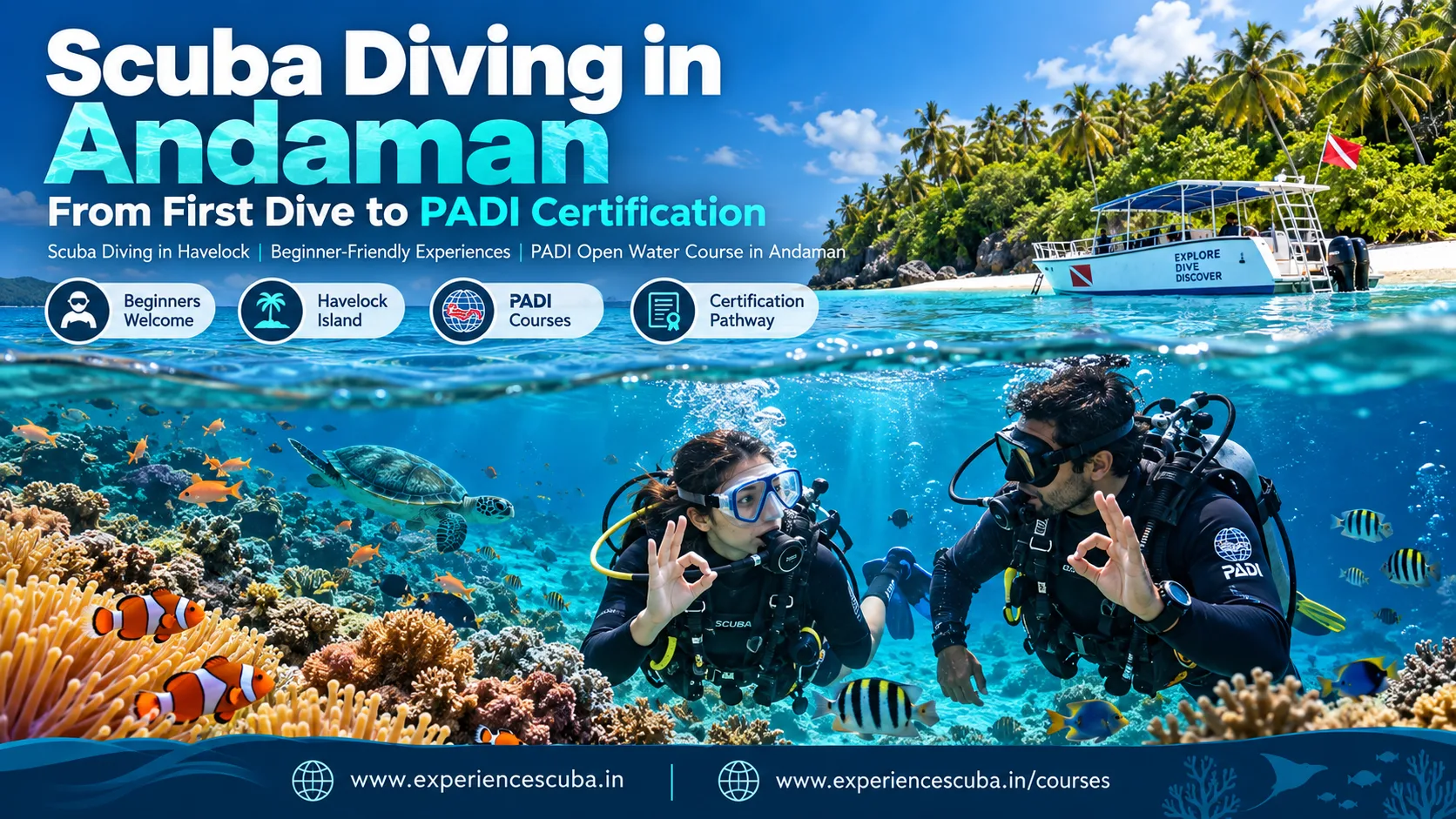
A scuba trip often starts with a very simple thought: What does it actually feel like to breathe underwater?
For many travellers visiting the Andaman Islands, scuba diving begins as one activity on a holiday itinerary. They plan beaches, ferry rides, island hopping and sightseeing—and somewhere between those plans, they decide to try a dive.
Then something interesting happens.
A first dive sometimes creates a much bigger interest in the underwater world. What begins as a holiday experience can lead to questions about proper training, certification and future diving trips.
That is where the difference between trying scuba and learning scuba becomes important.
Andaman, especially Havelock Island, gives travellers the opportunity to explore both.
Why Andaman Works Well for a First Scuba Experience
The Andaman Islands are already known for beaches and marine activities, so scuba fits naturally into a wider island holiday.
A traveller does not have to visit only for diving.
One part of the trip can be spent exploring beaches. Another day might involve snorkeling or a boat excursion. Scuba can then become one carefully planned experience within the holiday.
People researching Scuba diving in Havelock will find that Swaraj Dweep, still widely called Havelock Island, is one of the major centres for diving activity in Andaman.
For beginners, that is useful because they can experience scuba without giving up the relaxed feeling of an island vacation.
The First Dive Is Usually More About Breathing Than Fish
People often imagine their first scuba dive as an immediate encounter with coral reefs and colourful marine life.
In reality, the first few minutes can feel quite different.
Most beginners are thinking about one thing:
“Am I really breathing normally underwater?”
Breathing through a regulator feels unfamiliar at first. The equipment also takes a little time to get used to.
That is why the briefing before entering the water matters.
A beginner should understand basic hand signals, breathing techniques, pressure equalisation and how to communicate if something feels uncomfortable.
Once the breathing becomes natural, the experience changes.
You stop focusing so much on the equipment.
You begin looking around.
That is when the underwater world becomes the main attraction.
Your First Dive Does Not Need to Be Your Deepest Dive
Depth is one of the first questions many beginners ask.
But for someone entering the underwater world for the first time, depth should not be the main goal.
A better first dive is one where you remain calm enough to notice what is happening around you.
The quality of the experience depends far more on comfort, clear communication and good supervision than on reaching a particular number of metres.
This is one reason new divers should avoid comparing their first experience with photographs or videos of experienced divers.
Scuba is learned gradually.
There is no prize for rushing.
Trying Scuba and Learning Scuba Are Different Decisions
A supervised recreational dive is designed to introduce someone to the experience.
A certification course has a different purpose.
Once someone decides they want to dive independently within the limits of recreational training, they need structured education.
That includes theory, practical underwater skills, equipment knowledge and safety procedures.
For travellers considering a more serious route, PADI Scuba Diving Courses in Andaman offer a progression from entry-level learning to more advanced training.
This distinction is useful because not every traveller needs certification.
If you only want to discover what scuba feels like, start with an introductory experience.
If you already know that you want to dive again in other destinations, certification becomes much more relevant.
Where the PADI Open Water Course Fits In
The PADI Open Water course is a common starting point for people who want to become certified recreational divers.
The course does more than simply give students extra underwater time.
It teaches the fundamentals behind diving.
Students learn about equipment, basic dive principles, underwater communication and safety.
They practise essential skills in controlled conditions before applying those skills during open-water dives.
For someone considering a PADI Open Water Course in Andaman, the biggest difference from a tourist dive is responsibility.
During an introductory experience, you are closely guided through the activity.
During certification training, you begin learning how to understand and manage diving situations yourself, within your training limits and with a buddy.
Why Learning Buoyancy Matters
One skill that often surprises beginners is buoyancy control.
From the surface, scuba can look like simply swimming underwater.
It is not.
A large part of becoming comfortable underwater involves learning how to control your position without constantly using your hands or making unnecessary movements.
Good buoyancy can help a diver move more efficiently and maintain better control.
It also matters around reef environments because responsible divers should avoid unnecessary contact with coral or marine life.
Learning this skill takes practice.
That is another reason certification should not be treated simply as a card that can be collected quickly.
Do You Need to Know How to Swim?
For formal Open Water certification, basic swimming ability and water comfort are required.
This is different from certain supervised beginner scuba experiences where the requirements may be different.
PADI Open Water students are expected to complete basic swimming and floating or treading-water assessments as part of the certification process.
This distinction is important.
Someone may be able to participate in a suitable supervised introductory dive but still need to improve their swimming confidence before completing a full certification course.
If there is any uncertainty, it is better to discuss the requirements with the dive centre before booking rather than discovering them after the course begins.
PADI Certification Is a Starting Point, Not a Finish Line
People sometimes think of scuba certification as the end goal.
In practice, it is better understood as a foundation.
A PADI Certification in Andaman can provide the knowledge and skills needed to begin recreational diving more independently, but confidence develops through experience.
After Open Water, divers may eventually decide to continue with advanced training.
Some become interested in navigation.
Others want better buoyancy.
Some explore deeper recreational diving, underwater photography or rescue training.
There is no need to complete everything quickly.
Good diving develops gradually.
Should You Take a Course During a Holiday?
This depends on the kind of holiday you want.
A certification course requires real attention.
You need enough time for theory, practical sessions and open-water dives.
Trying to squeeze a multi-day course between ferry transfers and constant hotel changes can make the experience stressful.
If learning scuba is an important goal, allow enough time on Havelock.
Build the itinerary around the training instead of trying to fit training into every available gap.
This does not mean your entire holiday has to become a classroom.
You can still enjoy beaches and island life.
The key is simply not to overload the schedule.
How to Choose the Right Scuba Course
Price matters, but it should not be the only factor.
Before booking a course, understand what is included.
Ask how the training is structured.
Find out how many open-water dives are included.
Check whether equipment is provided.
Understand swimming and medical requirements.
Ask about instructor support and what happens if weather affects the schedule.
Also make sure you understand exactly which certification you are completing.
A good scuba course should be easy to explain before you enrol.
If the details are unclear, ask questions.
Beginner Dive or Certification: A Simple Way to Decide
Choose a beginner experience when:
- You have never tried scuba before.
- You are unsure whether diving will suit you.
- You have limited time.
- You want one memorable underwater experience during your holiday.
Consider formal certification when:
- You already know you want to dive again.
- You have enough time for structured training.
- You meet the course's water-skill and medical requirements.
- You want to continue scuba in other destinations.
There is nothing wrong with starting small.
Many confident divers began with one simple introductory dive.
Why Havelock Can Be a Good Place to Learn
Havelock offers something useful for learners: diving can be part of a broader island experience.
Training does not need to feel isolated from the holiday.
A typical day might include a morning training session followed by time at the beach.
That slower rhythm can make learning more enjoyable.
It also gives students time to process what they learned instead of immediately rushing toward another transfer or activity.
When planning a certification trip, that breathing room can be valuable.
What Comes After Open Water?
A new certification does not mean you suddenly know everything about diving.
It means you have built a foundation.
Experience is what makes that foundation stronger.
After completing more dives, some people become interested in advanced courses.
Others simply continue recreational diving and improve naturally with each experience.
There is no single correct route.
The best next step depends on confidence, interests and how often you expect to dive.
Frequently Asked Questions
Is Andaman suitable for first-time scuba divers?
Yes. The islands offer beginner-oriented diving experiences as well as structured scuba training for people who want certification.
Is Havelock good for scuba diving?
Havelock, or Swaraj Dweep, is one of the main diving destinations in Andaman and offers opportunities for both recreational and training dives.
Is an introductory dive the same as certification?
No. An introductory dive lets you experience scuba under close professional supervision. Certification involves structured learning, skills practice and assessment.
What is the PADI Open Water Course?
It is an entry-level recreational scuba certification course that teaches essential knowledge and practical diving skills.
Does Open Water certification require swimming ability?
Yes. Students must demonstrate basic swimming ability and water comfort as part of PADI Open Water certification.
Can I continue learning after Open Water?
Yes. Divers can later explore advanced courses, specialties, rescue training and professional-level pathways depending on their interests and experience.
Final Takeaway
Your scuba journey does not have to start with a course.
It can start with curiosity.
Try breathing underwater.
Learn how the equipment feels.
Discover whether you enjoy being beneath the surface.
If that first dive leaves you wanting more, then structured training becomes the natural next step.
The important thing is not to rush from beginner to certification simply to collect a qualification.
Learn properly.
Ask questions.
Practise the skills.
Respect the underwater environment.
And let confidence develop with experience.
Andaman may be the destination where you take your first underwater breath.
But if scuba becomes something you genuinely enjoy, that first dive could open the door to oceans far beyond the islands.