
The Goods and Services Tax (GST) return filing process has undergone major transformations since its rollout in 2017. Initially, businesses had to grapple with a complex, multi-form filing structure. Over the years, the system has evolved toward simplification, automation, and better compliance monitoring.
In this article, we’ll compare the old vs new GST return filing system, highlighting key differences, improvements, and how businesses can adapt using the right tools.
Why Was There a Need for a New GST Return System?
The initial GST return system was criticized for being overly complicated, time-consuming, and prone to errors. It included multiple forms like GSTR-1, GSTR-2, GSTR-3, and GSTR-3 B, and an iterative reconciliation process that many, especially small and medium-sized enterprises (SMEs), found difficult to manage.
The new GST return filing system was introduced with the aim of:
- Reducing compliance burden
- Automating reconciliation
- Enhancing accuracy and transparency
- Making the system more taxpayer-friendly
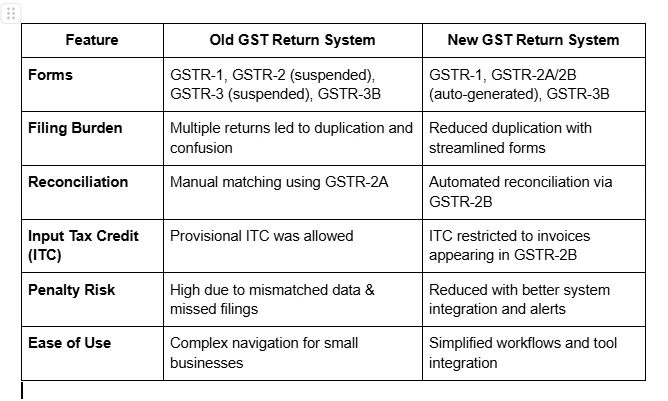
Old vs New GST Return Filing System: Key Differences
Major Improvements in the New GST Return System
Automation via GSTR-2B
The introduction of GSTR-2B (a static, auto-drafted ITC statement) has made it easier for businesses to reconcile input tax credits accurately and in real-time.
Reduced Filing Complexity
With GSTR-2 and GSTR-3 now suspended, the reliance is on GSTR-1 and GSTR-3B, making return filing more straightforward.
ITC Restrictions for Better Compliance
Businesses now need to ensure that suppliers have uploaded invoices accurately. This shift has encouraged stronger vendor compliance and improved invoice discipline.
AI-Powered Notices & Data Matching
The GSTN has started leveraging AI to flag inconsistencies, making error-free filing even more important for avoiding penalties and audits.
Who Benefits the Most from the New GST System?
- Small and Medium Businesses: With fewer forms and simpler workflows, SMEs no longer need to spend excessive time or money on GST filing.
- Tax Practitioners: Automated reconciliation and real-time data access speed up filing for multiple clients.
- Finance Teams: Reduced errors and clearer input-output tax data improve overall financial visibility.
How to Adapt to the New System
The shift from the old to the new return filing system calls for a smarter, more tech-enabled approach to compliance. Manual spreadsheets and scattered data won’t cut it anymore.
That’s where tools like GST return filing software come in handy.
Solutions like Optotax help:
- Auto-reconcile data using GSTR-2B
- Generate accurate reports
- File returns across multiple GSTINs
- Track ITC mismatches
- Avoid costly penalties
Whether you’re a CA handling clients or a business managing multiple GST registrations, having a platform like Optotax makes the new system work for you, not against you.
Conclusion: The Shift is for the Better
While the old GST return filing system was a bold start, it needed the flexibility and simplicity that businesses required. The new system addresses many of these gaps through automation, accuracy, and a better user experience.