
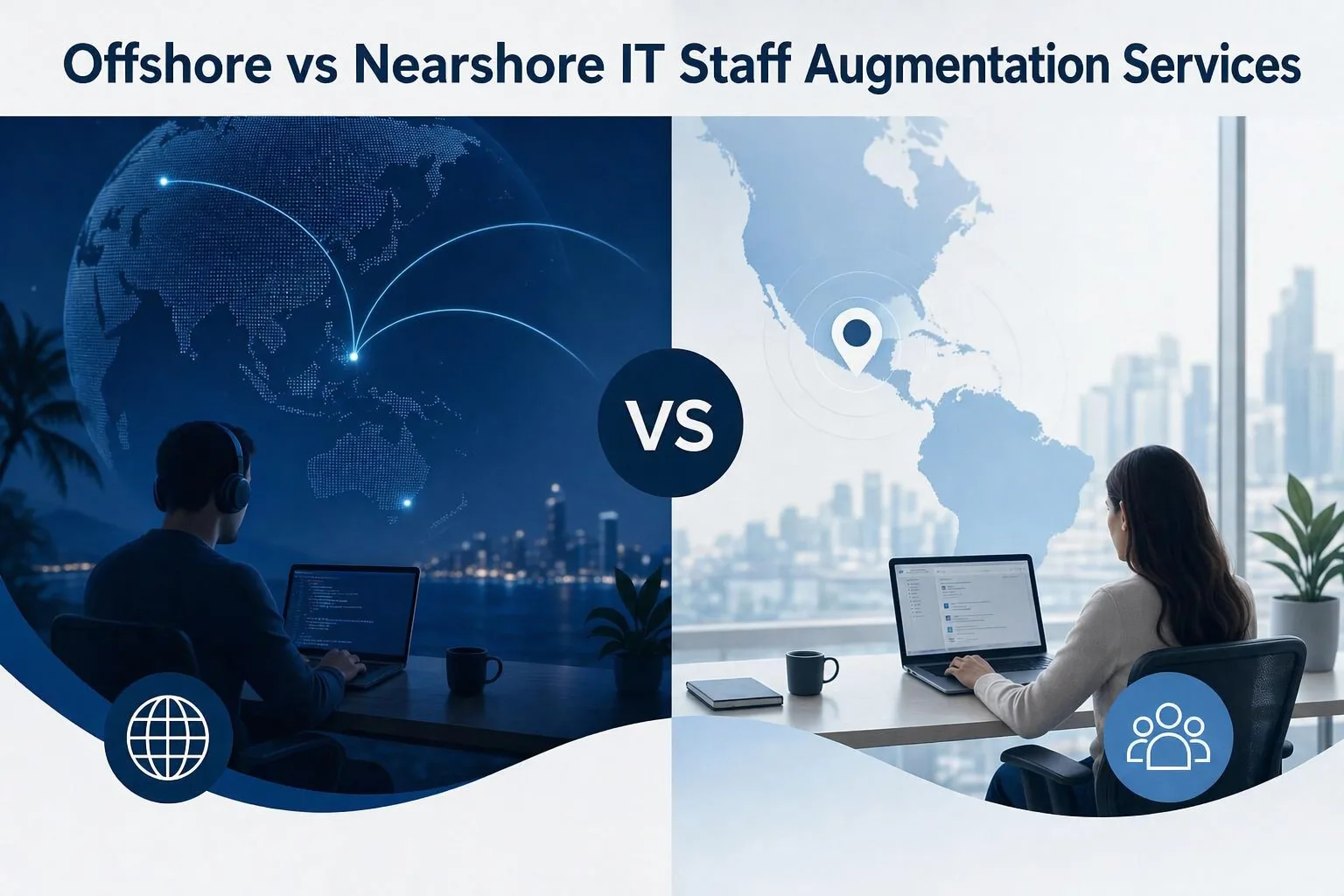
Most teams already know they need extra engineers. The harder question is where those engineers should sit. Offshore, in a time zone eight or more hours away, or nearshore, within two or three hours of your own working day.
That single choice decides more than cost. It shapes how fast code review happens, how painful standups feel, and whether your sprint speeds up or stalls. Pick wrong and you pay for capacity you cannot actually use.
This guide breaks down offshore versus nearshore for IT Staff Augmentation Services: what each model costs, where each one wins, and how to choose based on the shape of your work instead of a sales pitch.
What Offshore and Nearshore Actually Mean
Both are flavors of the same staff augmentation model. You rent pre-vetted engineers who join your team, use your tools, and follow your process. The difference is geography and the time zone that comes with it.
Offshore means a large time gap. For a US company, that usually means India or parts of Eastern Europe. For a UK company, it can mean South or Southeast Asia. Rates are typically the lowest available, and the talent pool is deep.
Nearshore means a nearby time zone. For a US company, that is Latin America. For Western Europe, it is Eastern or Southern Europe. You give up some of the cost saving in exchange for more hours of daily overlap.
Neither is better in the abstract. They solve different problems.
The Cost Difference, Honestly
Offshore rates are usually the lowest. Nearshore sits in the middle. Onshore contractors sit at the top.
As a rough guide, and treat these as illustrative rather than a quote: offshore engineers can run 40 to 70 percent below US contractor rates, while nearshore often lands 25 to 50 percent below. The gap between offshore and nearshore is real but smaller than most buyers expect once you count management overhead. Verify current rates through direct proposals before you budget.
Here is the part vendors skip. A cheap offshore rate is not cheap if the eight-hour gap doubles your feedback loops. A developer who ships on Tuesday but cannot get a review until Thursday costs you two days of idle capacity per cycle. Software Developer Outsourcing Services quoted purely on hourly rate hide that cost.
Count total cost, not the sticker rate.
Where Offshore Wins
Offshore staff augmentation is the stronger choice when the work is well defined and does not need constant back-and-forth.
Deep, stable backlogs
If you have months of clear work and a technical lead who can write good tickets, an Offshore Staff Augmentation Company gives you the best cost per shipped feature. The team builds context over time, and the time gap matters less because the work is already queued.
Follow-the-sun delivery
Handled well, the time gap becomes an advantage. Your team writes a spec at 6pm, an offshore team picks it up overnight, and progress is waiting when you log in. This only works with tight written handoffs, but when it clicks, it compresses timelines.
Cost-sensitive scale-ups
When you need several engineers and budget is the binding constraint, offshore wins on math. That is why many growth-stage teams lean on It staff augmentation companiesHuh. in India and Eastern Europe when they scale.
A US analytics company needed to clear a nine-month reporting backlog without growing permanent headcount. They brought in three offshore .NET engineers through a staff augmentation website, ran an afternoon-overlap schedule, and cleared the backlog on time. Four hours of daily overlap covered standups and reviews. The rest of the day, the queue kept everyone busy. (Illustrative scenario.)
Where Nearshore Wins
Nearshore earns its premium when the work needs real-time collaboration.
Fast, messy, evolving work
Early product discovery, live incident response, and design-heavy features need conversation, not ticket handoffs. When you need to hop on a call at 2pm and have an engineer there, nearshore overlap pays for itself.
Pairing and mentorship
If your augmented engineers will pair with your team daily or mentor juniors, you want overlapping hours, not a two-hour window at the edge of the day. Nearshore makes pair programming and mentorship practical.
Compliance and travel
When occasional in-person work matters, or when a client contract prefers same-region processing, nearshore cuts friction. A same-day flight is easier than a 20-hour one.
A US fintech running weekly design iterations on a new dashboard needed two engineers who could join live working sessions every afternoon. They chose a nearshore team in Latin America to extend development team remotely with near-full-day overlap. The higher rate was worth it because the work changed daily, and waiting overnight for answers would have stalled every sprint. (Illustrative scenario.)
How to Choose: Three Questions
Match the model to the work, not to the lowest quote.
How stable is the work? A locked backlog and clear tickets favor offshore. Fluid, exploratory work favors nearshore.
How much overlap does the work need? If four hours covers your standup and reviews, offshore fits. If you need most of the day, go nearshore.
Who carries delivery risk day to day? Both models leave delivery inside your process, so you need engineering management bandwidth either way. Offshore demands more discipline around written handoffs. Nearshore demands less.
If you are unsure, run a paid two-week trial with one engineer in each model before committing. One real sprint tells you more than any sales call.
What Does Not Change, Offshore or Nearshore
The geography debate distracts from the things that actually decide success. Whichever you pick, insist on these.
Pre-vetted engineers you interview yourself. Any real staff augmentation services provider lets you screen candidates through your own loop.
Named individuals, not a rotating bench. You want the same people building context, not a new face every month.
At least four hours of daily overlap. Below that, standups and code review slip regardless of region.
Direct tool access. Your Slack, your Jira, your GitHub. If you need a vendor project manager to relay updates, you hired outsourcing, not augmentation.
A written IP assignment clause. Code lands in your repository, owned by you on payment.
Get those right and both models work. Skip them and neither does.
The Bottom Line
Offshore gives you the lowest cost and a deep talent pool, and it shines when work is stable and handoffs are clean. Nearshore costs more but buys you overlap, which matters when work is fast and collaborative. Most mature teams end up using both: offshore for the steady backlog, nearshore for the work that needs a live conversation.
The mistake is choosing on rate alone. Choose on the shape of the work, then vet the people hard inside whichever model you pick.
Ready to Extend Your Team the Right Way?
Book a 30-minute call. Tell us your stack, your timeline, and how much daily overlap your work needs. We will recommend offshore, nearshore, or a mix, with named engineers you can interview and a two-week trial before any long commitment. No slide deck, just a working conversation.
Book a Free Consultation
Frequently Asked Questions
1. What is the difference between offshore and nearshore staff augmentation?
Both place external engineers inside your team. Offshore means a distant time zone and lower cost. Nearshore means a nearby time zone, more daily overlap, and a moderate premium.
2. Is offshore or nearshore cheaper?
Offshore is usually cheapest per hour, and nearshore sits in the middle. Total cost depends on overlap, though. A low offshore rate can cost more overall if the time gap doubles your feedback loops.
3. When should I choose an offshore staff augmentation company?
When the backlog is stable, tickets are clear, and four hours of daily overlap covers your standups and reviews. Offshore gives the best cost per shipped feature on well-defined work.
4. When is nearshore worth the premium?
When work is exploratory, changes daily, or needs live pairing and design sessions. Near-full-day overlap prevents the overnight waits that stall fast-moving sprints.
5. How much time zone overlap do I need to extend my development team remotely?
Four hours of daily overlap is the working minimum for standups, code review, and pair programming. Less than that and agile ceremonies get painful.
6. How is staff augmentation different from software developer outsourcing services?
Outsourcing hands a scoped project to a vendor who returns a deliverable. Staff augmentation gives you engineers who join your team, backlog, and process, so you keep control of priorities and code.
7. Can I hire dedicated developers in both models at once?
Yes. Many teams run an offshore group on the steady backlog and a nearshore pair on fast-changing work. Keep ownership clear so the two groups do not collide on the same code.
8. How do I vet it staff augmentation companies before signing?
Interview the actual engineers, ask for named references from the last year, verify certifications by requesting the certificate, and start with a paid two-week trial.
9. Does offshore staff augmentation hurt code quality?
Not if augmented engineers pass through your code review, testing, and CI process. Quality drops when you skip the process, not because the developer is remote.
10. What roles can I fill through staff augmentation services?
Backend, frontend, mobile, DevOps, QA, data engineering, and AI/ML. Most it staff augmentation companies specialize by stack, so match the vendor to the skills you need.