
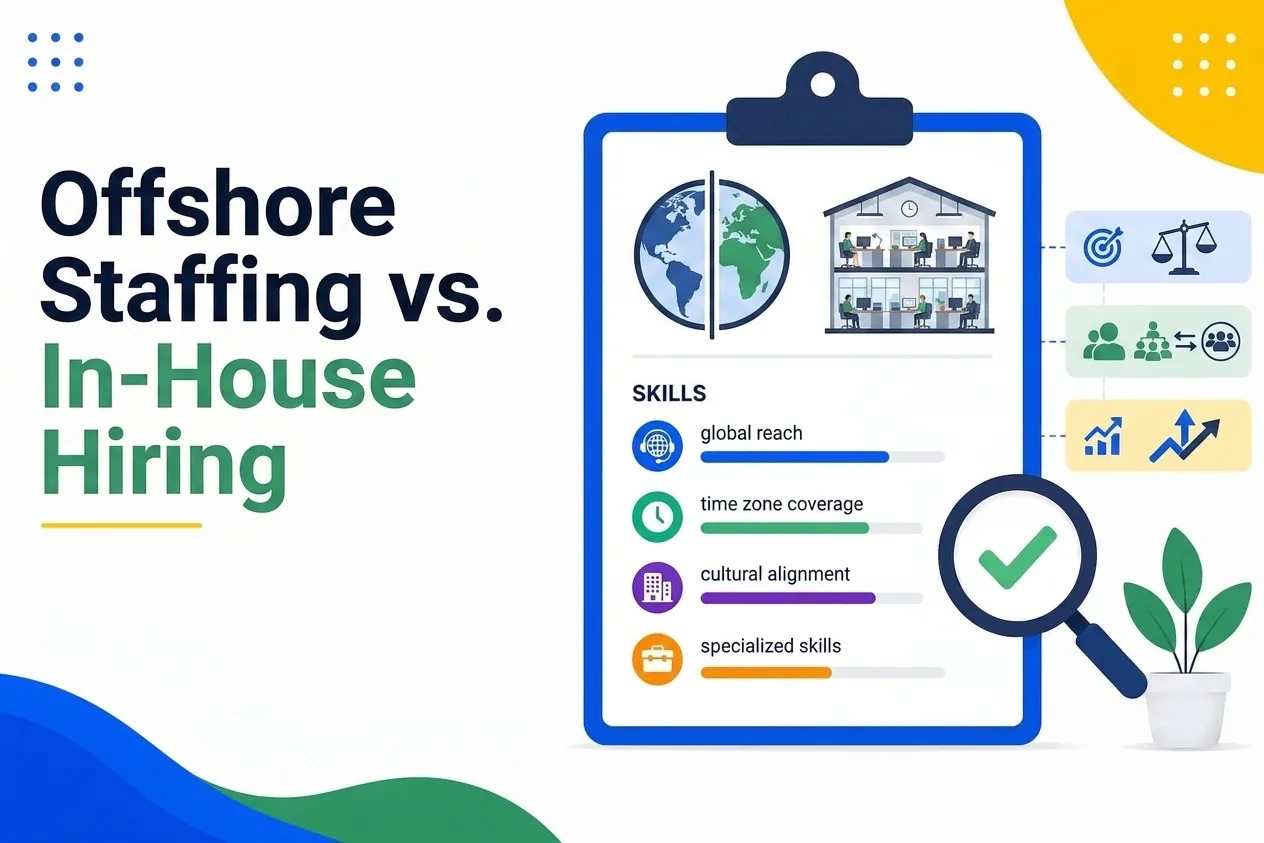
Neither offshore staffing nor in-house hiring is the universally right answer. The better choice depends on the function being staffed, how quickly the business needs the role filled, and how much oversight the work requires. This piece breaks down the practical differences so CPA and accounting firms can help clients, or their own practice, make this decision based on the specific role rather than a general preference for one model over the other.
Key Takeaways
- In-house hiring offers the most direct oversight and cultural integration, but usually takes longer and costs more for specialized or hard-to-fill roles.
- Offshore staffing offers faster access to a wider talent pool for process-driven functions, but requires more deliberate structure around communication and review.
- The decision usually comes down to the function, not a blanket policy. Client-facing and judgment-heavy roles tend to stay in-house; process-driven roles often move offshore well.
- Many growing businesses use both models side by side rather than choosing one exclusively.
Cost: What Actually Changes
In-house hiring costs include salary, benefits, payroll taxes, equipment, and office space, all priced at local market rates. For specialized functions, tech development, engineering and architecture, IT networking and support, those local rates have risen sharply as demand outpaces the supply of qualified candidates.
Offshore staffing costs are typically lower per role, but the real savings usually come from a different source: avoiding the cost of a vacant role sitting unfilled for months while a specialized local search runs its course. A business that cannot find a qualified in-house hire for six months is not saving money by waiting.
Speed to Hire
In-house hiring for a specialized role, particularly in tech development, engineering, or IT networking and support, commonly takes two to four months from job posting to start date in a tight local market. Offshore staffing, working with an established partner or talent pool, often fills the same type of role in two to six weeks, since the search draws from a much deeper and more available candidate base.
Talent Pool Access
Local hiring is limited to whoever is available, willing, and affordable within one geographic market. Offshore staffing opens access to a wider pool of trained professionals across functions like digital marketing, customer and technical support, admin and back office, sales and business development, HR and payroll, finance and accounts, and engineering and architecture, many of whom are actively looking for exactly this type of role.
Control and Oversight
In-house staff work under direct daily supervision, in the same office or on the same internal systems, with immediate access for questions and course correction. Offshore staff require a more deliberate structure: defined processes, a named point of contact, a review hierarchy, and enough time zone overlap to keep communication timely. This is not a disadvantage so much as a different operating model that needs to be built intentionally rather than assumed.
Side-by-Side Comparison
Cost per Role- In-House Hiring: Typically higher costs due to local market salaries and benefits.
- Offshore Staffing: Generally lower costs, with additional savings from reduced vacancy periods.
- In-House Hiring: Usually takes 2–4 months for specialized positions.
- Offshore Staffing: Often filled within 2–6 weeks through established staffing partners.
- In-House Hiring: Limited to candidates within the local market.
- Offshore Staffing: Access to a broader and more diverse global talent pool.
- In-House Hiring: Requires regular day-to-day management and supervision.
- Offshore Staffing: Operates with defined processes, review structures, and time-zone overlap plans.
- In-House Hiring: Client-facing, strategic, and culture-critical roles.
- Offshore Staffing: Process-driven, well-documented, and repeatable business functions.
When In-House Hiring Makes Sense
Client relationship management, final review and sign-off on financial statements or legal documents, strategic decision-making, and any role central to the business's culture or brand voice generally perform best with an in-house hire who has direct, daily context on the business.
When Offshore Staffing Makes Sense
Functions that are well-documented, repeatable, and reviewable tend to transfer cleanly offshore. This includes digital marketing execution, customer and technical support, admin and back office work, HR and payroll administration, IT networking and support, finance and accounts processing, and tech development on defined projects. Industries from e-commerce and SaaS to insurance, healthcare, real estate, manufacturing, and banking and financial services are building offshore capacity in exactly these functions.
The Hybrid Approach
Most growing businesses do not choose one model exclusively. A common pattern keeps strategy, client relationships, and final review in-house, while process-driven functions run through an offshore team under a clearly defined structure. Businesses formalizing this split often start by reviewing established offshoring engagement models, since the right structure, dedicated staff, project-based, or Build-Operate-Transfer, depends on which functions are moving offshore and how long the arrangement is expected to run.
Common Mistakes When Choosing Between the Two Models
- Defaulting to in-house for every role regardless of how process-driven the work actually is, which slows down hiring unnecessarily.
- Moving a client-facing or judgment-heavy role offshore purely to cut costs, without the oversight structure to support it.
- Comparing raw salary numbers without accounting for vacancy time, turnover, and training costs on the in-house side.
- Choosing an engagement model before identifying which specific function is being staffed.
Choosing Based on the Role, Not a Blanket Policy
The businesses that get the most value from either model are the ones that evaluate each role on its own terms: how process-driven the work is, how much oversight it needs, and how quickly it needs to be filled. For many growing businesses, the answer is not offshore staffing instead of in-house hiring, but a deliberate combination of both.
About MYCPE ONE
MYCPE ONE is a NASBA-approved platform serving more than 250,000 accounting professionals and thousands of firms and businesses across the United States, United Kingdom, and Canada. Beyond its continuing education library for CPAs and EAs, MYCPE ONE helps growing businesses build offshore capacity across functions including finance and accounts, IT support, HR and payroll, and back office operations, working alongside their existing in-house teams.
FAQs
Is offshore staffing cheaper than in-house hiring in every case?
Not always on a pure salary basis, but the total cost advantage usually comes from faster time to fill and lower turnover risk for hard-to-hire specialized roles.
Which roles should never be moved offshore?
Roles requiring a professional license tied to a specific jurisdiction, final sign-off on regulated work, and deep, ongoing client relationship management are generally best kept in-house.
Can a business use both in-house and offshore staff for the same function?
Yes. A common structure keeps a senior in-house lead overseeing a function, with offshore staff handling the process-driven volume underneath that oversight.
How long does it take to know if an offshore hire is working out compared to an in-house hire?
Most businesses can assess offshore performance within 60 to 90 days, similar to the ramp-up period expected of a new in-house employee in a specialized role.