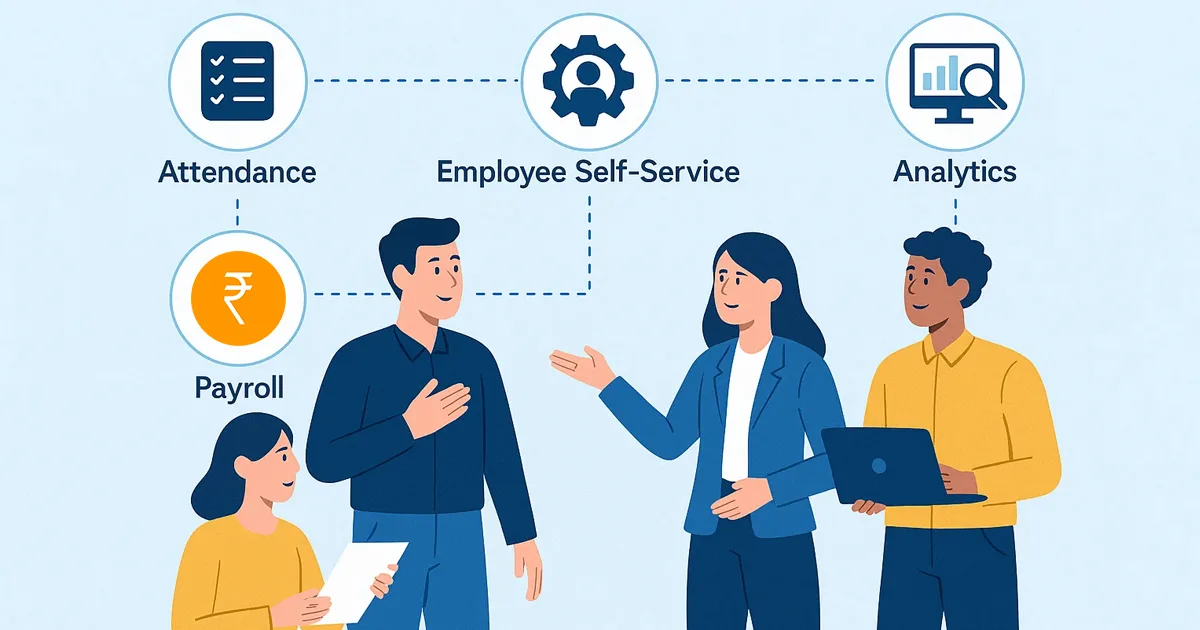
Managing employee leave and attendance should not require hours of manual effort, rework, and endless document management. The HR department is expected to ensure that employees work comfortably and effectively. However, managing employees becomes more challenging if they work from different locations or have flexible work schedules.
Right HRMS software makes these processes simpler. It brings everyday attendance tracking, leave approval, and employee information together so that the HR department can have a clearer view of attendance and leave-related information.
Quick Summary
● The HR software tracks the working hours of employees and everyday attendance.
● It simplifies leave applications and approval processes.
● It assists in creating leave policies as per organizational requirements.
● The system reduces manual efforts and human errors.
● Provides employees with direct access to their leave and attendance records.
● Generates reports to understand attendance trends and workforce needs.
Here is how a modern HRMS can improve leave and attendance management.
Centralized Attendance Tracking
Every month the HR department may struggle to check leave details, make corrections, and update employee records manually. This can lead to unnecessary delays or wrong entries.
The best HR software provides a centralized platform where leave and attendance records can be maintained and accessed anytime.
Key benefits:
● Managers and the HR department can view employees' records of different teams and departments.
● It reduces repeated data work and record keeping.
● The problem of late arrivals, missed entries, and wrong attendance records is reduced.
● It gives managers a complete view of employees' everyday availability.
Easy Leave Applications and Approvals
A lengthy or complicated leave application process is difficult for both employees and HR teams. Employees may need to send endless messages or emails, while managers would need extra time before approving a leave.
Reliable enterprise HR software simplifies the complete process and reduces confusion and chaos in the organization.
Key benefits:
● Officenet's AI based face recognition attendance system ensures high attendance accuracy.
● It allows employees to apply for leave through a mobile application.
● Helps managers to instantly review and approve leave requests.
● It also minimizes the problem of follow-up, manual messages, and paperwork.
Manages Different Leave Policies
Every organization has its own leave rules. Some departments may also have different types of leave policies, which are not applicable to other teams or departments. Managing these policies without the right system is not possible.
Officenet's leave management system allows organizations to handle leave policies related to casual leave, sick leave, or earned leave as per applicable policies.
Key benefits:
● The LMS assists organizations in setting up different leave types.
● It also manages leave carryforwards and leave encashments where applicable.
● Maintains consistent leave rules for employees of the same team.
● Reduces errors in leave calculations.
Connects Leave and Attendance with Payroll
Payroll processing is one of the most important processes in an organization. Employees expect error-free, timely, and accurate salaries. With wrong and incorrect leave entries, it is difficult to estimate working hours and the right salary payouts.
Integrating leave and attendance records with payroll management reduces paperwork and other formalities
Key benefits:
● The leave system transfers relevant attendance and leave information so payroll processing is error-free.
● It minimizes calculation errors and mistakes.
● Support accurate salary processing so there are no conflicts with employees.
● Identifies attendance-related and payroll-related issues.
Attendance Reports Helps in Better Workforce Decisions
Attendance and leave reports can provide useful details about attendance patterns. When information is not organized and is scattered in different files, it is not possible to clearly identify frequent absences or staffing concerns.
The secure cloud HR solutions for enterprises offer reporting and analytics features that help HR teams to understand this information more clearly.
Key benefits:
● It reviews attendance patterns and monitors absenteeism.
● Identifies attendance-related challenges.
● Supports better work planning so that projects and work remain unaffected.
● Organizations can use these organized reports to make correct HR decisions.
Conclusion
Effective leave and attendance management is necessary to ensure a well-organized workplace. When these processes are time-consuming or inconsistent, HR teams may need to do extra work, and employees may face unnecessary confusion.
Ready to upgrade your HR operations? Book a personalized demo with Officenet HRMS today and discover how this centralized HR solution supports complete leave and attendance management.
FAQs
How does HRMS reduce attendance errors?
The HRMS system reduces manual data entry work, document management, and paperwork formalities. It automates leave and attendance tracking, maintains all employees' records centrally, and reduces calculation issues and working hours irregularities.
Can employees apply for leave directly through the HRMS solution?
Yes. Employees can directly apply for leave through the ESS module. They don't need to send multiple emails or messages to managers and the HR department. Employees can also track the status of their leave application and access current and past leave records.
Can the HR department track employee attendance from different locations?
Yes, with Officenet's HR software solution, the HR department can track and check the attendance of employees working in different departments and locations. All records are stored centrally. They can also view employees’ leave trends and attendance consistency of all locations.
How can organizations plan employee availability with the HR system?
The HR system provides attendance and leave reports and also gives managers a clear view of employees' availability. This helps them to plan work better. Distributing tasks becomes more effective, and staffing gaps can be avoided easily.