
Artificial intelligence is moving beyond the cloud and into local development environments. As AI models become larger and more complex, developers, researchers, robotics engineers and businesses increasingly need access to powerful compute without sending every experiment to a remote data center.
This is where NVIDIA DGX Spark stands out.
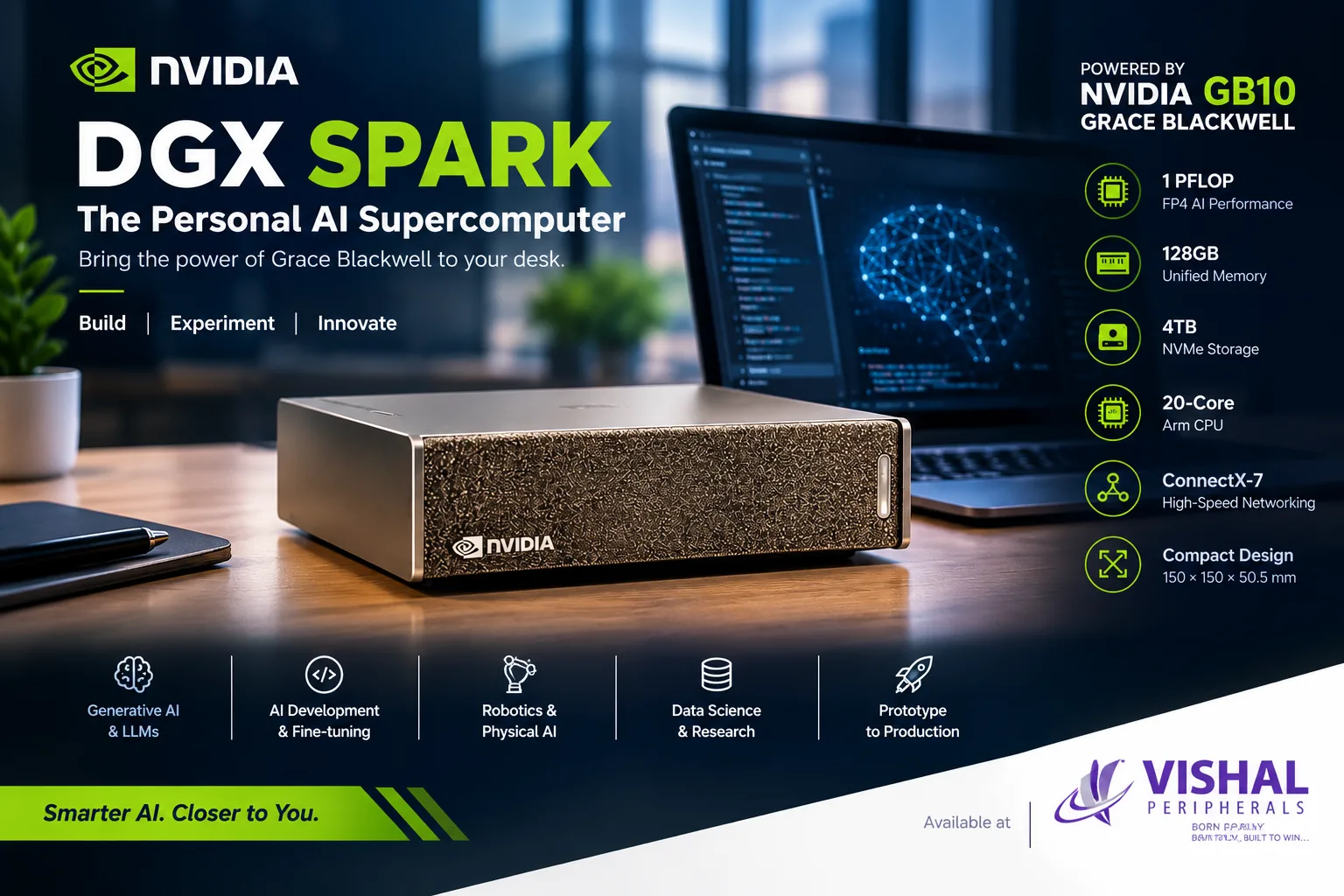
Designed as a compact personal AI supercomputer, NVIDIA DGX Spark brings the NVIDIA Grace Blackwell architecture to a desktop form factor. Powered by the NVIDIA GB10 Grace Blackwell Superchip, it combines a Blackwell GPU, a 20-core Arm CPU and 128GB of coherent unified memory in a system measuring just 150 × 150 × 50.5 mm.
At Vishal Peripherals, we see NVIDIA DGX Spark as a particularly interesting platform for developers and organizations looking to experiment with large AI models locally, build AI applications, work with generative AI and prototype workloads before moving them to larger infrastructure.
What Is NVIDIA DGX Spark?
NVIDIA DGX Spark is a personal AI computer designed specifically for AI development, inference, experimentation and model prototyping.
Instead of requiring access to a traditional data-center GPU server for every development task, DGX Spark provides a compact system that can sit on a desk and run substantial AI workloads locally.
The system is built around NVIDIA's GB10 Grace Blackwell Superchip, combining CPU and GPU technologies with a unified memory architecture. NVIDIA states that DGX Spark can support AI models with up to 200 billion parameters on a single system, while two DGX Spark systems can be connected for workloads involving models up to 405 billion parameters.
This makes DGX Spark particularly interesting for AI developers who want to prototype and test large models locally before deploying them to cloud or data-center infrastructure.
NVIDIA GB10 Grace Blackwell Superchip
At the heart of DGX Spark is the NVIDIA GB10 Grace Blackwell Superchip.
GB10 brings together NVIDIA Blackwell GPU architecture with a 20-core Arm CPU consisting of 10 Cortex-X925 cores and 10 Cortex-A725 cores. The GPU incorporates 5th-generation Tensor Cores and 4th-generation RT Cores.
This CPU-GPU integration is important for AI workloads because DGX Spark is not simply a desktop computer with a conventional graphics card. Its architecture is designed around moving and processing large amounts of AI data efficiently.
The result is a compact system designed for workloads including:
- Generative AI
- Large language models
- AI inference
- Model fine-tuning
- AI application development
- Robotics and physical AI
- Data processing
- AI experimentation
- Local prototyping
128GB of Unified Memory: Why It Matters
One of the most important features of DGX Spark is its 128GB of coherent unified system memory.
Traditional desktop systems generally divide memory between system RAM and GPU VRAM. DGX Spark uses a unified memory architecture, allowing the CPU and GPU to work with the same large memory pool.
The system uses 128GB LPDDR5x memory, with a 256-bit memory interface and up to 273GB/s of memory bandwidth.
For AI developers, this large unified memory pool can be particularly useful when working with large models locally.
Instead of being limited by a comparatively small dedicated GPU memory capacity, developers can work with much larger AI models within the system's unified memory architecture.
Up to 1 PFLOP of FP4 AI Performance
NVIDIA DGX Spark is designed for AI workloads where tensor performance and memory capacity are critical.
The GB10 platform delivers up to 1 PFLOP of FP4 AI performance, with NVIDIA also specifying up to 1,000 TOPS of inference performance under its stated conditions. The system uses 5th-generation Tensor Cores with FP4 support.
FP4 is particularly relevant to modern AI because lower-precision computation can help AI systems process models efficiently while reducing the computational and memory requirements associated with higher-precision formats.
For developers, this means DGX Spark can serve as a local environment for experimenting with modern AI inference and model development workflows.
4TB NVMe Storage for AI Workloads
The Vishal Peripherals configuration of NVIDIA DGX Spark comes with a 4TB NVMe M.2 SSD with self-encryption.
Storage capacity becomes increasingly important when working with AI because models, datasets, checkpoints, containers and development environments can consume substantial amounts of space.
With 4TB of NVMe storage, DGX Spark provides room for local AI development environments, model files, datasets and project files without requiring every resource to be stored on an external drive or remote server.
NVIDIA DGX Spark for Generative AI
Generative AI development is one of the primary use cases for DGX Spark.
Developers can use the system to experiment with large language models, AI inference and model fine-tuning directly from a local environment.
NVIDIA positions DGX Spark as a platform for prototyping, fine-tuning and inference of large AI models, with support for models from leading AI ecosystems. The system can also provide a development environment that allows projects to move from desktop experimentation toward larger cloud or data-center infrastructure.
This workflow can be particularly useful when developers need to iterate quickly.
Instead of:
Prototype → Send workload to cloud → Test → Modify → Send again
a local AI system can enable:
Prototype → Test → Modify → Iterate locally → Deploy at scale
That can make development workflows more convenient for teams working on AI applications.
NVIDIA DGX Spark for AI Developers
For AI developers, DGX Spark can function as a dedicated local AI development machine.
It can be used for:
- Developing AI applications
- Testing inference pipelines
- Experimenting with large language models
- Fine-tuning supported models
- Running AI frameworks
- Testing model optimizations
- Building local AI assistants
- Preparing workloads for cloud deployment
NVIDIA's DGX software environment is designed to provide the tools needed to begin AI development without having to build an entire AI software stack from scratch.
The platform supports widely used AI frameworks and NVIDIA software technologies, providing a foundation for development and experimentation.
DGX Spark for Robotics and Physical AI
AI is increasingly being used outside traditional data centers.
Robotics, autonomous machines and physical AI systems require AI models to understand environments, process sensor data and make decisions.
DGX Spark's combination of CPU processing, Blackwell GPU acceleration, large unified memory and high-speed networking makes it an interesting development platform for these workloads.
Developers can use local compute to experiment with perception systems, AI models and robotics software before deploying optimized workloads to edge devices or larger infrastructure.
This is particularly relevant for teams developing physical AI and autonomous systems, where rapid experimentation can be an important part of the development process.
ConnectX-7 and High-Speed Networking
DGX Spark is not designed to operate only as an isolated desktop system.
It includes an NVIDIA ConnectX-7 Smart NIC, along with 10GbE networking and Wi-Fi 7. NVIDIA specifies the ConnectX-7 NIC at up to 200Gbps.
The high-speed networking capability becomes especially interesting when connecting multiple systems or integrating DGX Spark into a larger development environment.
NVIDIA also describes configurations where two DGX Spark systems can be connected to work with larger models.
A Supercomputer That Fits on a Desk
One of the most striking aspects of NVIDIA DGX Spark is its physical size.
Despite being designed for serious AI workloads, the system measures only:
150mm × 150mm × 50.5mm
and weighs approximately 1.2kg.
That is significantly different from the traditional image of AI infrastructure consisting of large servers and data-center racks.
DGX Spark essentially brings a compact AI computing platform into a desktop environment.
For developers, researchers and small AI teams, this can make local AI experimentation much more accessible.
NVIDIA DGX Spark Specifications
Here are the key specifications of the NVIDIA DGX Spark configuration available from Vishal Peripherals:
- AI Platform: NVIDIA DGX Spark
- Superchip: NVIDIA GB10 Grace Blackwell
- GPU Architecture: NVIDIA Blackwell
- CPU: 20-core Arm CPU
- CPU Configuration: 10 Cortex-X925 + 10 Cortex-A725
- Tensor Cores: 5th Generation
- RT Cores: 4th Generation
- AI Performance: Up to 1 PFLOP FP4
- System Memory: 128GB LPDDR5x coherent unified memory
- Memory Interface: 256-bit
- Memory Bandwidth: Up to 273GB/s
- Storage: 4TB NVMe M.2 with self-encryption
- Networking: 10GbE
- NIC: NVIDIA ConnectX-7
- Wireless: Wi-Fi 7
- Bluetooth: Bluetooth 5.4
- USB: 4 × USB Type-C
- Display: HDMI 2.1a
- Video: NVENC and NVDEC
- Operating System: NVIDIA DGX OS
- Power Supply: 240W
- GB10 TDP: 140W
- Dimensions: 150 × 150 × 50.5mm
- Weight: Approximately 1.2kg
These specifications align with NVIDIA's current DGX Spark documentation and the 128GB/4TB configuration listed by Vishal Peripherals.
Who Should Consider NVIDIA DGX Spark?
NVIDIA DGX Spark is not intended to replace every workstation or gaming PC. Its value comes from the type of workloads it is designed to handle.
AI Developers
Developers building AI-powered applications can use DGX Spark as a dedicated environment for local model development and inference.
Data Scientists
Data scientists working with machine learning and AI workloads can benefit from having dedicated local compute for experimentation and testing.
AI Researchers
Researchers can use the system to experiment with models and workflows without depending entirely on shared infrastructure.
Robotics Developers
Robotics teams can use DGX Spark for AI development and experimentation related to perception, physical AI and autonomous systems.
Startups and AI Teams
For smaller teams, DGX Spark can provide a local AI development platform before workloads need to move to larger data-center or cloud infrastructure.
DGX Spark vs a Traditional High-End PC
A conventional high-end PC and DGX Spark serve different purposes.
A gaming or workstation PC may offer greater flexibility for gaming, general-purpose applications, graphics workloads and component upgrades.
DGX Spark, on the other hand, is purpose-built around AI development and accelerated computing.
Its value comes from the combination of:
Grace Blackwell + unified memory + Tensor Cores + AI software + high-speed networking + compact form factor.
For someone primarily building gaming PCs, a conventional system may make more sense.
For someone specifically working with AI models and AI development, DGX Spark provides a very different type of computing platform.
Why NVIDIA DGX Spark Is Important for Local AI
AI development has traditionally depended heavily on cloud GPUs and large data-center infrastructure.
Those resources remain essential for large-scale training and production deployment, but local AI computing provides another layer in the development process.
A developer can use a system such as DGX Spark to:
Experiment locally → Prototype models → Fine-tune → Test inference → Optimize → Deploy to cloud or data center
NVIDIA specifically positions DGX Spark as a system for prototyping and development that can complement larger infrastructure rather than simply replacing it.
That distinction is important.
DGX Spark is best understood as a personal AI supercomputer and development platform, not simply a smaller version of a data-center AI server.
NVIDIA DGX Spark at Vishal Peripherals
At Vishal Peripherals, we focus on bringing advanced computing hardware to developers, professionals, researchers and technology enthusiasts in India.
The NVIDIA DGX Spark 128GB / 4TB configuration is particularly suited to users who need a compact AI development system with substantial unified memory, Blackwell GPU acceleration and local storage.
The combination of 128GB unified memory, 4TB NVMe storage, NVIDIA GB10 Grace Blackwell and up to 1 PFLOP FP4 AI performance makes DGX Spark a compelling option for local AI development and experimentation.
If your work involves generative AI, large language models, AI inference, robotics, machine learning research or AI application development, DGX Spark offers a way to bring serious AI compute directly to your workspace.
Final Thoughts
The NVIDIA DGX Spark represents an important shift in how AI development hardware can be delivered.
Instead of requiring every AI development task to begin in a cloud environment or data center, developers can now have a compact Grace Blackwell-based system on their desk.
With the NVIDIA GB10 Grace Blackwell Superchip, 128GB of unified memory, 4TB NVMe storage, up to 1 PFLOP FP4 AI performance, ConnectX-7 networking and NVIDIA DGX OS, DGX Spark is designed to provide a powerful foundation for local AI development.
For developers and organizations building the next generation of generative AI, robotics and intelligent applications, the ability to develop locally and deploy at scale can be a valuable part of the AI development workflow.
And that is what makes NVIDIA DGX Spark more than a compact computer—it is a personal AI supercomputer built for the era of local AI development.