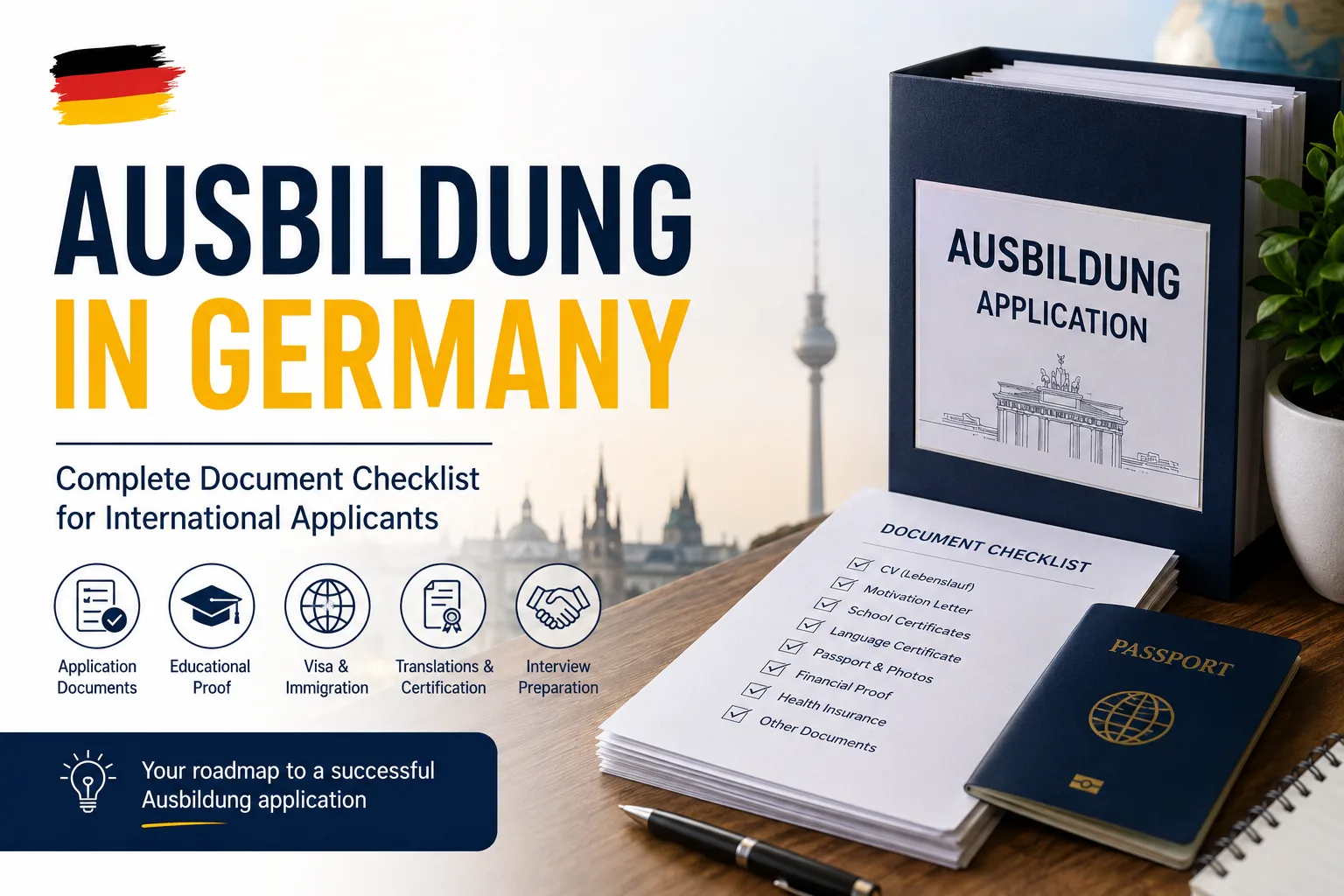
Introduction
Applying for an Ausbildung in Germany is a massive step for your career. The biggest roadblock is often the paperwork. Missing a single document can ruin your chances. Germany has a massive shortage of skilled workers. The Ausbildung system is a great way to enter the German job market. You get paid to learn. You gain real work experience. You also get a recognized qualification at the end.
Many international applicants feel overwhelmed by the strict rules. You might wonder which papers need translation. You might worry about notarization. This article breaks down exactly what you need. You will get a clear checklist of every required document. You will finish reading this guide feeling ready and confident.
Core Application Documents
Your first contact with a German employer is through your application folder. This folder must be perfect. The application process acts as a filter. Good documentation shows you are serious. It shows you are organized.
A Professional German CV
German employers expect a specific style of resume. It is called a tabular CV or Lebenslauf. You must list your education and work experience in reverse order. Keep it clean and easy to read. Include your contact details clearly. Do not include your religion. Do not include your parents' names. Stick to professional facts. Mention any software you know. Mention any volunteering experience. Make sure dates match exactly. Gaps in your CV will raise questions. You must explain any gap longer than three months. A well-formatted CV increases your interview chances [1].
"A standard resume in your home country will often fail in Germany. Local recruiters look for strict formatting and clear timelines."
The Motivation Letter
Your motivation letter is your chance to shine. Do not copy generic templates. You must explain why you want this specific job. Employers want to see your passion for the industry. You should also mention why you want to live in Germany. Start with a strong opening. State clearly where you found the job offer. Explain what skills you bring. Give examples from your past. Do not just list adjectives. Prove your claims. End the letter with a confident closing. State that you look forward to an interview. Always sign the letter by hand.
Educational Proof
You must prove your background. German schools and companies have strict standards. Your grades show your ability to learn new concepts quickly.
School Certificates
You need to submit your final school leaving certificates. These prove you have completed basic education. Your certificates must be translated into German. Your grades will be converted to the German system. The German system uses numbers from one to six. One is the best grade. Six is a failing grade. You must understand this conversion. It helps you target the right companies. Some companies only accept top grades. Others care more about your practical skills. The official Recognition in Germany portal explains the evaluation process [2].
"Educational equivalence is a strict requirement. Companies cannot legally hire you if your basic school leaving certificate is not recognized."
German Language Certificates
Language skills are crucial for any Ausbildung. You will learn in a German vocational school. You will also work with German colleagues and clients. Most programs require at least a B1 level of German [3]. Some competitive fields require a B2 level. You must provide an official certificate from recognized institutes. Do not fake your language skills. Employers will test your German during the interview. A certificate is just the first step. You must speak comfortably. Practice speaking every day. Watch German videos. Read German news. Immersion will help you pass the interview stage.
Sector-Specific Requirements
Different industries ask for different papers. I have written training scripts for many sectors. I see these variations all the time. There are many ausbildung courses in germany:
Healthcare and Nursing
Nursing is a highly regulated field in Germany. You will need a medical fitness certificate. A doctor must confirm you are healthy enough for physical work. You will also need a clean police clearance certificate. Hospitals must ensure patient safety [4].
Food Processing and Logistics
Food industry applicants need a special health certificate. This proves you understand food safety laws. Logistics applicants might need to show a valid driving license. These extra documents show you are ready for daily tasks.
"Specialized documents prove your dedication. Employers appreciate candidates who research industry standards beforehand."
Visa and Immigration Papers
International applicants from outside the EU need a visa. The visa process requires its own set of documents.
Valid Passport and Photos
Your passport must be valid for your entire stay. You also need biometric passport photos. Ensure these photos meet the strict German biometric guidelines.
Proof of Financial Support
Some applicants need a blocked account. This proves you can support yourself. You need this if your training salary is low. The Federal Foreign Office provides a clear list of financial requirements [5].
Health Insurance Verification
You must have health insurance to live in Germany. The embassy requires proof of insurance. You must buy travel health insurance for your first few weeks. Your employer will register you for public health insurance later. This covers you during your training. Keep all insurance documents in your main folder.
"Preparation is key for visa appointments. Always check the embassy website twice before your visit to avoid instant rejections."
Document Translation Rules
You cannot submit documents in your native language. German authorities require official translations. You must hire a sworn translator. A sworn translator is officially recognized by the German courts. Regular translations are not accepted. This rule applies to school certificates and medical records.
Certification and Notarization
You must also provide certified copies of your original documents. A certified copy has an official stamp. This stamp proves the copy is exactly like the original. You can get this stamp at a German embassy. You can also get it from a public notary in your home country. Never mail your original documents to an employer.
Preparing for the Embassy
Your embassy appointment is the final hurdle. You must bring all your paperwork. Bring the original documents. Bring the certified translations. Bring your signed training contract. The embassy staff will check everything very carefully. Missing one paper will cause instant delays.
"Certified translations are mandatory. You should budget for these costs early in your application process."
Common Application Mistakes
Many students make the same errors. I see these mistakes often in training reviews. They forget to sign their CV. A signed CV is a formal requirement in Germany. They submit blurry scans. You must use a proper scanner app. Employers ignore emails with poor attachments. They forget to add a clear subject line in their email. Employers ignore emails without a clear subject.
Employer Specific Forms
Some companies have their own application forms. You must fill these out completely. Do not leave blank spaces. Write 'not applicable' if a question does not fit you. These forms often ask about your shift work availability. They might ask about your physical fitness. Answer honestly. False information will lead to instant termination.
Digital Application Platforms
Many large companies use online portals. You cannot email them directly. You must create an account. You will upload your PDFs one by one. Follow the file size limits. A file that is too large will fail to upload. Keep each document under two megabytes. Check your spam folder regularly after applying.
"Attention to detail sets you apart. Following technical instructions for file uploads is your first test of competence."
Interview Preparation Documents
You might get invited to an interview. You need to bring certain documents with you. Bring a fresh printed copy of your CV. Bring copies of your certificates. Employers might ask to see them again. You should also bring a notebook and pen. Write down important details during the meeting.
How to Organize Your Documents
Never send loose papers. Organize your digital files carefully. Save every document as a PDF. Name your files clearly. Use a name like Firstname_Lastname_CV.pdf. You should create one single PDF binder. Do this if the employer asks for it. Keep all original physical copies safe. You will need to show them on your first day of work.