The Next-Generation Sequencing (NGS) Informatics refers to the suite of computational tools, software platforms, data management systems, and analytical pipelines that process, interpret, and store the enormous volumes of genomic data generated by modern sequencing technologies. As high-throughput sequencing becomes a cornerstone of precision medicine, oncology, rare disease diagnosis, and drug discovery, the informatics layer has evolved from a back-end utility into a mission-critical infrastructure component for clinical laboratories, research institutes, and pharmaceutical companies worldwide.
Market Overview
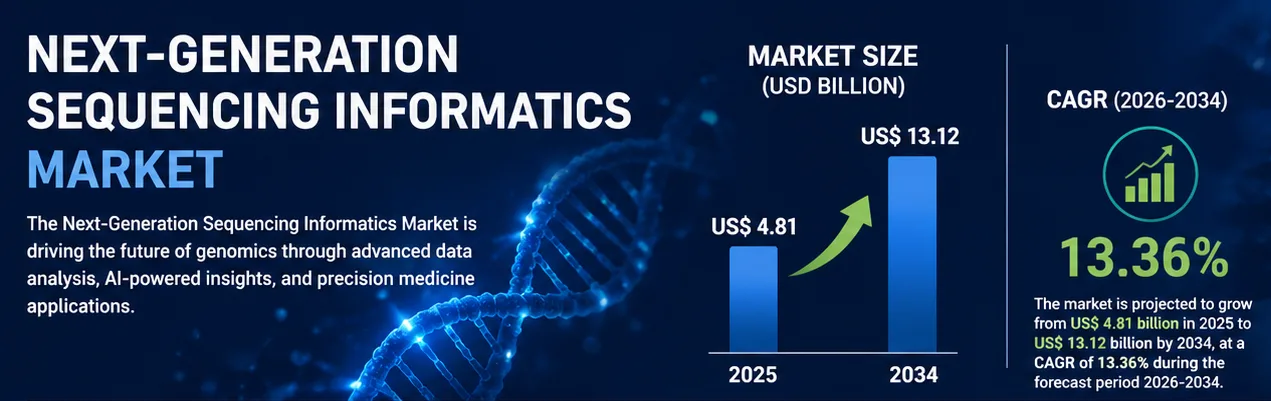
The global Next-Generation Sequencing Informatics Market size is projected to reach US$ 13.12 billion by 2034 from US$ 4.81 billion in 2025. The market is anticipated to register a CAGR of 13.36% during the forecast period 2026–2034. This robust expansion reflects the growing integration of genomics into routine clinical practice, the declining cost of sequencing, and rising demand for scalable bioinformatics infrastructure capable of managing petabyte-scale genomic datasets.
Next-Generation Sequencing Informatics Market Key Trends
The Next-Generation Sequencing Informatics Market Key Trends include the rapid integration of artificial intelligence and machine learning into variant interpretation pipelines, accelerating cloud-based genomic data management, expanding adoption of NGS in oncology and rare disease diagnostics, growing government investment in national genome programs, increasing demand for real-time data analysis tools in clinical settings, the rise of liquid biopsy as a minimally invasive cancer detection method, and the emergence of long-read sequencing technologies that enable more comprehensive genomic profiling.
What Role Is AI Playing in Transforming NGS Informatics?
Artificial intelligence and machine learning have fundamentally reshaped how genomic data is analyzed and interpreted. AI-powered variant classification algorithms can process whole-genome sequencing data in a fraction of the time required by traditional methods, enabling real-time clinical decision support. Machine learning models trained on large genomic databases have improved the sensitivity and specificity of mutation detection, especially for complex rearrangements and copy number variations. As clinical datasets grow, these models continue to learn and refine their predictions, reducing false positives and accelerating time-to-diagnosis for patients with rare or aggressive diseases.
Why Is Cloud Computing Becoming Essential for NGS Informatics?
The sheer volume of data generated by modern sequencing platforms demands scalable computational infrastructure. A single whole-genome sequencing run can generate over 100 gigabytes of raw data, making on-premises storage and processing impractical for most institutions. Cloud-based NGS informatics platforms offer elastic computing resources, pay-per-use pricing models, and integrated collaboration tools that allow multidisciplinary teams to access and analyze genomic data from any location. Major hyperscalers including Amazon Web Services and Microsoft Azure have developed dedicated genomics solutions, accelerating the shift of NGS workflows to the cloud.
How Is Precision Medicine Driving Demand for NGS Informatics Solutions?
Precision medicine initiatives are among the most powerful demand drivers for the NGS informatics market. As healthcare systems move away from one-size-fits-all treatment protocols, the need to characterize individual patient genomes has intensified. NGS informatics platforms enable clinicians to identify actionable mutations, match patients to targeted therapies, and monitor treatment response through serial genomic profiling. The World Health Organization estimates nearly 35 million new cancer cases annually by 2030, a figure that underscores the urgency of deploying scalable genomic analysis infrastructure capable of supporting oncology-driven precision care at a global scale.
Get Sample PDF @ https://www.theinsightpartners.com/sample/TIPRE00006921
Segmentation Analysis: Which Segments Are Driving Market Growth?
By Products and Services
The NGS informatics market is divided into NGS informatics services and data analysis and management tools. Data analysis and management tools represent the largest revenue contributor, driven by demand for integrated pipelines that handle quality filtering, alignment, annotation, and clinical reporting in a single workflow. The services segment, including managed bioinformatics services and consulting, is growing at the fastest rate as institutions seek external expertise to supplement in-house genomics teams.
By Application
Drug discovery leads market adoption, as pharmaceutical companies increasingly rely on NGS informatics to identify therapeutic targets, characterize biomarkers, and support companion diagnostic development. Genetic screening is the second-largest application segment, encompassing newborn screening, carrier testing, and hereditary disease identification. Precision medicine and oncology diagnostics together represent a rapidly expanding application space, with oncology diagnostics projected to account for nearly 38.7% of application-based revenues by 2034. Disease diagnosis, including rare disease and infectious disease genomics, completes the application landscape.
By End User
Hospitals and clinics are the fastest-growing end-user segment, propelled by the integration of NGS into routine oncology panels, infectious disease surveillance, and pharmacogenomics programs. Academic and research institutes remain the largest end-user category by volume, supported by grant funding and national genomics initiatives. Pharmaceutical and biotechnology companies represent the highest per-user spend, deploying NGS informatics at every stage of the drug development lifecycle, from target identification through clinical-stage biomarker analysis.
Top Players in the Next-Generation Sequencing Informatics Market
The competitive landscape of the NGS informatics market is characterized by a mix of global technology leaders, specialized bioinformatics vendors, and cloud platform providers. Leading companies shaping the market include:
- Agilent Technologies Inc.
- DNANEXUS, INC.
- F. Hoffmann-La Roche Ltd
- PerkinElmer Inc
- Illumina, Inc.
- GENEWIZ
- Partek, Incorporated
- QIAGEN
- DNASTAR
- Thermo Fischer Scientific Inc.
Other notable players include PacBio, Oxford Nanopore Technologies, QIAGEN, and BGI Genomics, each contributing unique technological capabilities to the evolving informatics ecosystem.
Regional Analysis
North America
North America commands the largest share of the global NGS informatics market, driven by a concentration of leading genomics companies, high research funding, advanced healthcare infrastructure, and widespread clinical adoption of NGS. The United States benefits from NIH's multi-billion dollar annual genomics research budget, Medicare reimbursement expansion covering oncology-related sequencing tests, and a dense network of academic medical centers pushing the boundaries of genomic medicine. North America is expected to hold approximately 45.1% of global market revenues by 2034.
Europe
Europe represents the second-largest regional market, supported by the European Genome-phenome Archive, national precision medicine programs in the UK, Germany, and France, and robust regulatory frameworks enabling responsible genomic data sharing. The UK's Genomics England initiative and similar programs across the continent are generating sustained institutional demand for informatics platforms capable of handling population-scale sequencing data.
Asia Pacific
Asia Pacific is the fastest-growing regional market and is projected to register the highest CAGR through 2034. China's ambitious genomics infrastructure investments, Japan's national precision medicine strategy, and India's Genome India Project are collectively driving rapid expansion. The region benefits from a growing base of skilled bioinformaticians, increasing healthcare expenditure, and supportive government policies promoting genomic research and clinical translation.
Latin America and Middle East and Africa
Latin America and the Middle East and Africa represent emerging opportunity markets. Increasing investment in healthcare modernization, rising awareness of genetic disease burden, and improving sequencing affordability are gradually expanding NGS informatics adoption in these regions. Brazil, South Africa, and Saudi Arabia are among the leading countries building genomics capacity supported by public-private partnerships and international collaborations.
Future Outlook
The future of the NGS informatics market will be shaped by several converging forces. The continued decline in sequencing costs, projected to approach the long-anticipated sub-$100 genome threshold within this decade, will dramatically expand the volume of genomic data requiring informatics support. Long-read sequencing technologies from PacBio and Oxford Nanopore Technologies will increasingly complement short-read platforms, demanding next-generation pipelines capable of handling higher complexity data structures.
About The Insight Partners
The Insight Partners delivers market intelligence and consulting services to help clients make informed decisions. The firm covers industries such as Aerospace and Defense, Automotive and Transportation, Semiconductor and Electronics, Biotechnology, Healthcare IT, Manufacturing, Medical Devices, Technology, Media, and Chemicals and Materials.
Contact Us
Email: [email protected]
Website: www.theinsightpartners.com
Phone: +1-646-491-9876
Also Available in :