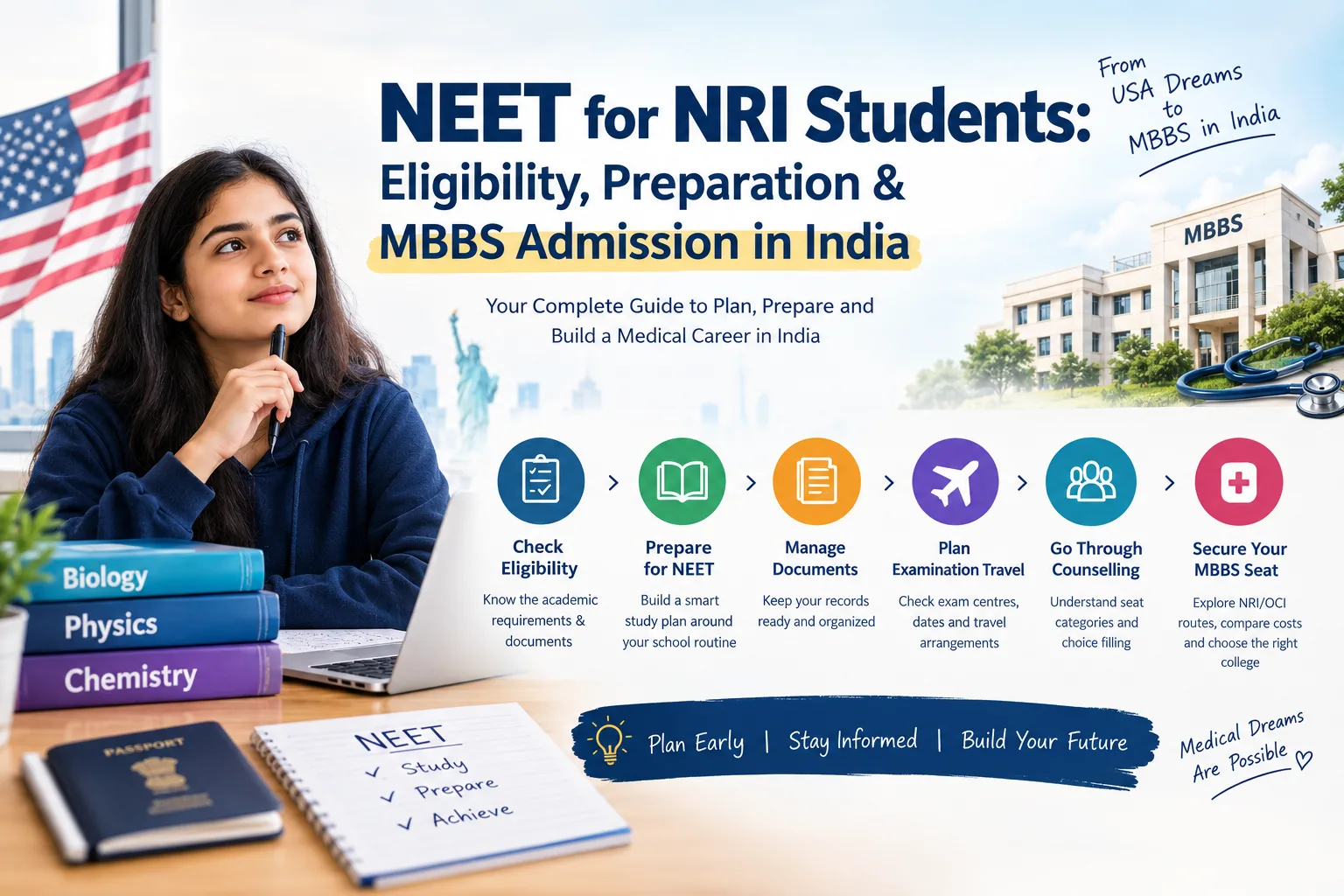
For Indian-origin families living in the United States, planning a child’s medical education in India involves more than preparing for an entrance examination. Students must balance US high-school coursework with NEET preparation while families investigate academic eligibility, documentation, examination logistics, and admission pathways. This practical guide to NEET for NRis students provides a starting point for understanding the requirements, while this article focuses on how families can organize their preparation and planning from the USA.
Why US-Based NRI Families Need an Early NEET Plan
The students enrolled in high schools in the US adhere to an educational schedule and course work which is different from the educational background which is typical for preparing Indian medical students for NEET. Consequently, preparing for NEET while dealing with school homework and tests may pose some scheduling problems.
Parents should approach the process as three connected tasks:
- Academic planning: Determine whether the student’s educational background and subjects meet the applicable eligibility requirements.
- Examination preparation: Build a sustainable study routine around school commitments.
- Admission planning: Understand the separate requirements for counselling, seat categories, documentation, and college selection.
Starting early gives families time to identify gaps, ask questions, and avoid making major decisions under deadline pressure.
Check Academic Eligibility Before Finalizing Your Plan
Among the first things to be done would be to examine the student’s academic record. Do not presume that graduating from high school in the United States fulfills all the requirements to study medicine in India.
Examine the academic transcripts, the science courses taken and those that remain to be taken, test scores, and expected date of graduation of the student. Then match them against the eligibility criteria mentioned in the applicable NEET bulletin and the medical admissions regulations.
The family must note the following:
- Required subjects and applicable practical components.
- Minimum qualifying marks and how they apply to the student’s category.
- Rules for candidates educated outside India.
- The documentation needed to establish academic eligibility.
It is essential to note that American high school subjects, AP courses, and other educational credentials do not necessarily carry automatic equivalency. In case a subject or credential is not certain, confirm this from the relevant body before proceeding with the preparation and application process of the student.
The eligibility to sit NEET and that of applying for a specific MBBS seat category are two different things that require different processes.
Build a NEET Preparation Schedule Around US High School
An approach that works in reality is more beneficial than the one where a student is unable to follow due to overambitious goals. Preparations for NEET must suit within the school routine rather than always conflicting with it.
A realistic routine might comprise of four aspects:
1. Syllabus mapping
Firstly, examine the NEET syllabus to determine which concepts need further attention from those that are currently being taught in school classes, rather than simply considering that all topics will be covered in classes at school.
2. Consistent weekly study
Distribute the time spent studying Biology, Physics, and Chemistry based on the requirements of the student. Make use of small periods of time for studying on hectic school days, but spend more time on harder subjects whenever possible.
3. Practice and error review
Utilize topic-related questions to locate your areas of weakness. After completing each practice test, analyze the mistakes you have made and find out whether they arose due to conceptual errors, calculation mistakes, missing details, or time constraints.
4. Mock tests and revision
Timed practice should be introduced as the preparation advances. Each test should be analyzed thoroughly rather than just concentrating on the results. The mistakes made repeatedly can be reviewed in future study sessions.
In addition, families should factor in school exam time, vacation period, deadlines for application, and any travel plans that may be included. A schedule that incorporates relaxation and revision is easier to adhere to than one that does not.
Organize Academic and NRI Documentation Early
Documentation is often easier to manage when families create an organized record before application or counselling deadlines approach.
Depending on the student’s circumstances and the relevant process, records to review may include:
- Passport and other accepted identity documents.
- School transcripts, marksheets, and qualifying examination records.
- Proof of educational qualifications completed outside India.
- Documents relevant to NRI, OCI, or other applicable status.
- Sponsorship, relationship, or residence-related documents where required.
This is just a preparatory checklist and does not provide a complete list of mandatory documents required for each particular case.
Maintain proper digital copies and store original documents in proper order. Cross-check the spellings of the name, date of birth, passport details, and all other information. Variations in documents might cause unnecessary bureaucratic troubles.
Before applying for the test and counselling, make sure to read the updated instructions provided by the official authority. Always refer to the latest instructions rather than going by last year’s checklist.
Plan NEET Examination Travel From the United States
Families staying in the United States must confirm the details of the examinations before making any non-refundable booking for their travel. It may happen that the list of countries where examination centers are available changes from examination cycle to examination cycle. So it cannot be assumed that a center is available in the United States.
When the concerned authority releases the instructions for the examination, then families should check about the list of permitted cities, application procedures, date of the examination and how to confirm the allotted examination center.
If travel to India or other permitted place is required then families must make arrangements for flights, stay, local transport and comfort of the students on examination day.passport, admit card, and other things required for the examination.
Plans for travel should be made on the basis of the confirmation of the examination and not on the basis of previous experience.
Understand the Journey From NEET to MBBS Admission
NEET is an important part of the medical-admission process, but qualifying for the examination does not guarantee an MBBS seat.
Families should understand the broad stages that follow:
- Application and examination: Complete the required registration process and appear for NEET according to the applicable instructions.
- Result and qualification: Review the official result and determine whether the student meets the relevant qualification requirements.
- Seat-category eligibility: Establish whether the student meets the separate conditions for the admission route being considered.
- Counselling registration: Identify the appropriate counselling authority and follow its registration, document-verification, and choice-filling procedures.
- Seat allotment and joining: Review any allotment carefully and complete the required admission formalities within the specified timeline.
The appropriate counselling agency varies based on the nature of the seat, the institution, and relevant rules. While some students require central counselling for their admissions, other cases require state counselling.
It is important to find out about the right mode of counselling before preparing the list of colleges. Failure to do so may jeopardize the chances of admission despite having a qualifying NEET score.
Research NRI Admission Routes and Total Costs
NRI category admissions must be considered separately from the general examination category. Residence in the USA does not alone qualify someone to avail of an NRI quota.
The categories of NRI, OCI, and foreign national must not be equated. It depends upon the relevant rules, documentation required, sponsor/relationship requirement, etc.
Compare before shortlisting colleges:
- Whether the institution offers the relevant seat category.
- The current eligibility and document-verification requirements.
- The applicable counselling process.
- Published tuition and other mandatory charges.
- Accommodation, travel, insurance, and personal expenses.
- Payment deadlines and the terms governing refunds, where applicable.
The use of official notice about fees and up-to-date information about counseling is preferred over using outdated articles and any guesswork. Moreover, families should make a distinction between application fees, fees for attending a medical school, and additional expenses if taking a seat is considered.
An effective college list should take into account such factors as affordability, eligibility, preferences, geographical preferences, and admission process.
Common Planning Mistakes NRI Families Should Avoid
Several avoidable mistakes can make the process more difficult:
- Starting eligibility checks too late: Review academic requirements before committing to a preparation timeline.
- Assuming US coursework automatically qualifies: Confirm how the student’s specific subjects and credentials are assessed.
- Preparing documents only at counselling time: Organize records early and verify the current requirements.
- Assuming an examination centre will be available in the USA: Check the official city list for the relevant cycle.
- **Confusing NEET