
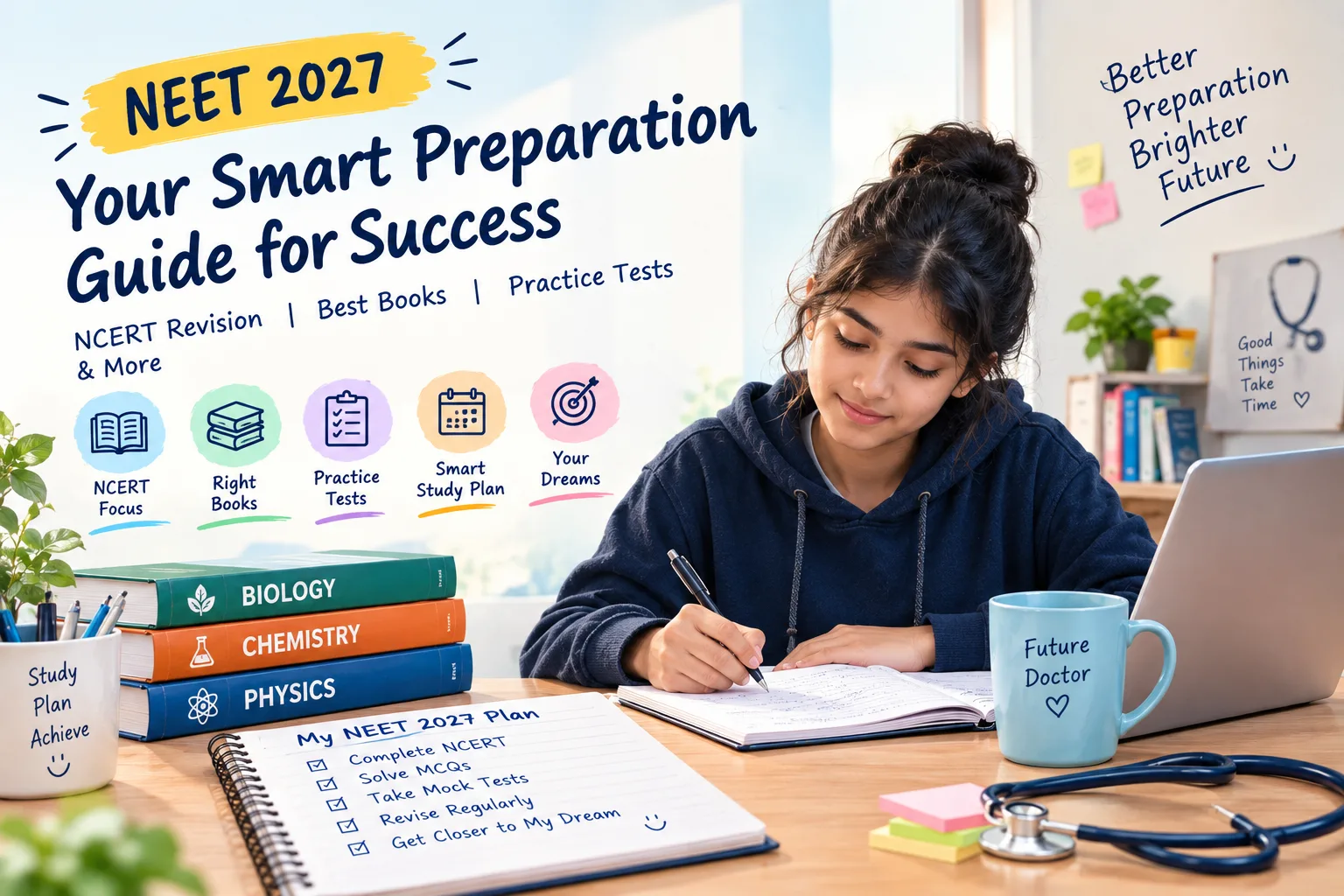
NEET 2027 and Board Exam Preparation: How to Balance NCERT, Revision and Mock Tests
Preparing for NEET UG 2027 while managing Class 12 board examinations can feel like preparing for two major goals at the same time. Students need to understand concepts, remember important details, practise numerical problems and prepare for both descriptive and multiple-choice questions.
The good news is that you do not always need two separate study plans. Many topics overlap between board-level Physics, Chemistry and Biology and NEET preparation. By organising your schedule carefully, you can strengthen your school subjects while improving your performance in the medical entrance examination.
Here is a practical approach to managing both preparations without allowing revision or practice to fall behind.
1. Use NCERT as the Common Foundation
One of the most effective ways to manage your workload is to connect board exam preparation with NEET preparation wherever the syllabi overlap.
NCERT textbooks provide an important foundation for Biology and Chemistry, while Physics requires both conceptual understanding and regular numerical practice. Read each chapter carefully, understand the underlying principles and then practise questions based on the same concepts.
When comparing NEET preparation books, choose resources that complement your textbooks rather than repeat the same explanations without adding useful practice.
For example, after completing a Biology chapter, revise the important textbook details, practise NEET-style MCQs and prepare a short summary for later revision. This helps you use one study session for several learning objectives.
2. Divide Your Time Between Boards and NEET
Your daily schedule should reflect your current academic priorities. During regular school months, you may need to spend more time completing classroom assignments and understanding new chapters. As board examinations approach, written-answer practice becomes increasingly important.
However, completely stopping NEET practice for several weeks can make it harder to maintain speed and accuracy.
A flexible routine could include:
- Concept learning: Study the current school chapter and understand its fundamentals.
- Board preparation: Practise written answers, derivations, diagrams and numerical questions where relevant.
- NEET practice: Solve MCQs from the same chapter after revising the concepts.
- Revision: Spend a short session reviewing previously completed topics.
Adjust the duration of each session according to your school timetable, upcoming tests and preparation level. The objective is to maintain progress in both areas without following an unrealistic schedule.
3. Give Class 11 Topics Regular Attention
Students studying in Class 12 often concentrate heavily on their current syllabus because board examinations are approaching. As a result, earlier Class 11 topics may receive less attention than they need.
Avoid leaving the entire Class 11 revision for the final months.
Instead, select a few previously studied chapters each week and revise them alongside your current Class 12 syllabus. Begin with topics where you have forgotten concepts or repeatedly make mistakes in practice questions.
A simple weekly method is to reserve dedicated revision sessions for Class 11 Physics, Chemistry and Biology. Rotate the subjects so that none remains untouched for too long.
Students looking for NEET 2027 books should also consider whether their resources help with both chapter-level revision and full-syllabus practice.
4. Make Physics Practice a Daily Habit
Physics can become difficult when students understand a formula but struggle to apply it to unfamiliar questions. Regular problem-solving helps bridge this gap.
After studying a concept, solve a few questions without immediately checking the solution. Identify the information provided, determine which principle applies and then work through the calculation.
Keep a separate record of:
- Formulas that you frequently forget.
- Questions where you select the wrong approach.
- Calculation mistakes and unit-conversion errors.
- Concepts that require another explanation or revision.
During board preparation, continue practising derivations and written solutions. For NEET, gradually increase your focus on timed MCQs and selecting the correct approach efficiently.
5. Prepare Chemistry Through Concepts, Reactions and Practice
Chemistry preparation requires a balanced approach because different chapters demand different study methods.
For Physical Chemistry, focus on understanding concepts, remembering relevant formulas and practising calculations. For Organic Chemistry, build a clear understanding of reaction mechanisms, conversions and important reactions. For Inorganic Chemistry, revise textbook details and practise recalling facts accurately.
Do not wait until the entire syllabus is complete before solving questions. Use chapter-wise MCQs to check your understanding after each topic.
For board examinations, practise presenting explanations and calculations clearly. For NEET, focus on applying concepts and identifying the correct answer among similar options.
6. Revise Biology Without Depending Only on Memorisation
Biology requires repeated revision because students need to remember terminology, diagrams, processes and relationships between concepts.
Start with careful textbook reading. Pay attention to labelled diagrams, tables, examples and terms that can change the meaning of a statement.
After completing a chapter, close the book and try to recall its main ideas. Then solve MCQs and revisit the sections where you make mistakes.
For board examinations, practise diagrams and structured descriptive answers. For NEET, test your recall through objective questions and learn to distinguish between options that appear similar.
A regular revision cycle is more useful than reading the entire textbook once and assuming that the information will remain in memory.
7. Choose Study Material That Matches Your Current Needs
Collecting too many resources can make preparation harder to manage. A student who is still learning the syllabus may need detailed explanations, whereas a student who has completed most chapters may benefit more from revision notes, previous-year questions and mock tests.
When selecting NEET 2027 study material, consider the following:
- Does it match the applicable syllabus?
- Are the explanations clear enough for independent study?
- Does it provide relevant chapter-wise questions?
- Can you use it for revision without spending too much time?
- Does it address a genuine gap in your current preparation?
You can compare relevant resources in the NEET 2027 books collection. Choose resources according to your preparation stage rather than purchasing every book recommended online.
8. Introduce Mock Tests Gradually
Mock tests are useful for measuring progress, but the right timing and review process matter.
During the learning phase, begin with chapter-wise tests. Once you have covered a substantial portion of the syllabus, add subject-wise tests and gradually move towards full-length practice papers based on the official examination pattern.
After every test, review your incorrect answers. Also revisit questions you answered correctly by guessing, as these may indicate incomplete understanding.
Record the reason for each mistake and plan a follow-up revision session. This process helps convert test results into specific improvements rather than treating a score as the only measure of progress.
As the examination approaches, increase timed practice according to your readiness and available time.
9. Keep Your NEET UG Resources Organised
A structured NEET UG study guide can help you keep track of chapter completion, revision dates, practice tests and weak areas.
Your tracking system does not need to be complicated. A notebook or simple checklist can include:
- Chapters completed for the first time.
- Chapters revised during the week.
- MCQs attempted and reviewed.
- Topics that need additional practice.
- Upcoming school tests and board preparation targets.
Students comparing NEET UG books can explore the NEET UG books collection to review resources relevant to their preparation needs. For students searching for NEET UG books online, it is worth checking the book's edition, subject coverage and suitability before ordering.
The purpose of organising your resources is to make revision easier, not create another task that consumes valuable study time.
10. Protect Your Final Revision Time
As board examinations and NEET get closer, avoid allowing unfinished notes and new resources to take over your schedule.
Prioritise the chapters that need attention, revise your own short notes and revisit questions you previously answered incorrectly. Keep practising essential concepts while adjusting the intensity of your study around your examination dates.
Before following a final-stage timetable, verify the latest official syllabus, examination pattern and schedule. Do not make major preparation decisions based solely on rumours or unconfirmed announcements.
A realistic revision plan should also leave room for adequate sleep, meals and breaks. Consistent preparation is difficult to maintain when you are exhausted.
Conclusion
Balancing board examinations and NEET UG 2027 becomes easier when you connect overlapping subjects, revise Class 11 topics regularly and practise MCQs alongside your school studies.
Use NCERT as a foundation, select suitable study resources and introduce mock tests gradually. Most importantly, analyse your mistakes and adjust your timetable according to actual progress.
You do not need to complete everything in a single day. A manageable routine followed consistently can help you prepare for both examinations with greater confidence and better organisation.