Some workplace accidents are small and local. Others injure many people at once, damage plants and affect whole communities. Process safety is the discipline that prevents the second kind. If you work in oil and gas, petrochemicals, manufacturing or energy, NEBOSH PSM training from Gulf Academy of Safety can help you understand how major incidents develop and how to stop them before they start.
What is process safety?
Personal safety deals with hazards such as slips, trips and falls. Process safety deals with the integrity of operating systems and processes that handle hazardous substances. When these systems fail, the result can be fires, explosions or toxic releases that cause widespread damage.
Major incidents rarely come from a single mistake. They usually develop from a chain of weaknesses: poor maintenance, ignored alarms, unclear procedures, rushed changes and a culture that accepted risk without questioning it. Process safety training teaches you to spot those links early.
About the NEBOSH HSE Certificate in Process Safety Management
The NEBOSH HSE Certificate in Process Safety Management, commonly called NEBOSH PSM, is a qualification developed by NEBOSH, the UK’s leading health and safety awarding body, together with the Health and Safety Executive. It focuses specifically on managing the integrity of systems that handle dangerous materials.
It bridges the gap between technical knowledge and everyday safety practice, which is why it is in demand among professionals who work in hazardous environments.
What you will learn
The course is organised into four units. Unit 1 covers process safety leadership, including organisational learning from incidents, worker engagement, safety culture and management commitment. Unit 2 looks at the management of process risk, including risk assessment techniques such as HAZOP and HAZID, safe systems of work and permit-to-work systems.
Unit 3 deals with process safety control, covering operating procedures and process deviation, asset integrity and maintenance, and safety instrumented systems. Unit 4 covers fire and explosion protection, including the fire triangle, explosion mechanisms, DSEAR and ATEX zones, mitigation techniques, and emergency response and recovery planning.
Real-world case studies support each unit, so you see how the principles apply in actual high-hazard workplaces.
Learning from what went wrong
One of the most powerful parts of process safety training is studying how past incidents unfolded. A leaking valve, an overridden alarm, or a poorly handled shutdown can look minor until it combines with other weaknesses.
By examining these patterns, you develop a questioning attitude. You start to ask what could go wrong, which barriers are in place, and whether those barriers genuinely work. That mindset is one of the most valuable outcomes of the course.
Who should take the course?
The qualification suits chemical and process engineers, HSE managers and safety officers, operations and plant managers, oil and gas professionals, maintenance supervisors, fire and safety engineers, environmental and compliance officers, and contractors working in high-risk environments.
If your role touches hazardous materials, plant operations, maintenance or process changes, the knowledge you gain will help you make safer decisions and communicate more clearly with colleagues.
Training in the UAE and Saudi Arabia
Gulf Academy of Safety offers NEBOSH PSM training for learners across the UAE and Saudi Arabia, including cities such as Dubai, Abu Dhabi, Sharjah, Riyadh, Dammam and Jeddah. Learners can choose classroom, e-learning or live online delivery depending on their schedule.
Because the academy works within the regional industrial environment, discussions and examples connect directly to the realities that learners face on their own sites.
Why choose Gulf Academy of Safety
Gulf Academy of Safety is a NEBOSH Gold Learning Partner. Learners benefit from experienced NEBOSH-certified trainers with industry backgrounds, flexible schedules including weekend batches, exam preparation and revision sessions, and a recognised certificate valued by companies across the GCC.
The aim is not only to help you pass the assessment but to prepare you to perform confidently in the real world.
Benefits for individuals and employers
For individuals, a recognised process safety qualification strengthens your CV and shows commitment to a specialist area. It can support progression into roles such as process safety engineer, HSE adviser, safety and risk analyst or plant supervisor.
For employers, trained staff improve how hazards are identified and controlled. They ask better questions during reviews, support stronger procedures and help build a culture where concerns are raised early. Those benefits help protect people, assets and reputation.
The certificate has lifetime validity and global recognition, so the investment continues to pay off throughout your career.
Four ways process safety training changes daily work
First, you pay closer attention to barriers. Instead of assuming that an alarm, relief device or interlock will always work, you ask when it was last tested and who is responsible for it. Second, you treat changes with respect. A temporary bypass, a modified procedure or a new piece of equipment can introduce hazards that no one has reviewed, so you learn to ask whether a change has been properly assessed.
Third, you value reporting. Near misses and small leaks are early warnings, and a workforce that reports them openly gives the organisation a chance to learn before harm occurs. Fourth, you appreciate leadership. When managers visibly support process safety, listen to concerns and provide resources for maintenance, everyone else follows.
Practical support during the course
Learners receive trainer support, mock tests, revision sessions, and 24/7 student assistance. These tools make it easier to handle the technical content and to prepare for the scenario-based assessment. If you are unsure which delivery mode is best for you, the academy’s advisers can discuss your schedule and recommend an approach.
A culture that protects
Technology and procedures matter, but culture decides whether they work. In a strong process safety culture, people feel safe raising concerns, supervisors follow up, and lessons from incidents elsewhere are taken seriously. Training helps you contribute to that culture by explaining why controls exist and by encouraging colleagues to speak up when something looks wrong.
Preventing incidents begins with knowledge
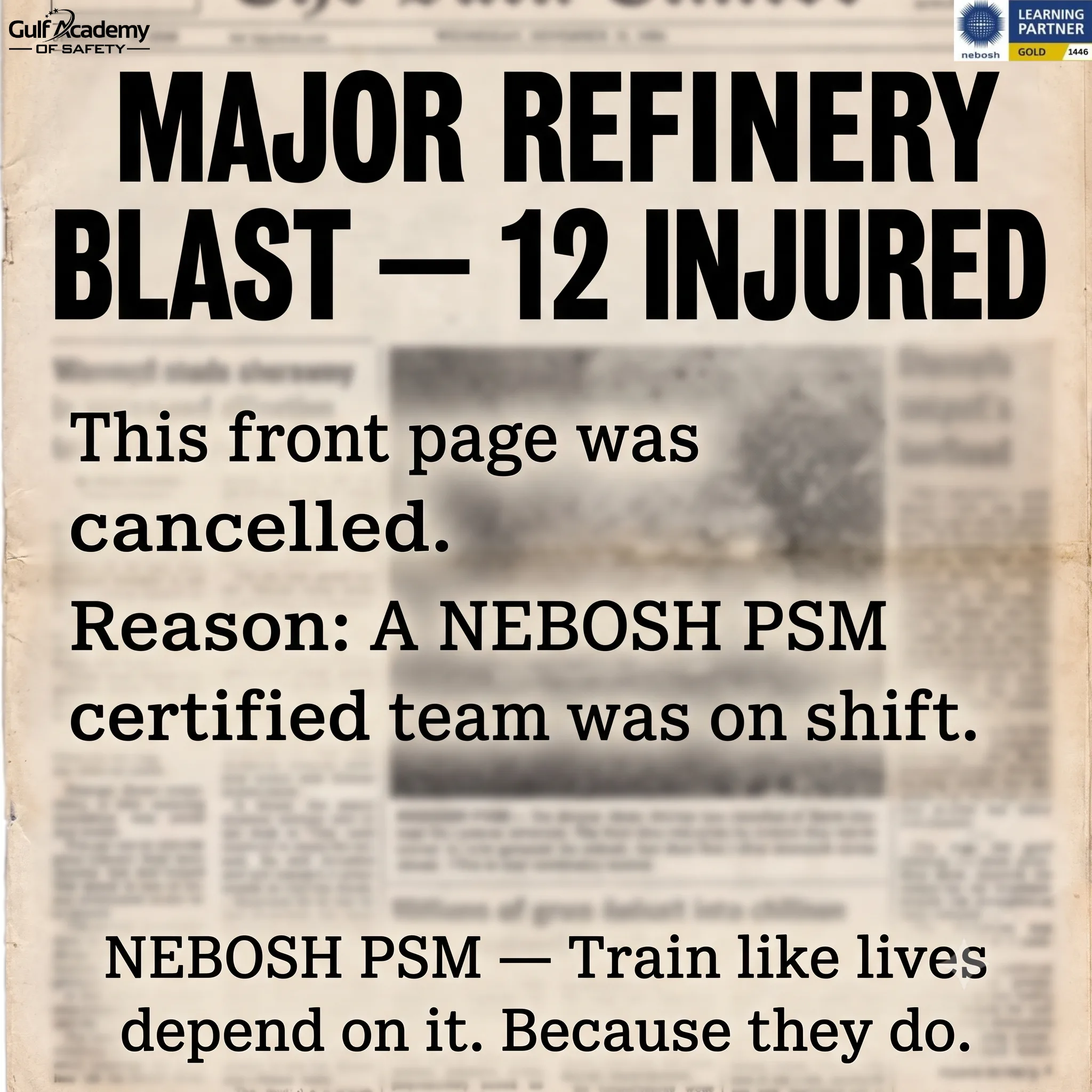
Major incidents are preventable when people recognise warning signs and act on them. Training gives you the understanding and the confidence to do exactly that. Enrol in the NEBOSH PSM course with Gulf Academy of Safety today!