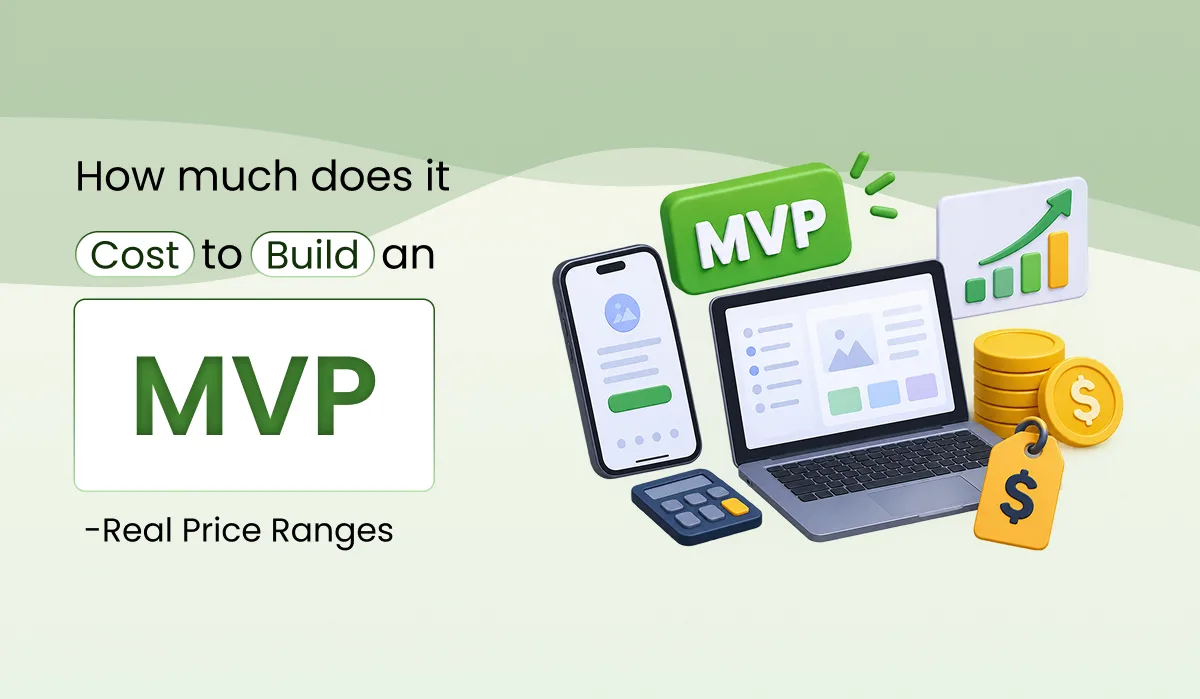
Realistic budget ranges, a sample $20,000 breakdown, the hidden costs most quotes skip and seven ways to spend less without losing the learning.
Every founder asks the same question before writing a single line of code: what will this actually cost? The honest answer is that an MVP is not a cheaper version of a full product. It is the smallest working product that lets real users show you whether your idea is worth building. Its price depends far more on what you leave out than on what you put in.
This guide explains MVP development cost in plain numbers, shows what drives it, and gives you a checklist for choosing a partner. For the full pricing breakdown, see our complete MVP development cost guide. All figures are illustrative planning ranges for India-based delivery, not market averages, fixed packages or a Primocys quotation.
How much does MVP development cost?
If you are asking how much does MVP development cost, start with three realistic tiers:
- Lean validation MVP: $8,000–$15,000, usually 6–10 weeks. One core workflow, basic design, limited user roles and few integrations.
- Standard custom MVP: $15,000–$40,000, usually 8–16 weeks. A customer experience, a backend, essential admin tools, and payments or notifications.
- Complex or regulated MVP: $40,000–$100,000+, usually 16–28+ weeks. Several roles, complex permissions, integrations, security or compliance requirements.
These ranges assume a focused launch scope and conventional cloud architecture. Taxes, cloud usage and third-party subscriptions may be extra. Can an MVP cost under $10,000? Sometimes, but only with a very narrow scope.
Cost to develop MVP: India versus US and UK
Location is one of the biggest levers on the cost to develop MVP projects. For planning, an India-based agency is commonly budgeted at roughly $20–$60 per hour, while a US, UK or Western European agency or contractor is more like $80–$150+ per hour. Independent freelancers vary widely.
A lower rate is only useful if delivery is dependable, so compare the whole package: scope clarity, testing, communication, source-code ownership and support after launch. Do not choose on rate alone.
MVP app development cost by product type
The category of product changes the starting point. As a rough guide to MVP app development cost:
- Service-booking app: usually a standard build. Payments, provider roles and location logic drive the price.
- Multi-role marketplace: starts standard and can reach complex because of payouts, disputes, verification and dashboards.
- SaaS or B2B dashboard: usually standard. Permissions, integrations and billing are the cost drivers.
- Chat or social app: starts standard and can reach complex, because real-time messaging, calling, moderation and scale add work.
- Fintech or healthcare app: typically complex, because of security, consent, audit trails and compliance review.
- AI-powered product: starts standard and can reach complex, with model integration, evaluation and usage-based API costs.
What actually drives the price
Six factors explain most of the difference between one quote and another:
- The number of user roles and workflows
- Platform choice: web, iOS, Android or all three
- Third-party integrations such as payments, maps, SMS, identity and AI APIs
- Product design and discovery
- Security, privacy and regulated data
- Quality assurance and launch readiness
If you can reduce any one of these before you request quotes, your MVP development cost falls without hurting the learning you are after.
A sample $20,000 MVP budget
To make this concrete, imagine a hypothetical $20,000 scope for a booking-style product with customers and providers. A reasonable split looks like this:
- Discovery, flows and UI design: $2,000
- Customer and provider experience: $6,000
- Backend, database and permissions: $5,000
- Payments, notifications and basic admin: $4,000
- Testing, deployment and release support: $3,000
Notice that around 55% goes to customer, provider and backend work. This is an illustration of how a budget can be distributed, not an actual invoice or an advertised package.
The hidden costs of building an MVP
The build quote is rarely the whole bill. Plan for these as well:
- Hosting and storage that grow with usage.
- Paid APIs for maps, SMS, email, payments, AI models and identity verification.
- App distribution: developer accounts, store review and device compatibility.
- Maintenance: security patches, bug fixes and dependency updates.
- Product iteration based on what users actually do.
- Legal and compliance work where it applies.
A common planning figure for upkeep is 15–25% of the build cost per year. Ask every vendor for two numbers: the cost to launch and the cost to operate for the first 6–12 months.
Subscribe to Pro Writer Tools to remove upgrade prompts from your unlocked stories.
Want a quote that shows both numbers? Share your MVP scope and we will help you estimate the cost to launch and to operate.
Seven ways to reduce MVP development cost
- Write one measurable product hypothesis. Know what you are trying to prove.
- Prioritise one end-to-end workflow. A complete journey beats many half-built ones.
- Choose the first platform based on your actual users.
- Use established components for authentication, payments and notifications.
- Handle rare operations manually at first instead of automating everything.
- Agree acceptance criteria before coding so scope disputes do not become paid changes.
- Reserve a post-launch budget for fixes and the first round of improvements.
What to build now and what to defer
Build now: one complete user journey, secure login where needed, the core data model, essential notifications, basic admin controls, error handling and analytics. Usually defer: referral engines, advanced AI personalisation, multi-region infrastructure, elaborate dashboards, multiple payment providers and edge-case automation. Everything on the second list can wait until real users prove the first list matters.
How long does it take?
A focused MVP typically takes around 8–16 weeks. A rough breakdown is discovery and scope in 1–2 weeks, UX and UI design in 1–3 weeks, development in 4–10+ weeks, and QA, deployment and review in 1–3 weeks. Phases can overlap, and API approvals, app-store reviews or compliance work may add time.
No-code tools or a custom MVP?
No-code and AI tools are a good fit for landing pages, simple internal tools and early demand tests. Move to custom development when you need custom workflows, secure payments, several user roles, app-store release, scale or full code ownership. A sensible hybrid is to validate with no-code first, then rebuild the proven workflow as a custom MVP. Also remember the difference between a prototype (a clickable design), a proof of concept (a technical experiment for a risky feature) and an MVP (a working product for real users).
How to choose an MVP development company
The right mvp development company will challenge your scope instead of simply agreeing to everything. Ask these five questions, whichever mvp development services provider you are considering:
- Which similar products have you built, and what did your team personally deliver?
- How do you separate launch essentials from phase-two features?
- Who owns the source code, repositories and cloud accounts?
- How often will I see working software, and how are changes priced?
- What is included after launch: bug fixes, hosting support and handover?
Watch for red flags: a fixed price with no written scope, no testing line item, vague ownership terms, or unlimited changes with a guaranteed deadline. On pricing models, fixed price suits a clear scope, time and materials suits scope that will evolve, and a dedicated team suits a roadmap that continues beyond the MVP.
Conclusion: plan your MVP budget around learning
The goal of an MVP is not to spend the least. It is to learn the most for each pound or dollar spent. Define one hypothesis, build one complete journey, budget for hosting and upkeep, and choose a partner who is honest about scope. Do that and your MVP development cost becomes an investment in evidence, not a bet on guesswork. To go deeper, read the full MVP pricing guide on the Primocys blog.
Ready to turn your idea into a costed MVP plan? Tell us your users, core workflow and launch timeline, and we will help you shape a lean scope and a realistic budget. Explore our MVP development services or get a free MVP estimate.
This article was originally published on the Primocys blog. Cost figures are illustrative planning ranges, not independently audited benchmarks or binding offers. Final prices depend on a documented scope and contract.