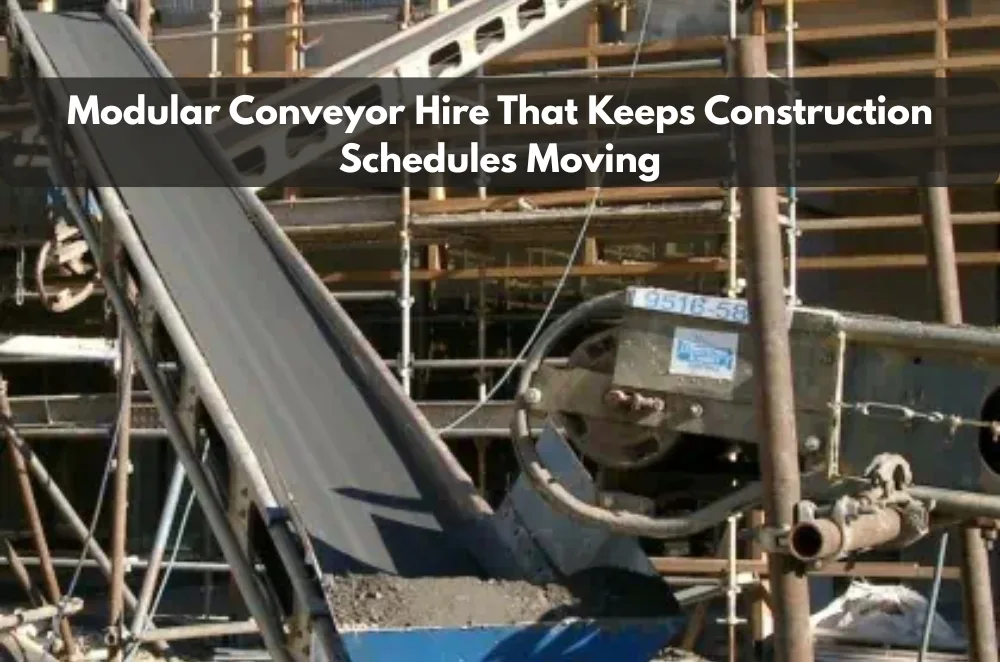
Construction programmes rarely slip because of the big-ticket milestones everyone tracks. More often it’s the repetitive micro-tasks—shifting spoil, aggregate, bricks or demolition waste across awkward ground—that shave a few minutes off every hour until handover dates start wobbling. For contractors looking to claw those minutes back, construction conveyors hired for the exact window of need are proving the simplest lever.
The Quiet Bottleneck Hiding on Most Sites
A tight labour market and stricter fatigue rules have already forced many supervisors to rethink “strong backs and barrows” as the default approach. Yet manual slog still creeps in whenever a skip is a little too far from the pour, or the lift is tied up shifting pallets. Add a muddy ramp or a temporary staircase and productivity can stall.
Two patterns show up again and again:
- Crews queue for limited plant (telehandlers, cranes, hoists) just to move loose material a short distance.
- Labourers zig-zag around obstacles with wheelbarrows or buckets, burning energy that could be spent on higher-skill tasks.
Both issues scale with building height and site congestion. A single 600 mm conveyor thread snaked through scaffold lifts free up plant, keeps walkways clear and replaces half-day jobs with 90-minute bursts.
Where the Time Really Goes
Below is a practical comparison of how sites handle bulk material on tight footprints:
TaskTypical Manual ApproachConveyor-Assisted ApproachMoving demolition rubble from level 3 to skip binLoad wheelbarrows, navigate ramp, wait for liftFeed rubble into hopper, continuous discharge to skipPlacing backfill behind retaining wallBobcat loads, labourers spread by shovelConveyor drops backfill directly behind wall, crew trimsShifting bags of sand across slabTwo labourers relay, risk repetitive strainSand tipped at edge, conveyor delivers to bricklaying areaA 20-metre modular belt shifting one tonne every five minutes can wipe out dozens of return trips before smoko.
Hire or Buy? Weighing Up a 2026 Reality
Capital budgets feel the pinch when interest rates stay stubbornly high. Few builders want another depreciating asset idle between jobs, yet they still need the capability on demand. Short-term hire removes that trade-off: pay only for the weeks the kit is earning its keep, then off-hire before the invoice rolls into the next month.
For managers running multi-site programmes, having versatile conveyor hire options in the rental fleet means each project manager can dial up length, width and discharge height without waiting for group capex approval. Transport is no headache either; five-metre sections and clip-on hoppers fit on a tilt tray and land on site the same day in most metro areas.
Financial controllers like the model too. Hire costs book straight to the project rather than inflating the balance sheet, and maintenance responsibilities sit with the supplier. That eliminates surprise repair invoices half-way through the build.
Safety and Compliance Come First
Every extra handle of a shovel raises the risk of musculoskeletal injuries. The latest Safe Work Australia statistics still list manual handling as a top driver of lost-time injuries in construction. A conveyor’s continuous flow slashes lift-twist-dump cycles and keeps load heights within safe zones.
Noise and dust are often lower as well. Electric drive units hum below typical hammer-drill levels, and adjustable drop heights minimise fine-particle plumes. When noise or silica suppression plans drive daily conversations on site, small wins like these matter.
Supervisors should still carry out a site-specific risk assessment: guardrails, start-stop e-stops, and clear pedestrian segregation are non-negotiable. But compared with relocating a crane pick point or extending scaffold, implementing a conveyor system is usually straightforward.
Getting the Spec Right the First Time
A quick phone call rattling off length and throughput numbers seldom delivers the most cost-effective setup. A few details tighten the match between kit and task:
- Material type and moisture. Damp clay behaves very differently from crushed brick. Belt cleats, side skirts and scraper blades must suit the load.
- Feed method. Are you tipping with an excavator bucket or wheelbarrow? Hopper size and height make or break efficiency.
- Discharge point. If you’re aiming over perimeter fencing into a truck, check local council rules on drop height and dust control.
- Power access. A 415 V three-phase supply is common on commercial builds, but many residential sites rely on portable generators—factor in load and refuelling access.
A reputable rental supplier will walk through these questions and suggest the smallest footprint that still meets hourly tonnage targets.
Lessons from Sites That Switched
Contractors refurbishing CBD office floors often face strict hoist bookings and limited skip access. One Sydney crew replaced a team of four labourers wheeling debris down a goods lift with a 300 mm wide conveyor rising through a stair void. They cleared each floor three hours faster and avoided overtime when the lift broke down.
Regional highway projects see payback too. During culvert construction west of Dubbo, aggregate needed to travel 15 metres across fresh pour each morning. The superintendent trimmed two days off the programme by feeding from a loader directly into a conveyor that arched over reinforcement steel, keeping boots off the green concrete.
Ready to take the next step? Visit our Learn more to find out more.
The Regulatory Pulse Heading Into 2027
Sustainability reporting is no longer the preserve of tier-one builders. Medium contractors now field questions about embodied carbon and worker wellbeing during tender evaluation. Reducing idling plant hours and manual strain ticks both boxes. Guidance from Safe Work Australia notes mechanical aids as one of the primary controls for repetitive handling—an easy line item to evidence in audit trails.
Future updates to the National Construction Code are tipped to push further on dust containment and noise thresholds. A modular conveyor with fitted covers and variable-speed drives positions crews ahead of the curve rather than scrambling after a citation.
A site that keeps people fresh and materials flowing rarely loses momentum. By treating conveyor hire as a precision tool—deployed for the task, sized to the footprint and off-hired before it gathers dust—contractors hold their schedules steady and their crews safer.