Ask three agencies what their mobile app development services include and you will get three different lists. One leads with design, one with code and one with a long list of technologies. None of that tells you what will actually land in your hands when the project ends.
This guide lays out what a complete engagement contains, stage by stage, and what you should have in writing before you sign. It also shows where services tend to get left out of quotes, so you can compare offers on equal terms.
The short version
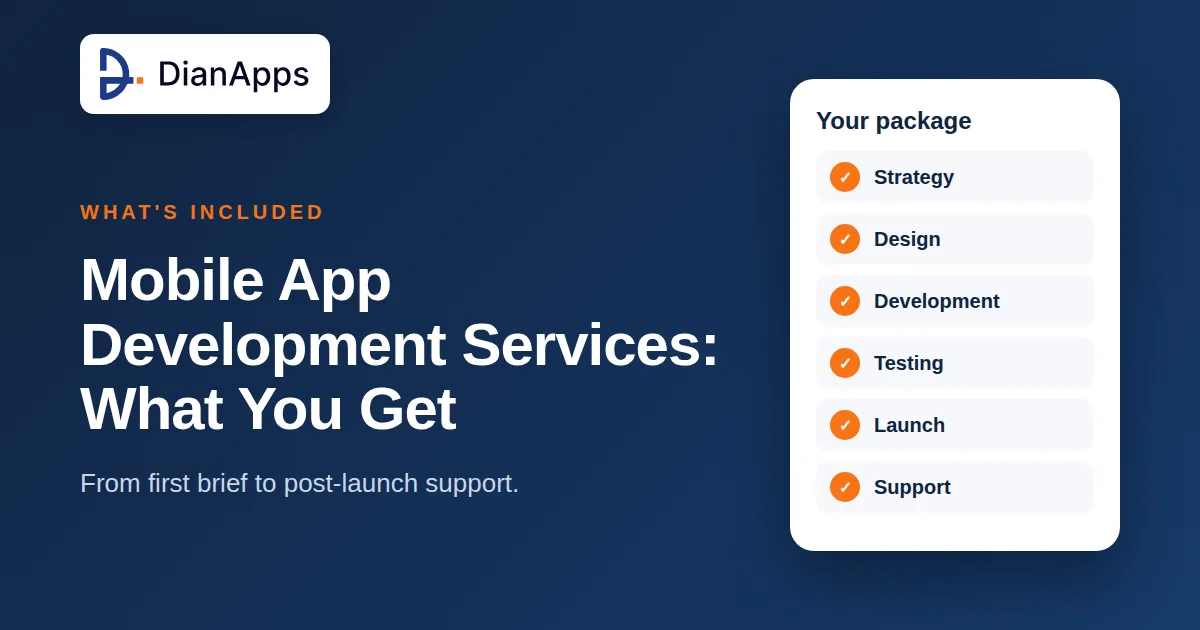
A full-service mobile app development company covers six things: strategy, design, development, testing, launch and ongoing support. You should receive a working app, the source code, the store listings and a plan for what happens next.
Some agencies sell only one or two of those pieces and call it a full service. The sections below show what each stage should deliver, so you can spot the gaps.

Strategy and discovery
Good projects start with questions, not code. In discovery the team studies your users, your competitors and your business goals, then turns them into a plan.
What you should get:
- A written product brief with the main user journeys
- A ranked feature list with a clear first release
- A rough timeline and budget range
- A recommendation on native or cross-platform and on Android, iOS or both
If a vendor sends a quote before asking about your users, discovery was skipped. That is a warning sign, because every later estimate rests on it.
UX and UI design
Design is more than colors. It covers how people move through the app, what each screen asks of them and how the product feels in the hand.
You should receive wireframes, a clickable prototype, a visual design system and the final design files. The prototype matters most. Testing it with a handful of real users before development starts catches confusing screens when changes are cheap.
Development
This is the stage most buyers think of first. It includes the app itself, the backend that powers it and the APIs that connect them.
For the app, the team builds in Kotlin or Java for Android, Swift for iOS or a cross-platform framework such as Flutter or React Native. Our comparison of Flutter vs React Native explains how that choice affects speed and cost. Android app development and iOS work can run in parallel when the design is settled.
The backend handles accounts, data, payments and business rules. Many quotes list the app and quietly leave the backend out, so ask directly whether it is included. Work should move in short sprints, each ending with a build you can try.
Quality assurance and testing
Testing is a service in its own right, and it is the one most often squeezed. A proper QA stage covers feature checks, real device testing, speed under load and security.
Device coverage matters most in android application development, where your app has to behave across hundreds of phone models. Ask how many real devices the team tests on. Ask also whether testing runs during development or only at the end. Running it in each sprint finds problems while they are still small.
Launch and store release
Getting into the stores takes preparation. The team creates the listings, screenshots and descriptions, sets up the developer accounts, fills in the privacy disclosures and submits the build for review.
A good partner also plans a staged rollout, which releases the app to a small share of users first. If something breaks, it breaks for a few people instead of everyone. Make sure the developer accounts and the code are registered in your name.
Support and maintenance
Launch is the start of the app's life. New Android and iOS versions arrive every year, and an app that is not updated slowly stops working properly.
Ongoing services usually include bug fixes, operating system updates, security patches, monitoring and small improvements. Ask what the support window is after launch and what it costs. Our guide on how much it costs to build an app covers the maintenance budget in more detail.

Extra services worth asking about
Not every project needs these, but they often decide whether the app succeeds:
- Backend and cloud setup: Hosting, databases, admin panels and scaling plans
- AI features: Recommendations, chat assistants or image recognition. Our guide to choosing an AI mobile app development company lists what to ask
- App store optimization: Titles, keywords and screenshots that help people find the app
- Analytics and crash reporting: Tools that show how people use the app and what breaks
- MVP planning: A focused first version that tests the idea before you commit the full budget
Many of these fall under wider application development services, so check whether your partner handles them in-house or hands them to someone else.
How to compare quotes
Two quotes can look similar and cover very different work. Put the same lines side by side:
1. Discovery and planning
2. Design and prototype
3. App development for each platform
4. Backend and APIs
5. Testing and device coverage
6. Store release
7. Post-launch support
8. Code and account ownership
Whoever leaves a line blank is the one who will bill you for it later. A price far below the rest usually has missing lines, not better efficiency.
If you plan to hire mobile app developers directly instead of buying a package, our guide on how to hire developers for a startup explains what you will need to cover yourself.
Choosing who delivers the services
A mobile app development company brings design, development and testing under one contract. A freelancer covers a slice. An in-house team gives control and takes months to build. Each works in the right situation, and an app development agency is usually the fastest route when your scope is clear and you want a launch date.
Whichever you pick, ask to speak with the people who will build your app, check live apps they have shipped and get ownership of the code in writing. Custom mobile app development rewards that kind of care at the start.
What DianApps delivers
At DianApps, we cover the full cycle for Android, iOS, Flutter and React Native apps: strategy, design, development, QA, release and support, with one team accountable from first brief to post-launch updates. The same team builds backends and AI features, so you are not stitching several vendors together.
If you want to see how our mobile app development services work from brief to launch, send us your idea and we will tell you plainly what it needs, including what to leave out of version one.
Before you sign
Ask for the deliverables list in writing, compare quotes line by line and confirm who owns the code. A clear list of what you get is the best protection against surprises later. Mobile application development goes best when both sides know exactly what is included.