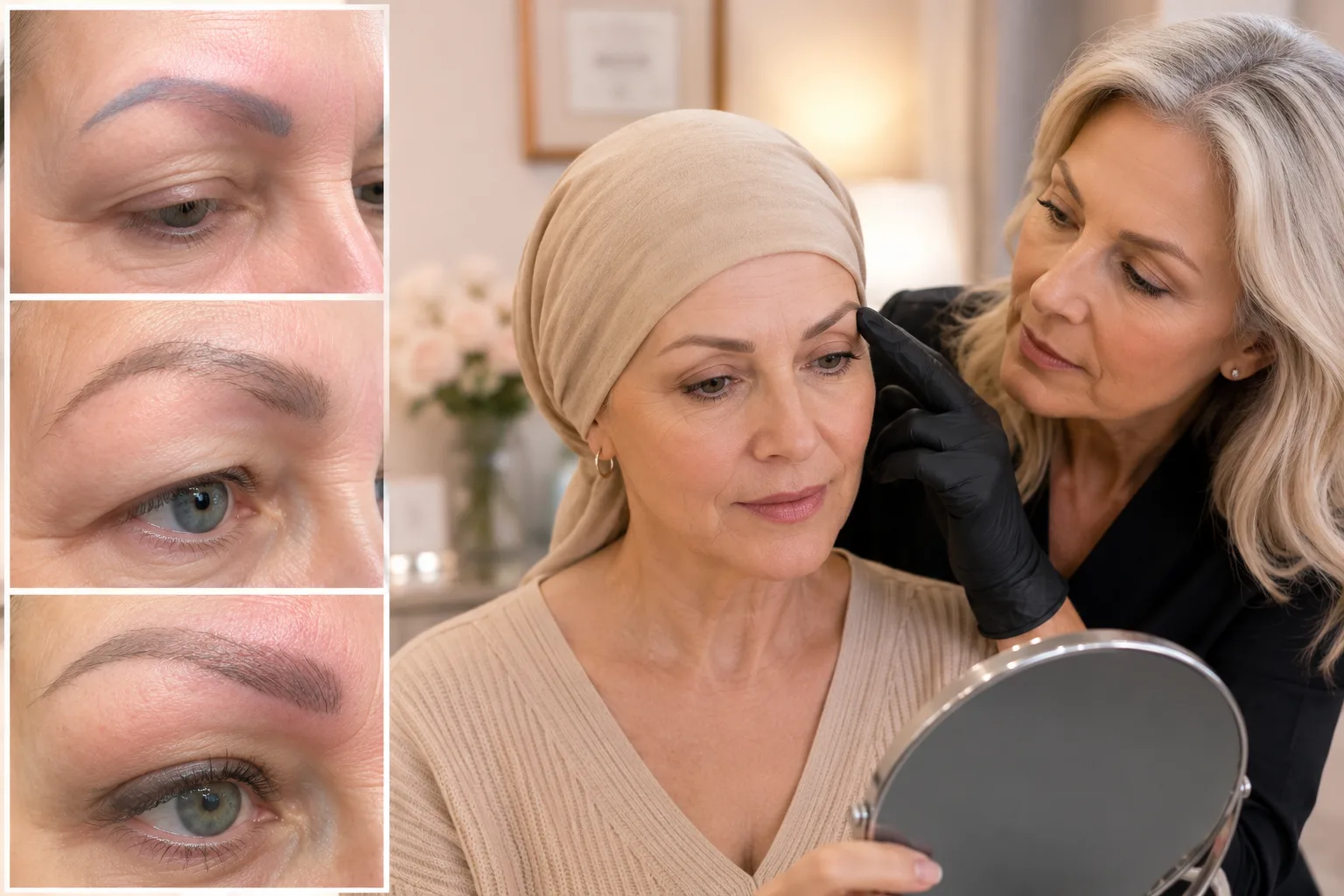
You looked in the mirror and something had changed.
Maybe the crisp hairstrokes you paid for have blurred into a soft grey smudge. Maybe the colour has drifted orange or red. Maybe one brow sits noticeably higher than the other, and now you can't unsee it. Or maybe they simply refuse to fade, years after you were promised they would.
If any of that sounds familiar, you're in a very large group of people. Microblading peaked in popularity between roughly 2017 and 2023, and a great deal of that work is now reaching the stage where pigment breaks down and shifts colour. At BrowLady Dallas,correcting it has quietly become one of the most common things permanent makeup artists do.
The good news is that most bad brow work can be improved substantially. The honest news is that correction is slower, more expensive, and more patience-intensive than the original procedure — and a few things genuinely can't be undone. Here's the full picture.
Why do permanent brows go wrong?
In most cases, permanent brows don't fail because of one dramatic mistake — they fail because pigment behaves differently over time than it looks on day one. Understanding which problem you have determines which fix you need.
Grey or blue brows. This is the most common complaint, and it's usually about pigment chemistry rather than skill. Many brow pigments contain white components to soften the shade. Warm tones break down faster than cool ones under UV exposure and time, so as the warmth leaves, the remaining cool base surfaces — and a soft brown reads grey or bluish.
Orange or red brows. The reverse problem. Pigments built on a warm base can lose their darker components first, leaving the underlying warmth exposed. Sun exposure accelerates this considerably.
Blurred, spread hairstrokes. Usually a skin-type mismatch. Microblading uses a blade to cut fine channels, and on oily skin excess sebum pushes pigment outward beneath the surface. Strokes that looked immaculate at week two soften and merge over the following year. This is the single most preventable cause on the list, and it's why an honest artist assesses your skin before recommending a technique. If you're weighing your options for the future, understanding which brow technique suits your skin type matters more than almost anything else.
Asymmetry. Brows mapped to your existing eyebrow hair rather than to your bone structure will follow whatever imbalance was already there. Faces aren't symmetrical, and good mapping compensates for that. Poor mapping cements it.
Patchy retention. Often aftercare. Picking flakes during healing pulls the pigment underneath out with them. Skipping the six-to-eight-week touch-up leaves gaps that were always going to need a second pass.
Too dark, too thick, or too solid. Over-saturation — pigment packed too densely or implanted too deep. This is the hardest category to correct, because there's simply more pigment to remove.
Scarring. Where a blade has worked too deeply or the same area has been worked repeatedly, raised or textured tissue can result. Be aware that this is the one outcome pigment work cannot resolve.
Can bad microblading actually be fixed?
Yes, in the great majority of cases — but "fixed" usually means significantly improved over several months rather than instantly erased.
Set expectations properly before you start. Correction is a process, not an appointment. Most people need between two and five sessions spaced six to ten weeks apart, because skin needs full recovery time between treatments.
What can realistically be achieved: colour shifted back to a natural tone, shape rebalanced, density softened, and old work faded enough to be covered cleanly.
What cannot: scar tissue removed by any pigment-based method, and in some cases, extremely saturated old work fully cleared. Some deeply implanted pigment lightens well but never disappears entirely. Any artist who guarantees complete removal in one or two sessions is overselling.
What are your options for fixing bad brows?
Colour correction
Colour correction neutralises an unwanted tone by implanting a complementary pigment over it, and it's the fastest route when your shape is fine but the colour has drifted. Orange is neutralised with a cooler counter-tone; grey and blue are warmed. It's essentially colour theory applied to skin.
Best for grey, blue, orange or red brows where the shape and thickness are still good. Usually one to two sessions. This is the most efficient correction available — but it only works if you're happy with everything except the colour.
Saline lightening
Saline lightening uses a high-concentration saline solution implanted into the skin to draw pigment upward through osmosis, lifting it out as the area scabs and heals. It's the workhorse of brow correction: slower than laser, gentler on the skin, and effective on pigment colours that laser can struggle with.
Best for brows that are too dark, too thick, or the wrong shape, where you need to remove pigment rather than recolour it. Typically two to five sessions across four to ten months. Patience is genuinely required, and the temptation to rush between sessions is the most common reason results disappoint.
Laser removal
Laser removal breaks pigment particles apart so the body's immune system can clear them, and it's the most effective option for dense, dark, stubborn work. It's performed by a laser technician rather than a permanent makeup artist, so this route usually involves two professionals working in sequence.
Best for heavily saturated pigment that saline is clearing too slowly. Two to six sessions over six to twelve months. One important caution: certain pigments — particularly those containing iron oxides or titanium dioxide — can darken or turn grey on contact with laser energy. A test patch is essential, and any reputable technician will insist on one.
Cover-up with ombré powder brows
A powder-brow cover-up places soft, shaded pigment over existing work, and it's often the most practical solution for brows that have simply faded rather than gone badly wrong. Because the technique deposits thousands of dispersed dots rather than continuous lines, it conceals underlying irregularity far more effectively than hairstrokes can.
Best for faded, soft old work where the shape is acceptable and the tone can be worked with. Frequently, ombré powder brows over faded microblading achieve in one or two sessions what removal would take the better part of a year to accomplish. It won't work over very dark or very cool-toned pigment — that needs lightening first.
How long does the correction take?
Plan for six months to a year from first consultation to final result, depending on how much pigment needs to come out.
The single most important rule is spacing. Skin needs six to ten weeks to recover fully between sessions, and pushing that interval shorter doesn't speed anything up — it increases the risk of scarring and reduces how much pigment lifts each time.
Give yourself a realistic runway. If you have a wedding or a major event coming, start at least nine months out.
What does brow correction cost?
Correction generally costs more than the original procedure, often two to three times as much, because it takes more sessions and considerably more skill.
Removal sessions are typically priced individually, and the total depends on how many you need — which no honest artist can predict precisely before seeing how your skin responds to the first one. Expect a per-session price rather than a flat quote, and treat anyone offering a guaranteed total upfront with some caution.
It's frustrating, and it's the strongest argument for choosing carefully the first time. Fixing brow work costs more than getting it right.
How do you choose an artist for correction work?
Judge a correction specialist on healed correction photographs specifically — not on their general portfolio. Beautiful work on fresh, untouched skin tells you nothing about someone's ability to fix a difficult case.
Ask to see before-and-after sets of brows that started in a similar state to yours, photographed at least eight weeks after the final session. Studios that do this work regularly will have them ready, and asking is entirely normal. Reviewing healed correction and cover-up results before you book is the most useful thirty minutes you can spend.
Beyond that, look for:
- State licensing and bloodborne pathogen certification. In Texas, permanent cosmetics fall under tattoo studio regulation, and licence status is publicly verifiable.
- A consultation before any commitment, ideally in person, with your brows unfilled so the artist can see exactly what they're working with.
- A staged plan, not a single appointment. Anyone proposing to fix significant work in one visit hasn't assessed it properly.
- Willingness to state limits. An artist who tells you upfront that a section is scarred, or that full removal isn't achievable, is being straight with you.
- Photographs at every stage, so progress is documented objectively rather than by memory.
How to avoid going through this again
Once your brows are corrected, the same decision returns: which technique now?
Choose based on your skin, not on what looked good on someone else. Oily and combination skin does markedly better with nano brows or powder brows than with microblading. Mature or previously tattooed skin nearly always does better with shading than with strokes. Wear SPF on the brow area daily, keep retinol and acids away from them, and don't skip the six-to-eight-week touch-up.
Do those four things and your next set should hold beautifully for years
Frequently asked questions
Will my brows go back to completely bare skin?
Rarely to entirely bare, though many people get close. Very saturated pigment can leave a faint shadow visible only up close. Most clients find the remaining trace easy to conceal or cover.
Does saline removal hurt more than microblading?
It's comparable, with more discomfort during healing than during the session itself. The area scabs more heavily than a standard procedure, and that healing phase is the harder part.
Can I just get new brows over the old ones?
Only if the existing pigment is light and warm enough to work with. Tattooing over dark or cool-toned pigment produces muddy, unpredictable results — which is how a bad situation becomes a worse one.
How soon after removal can I get new brows?
Usually eight to twelve weeks after your final removal session, once the skin has fully recovered and settled.
Will there be scarring?
Correctly performed saline and laser work carry low scarring risk. Risk rises sharply when sessions are spaced too closely or scabs are picked during healing.
Ready to find out what's actually possible with your brows?
Every set of brows is different, and no honest artist can tell you what your correction will involve without seeing them in person. That's what a consultation is for — and it costs you nothing but half an hour.
At BrowLady in Dallas, Silvia will look at your brows unfilled, tell you honestly which category they fall into, and walk you through a staged plan with a realistic timeline and cost — before anyone touches your face. If your brows can't be fully corrected, you'll hear that too.
Book your brow correction consultation at BrowLady →
Serving Dallas, Plano, Frisco, Richardson and McKinney.