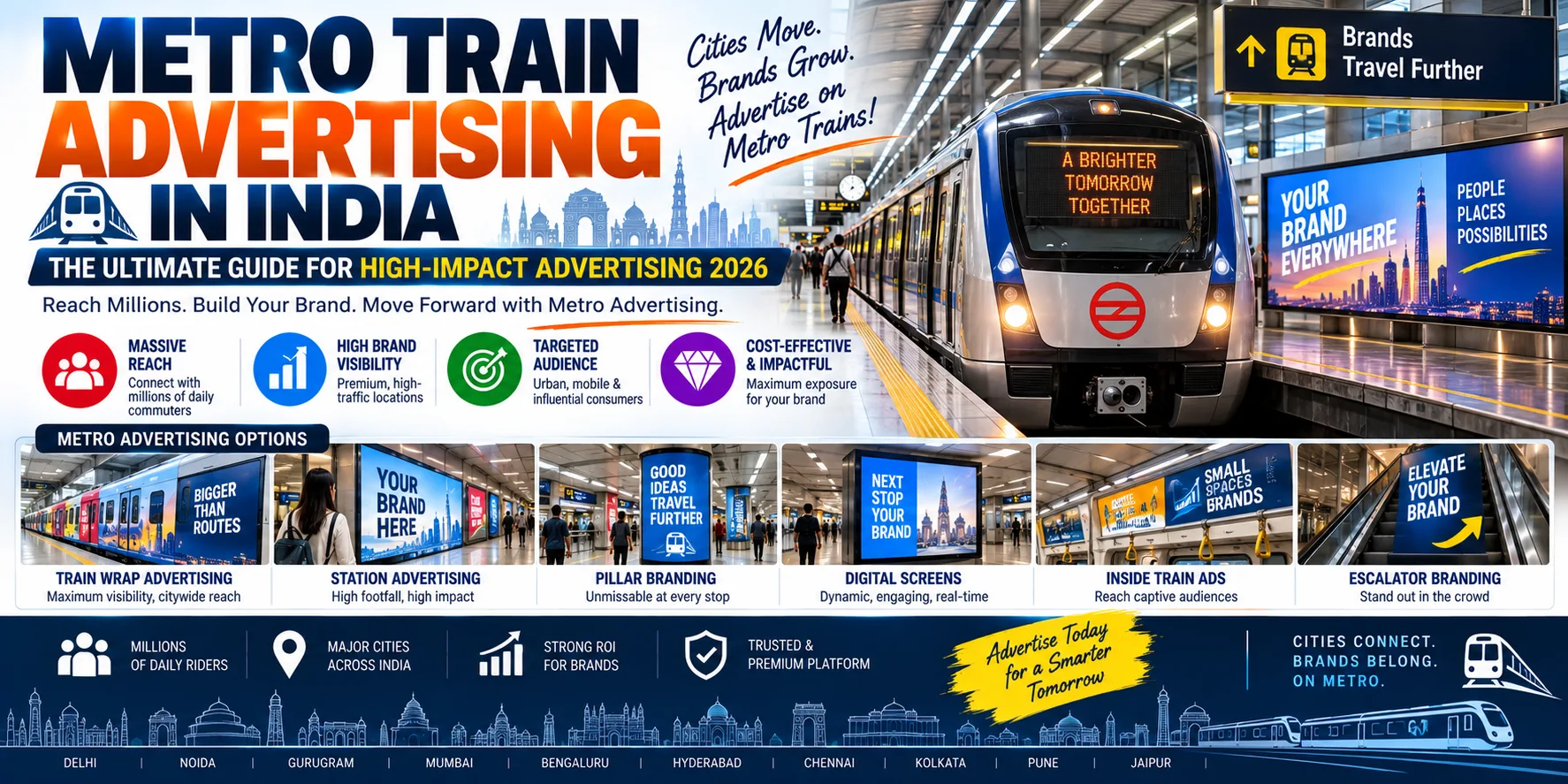
The Ultimate Guide for High-Impact Metro Train Advertising in India 2026
Metro systems have become one of the most visible advertising environments in India's major cities. Every day, thousands of commuters travel through metro stations, enter and exit trains, wait on platforms, use concourses, and pass through busy interchange points. For brands looking to build awareness in urban markets, this environment offers repeated exposure and multiple opportunities to connect with consumers.
Metro rail advertising has evolved significantly from traditional posters and static panels. Today, brands can use train wraps, station branding, digital screens, platform displays, pillars, entry and exit areas, escalators, and other media formats to create integrated campaigns. When strategically planned, these formats can combine visibility, frequency, location targeting, and creative storytelling.
This guide explores how metro train advertising works, the role of metro station advertising, major opportunities in Delhi metro advertising and Noida metro advertising, factors affecting metro advertising cost, and strategies businesses can use to create high-impact campaigns in 2026.
What Is Metro Rail Advertising?
Metro rail advertising refers to promotional campaigns displayed across metro transportation networks. Advertising can appear inside trains, on train exteriors, on station walls, platforms, pillars, digital screens, entry gates, escalators, and other approved advertising spaces.
Unlike many conventional advertising channels, metro media operates within an environment where audiences frequently spend several minutes commuting or waiting. This creates opportunities for repeated brand exposure.
Metro advertising can be used by a wide range of businesses, including:
- Real estate companies
- Educational institutions
- Banks and financial services
- Consumer brands
- E-commerce businesses
- Automobile companies
- Healthcare organizations
- Restaurants and food brands
- Technology companies
- Travel companies
- Retail businesses
- Government and public-awareness campaigns
- Entertainment and media companies
The objective can range from brand awareness and product launches to local lead generation and promotional campaigns.
Why Metro Train Advertising Is Important in 2026
India's urban population continues to rely heavily on public transportation. Metro networks connect residential areas, business districts, commercial centers, educational hubs, airports, shopping destinations, and other important locations.
This makes metro train advertising particularly relevant for brands seeking visibility among urban audiences.
1. High Repetition
A commuter may see the same advertisement several times during a regular journey. Repetition can help improve brand recall when the creative execution is consistent.
2. Strategic Geographic Exposure
Brands can select routes, stations, corridors, or specific locations according to campaign objectives and available inventory.
3. Large Urban Audience
Metro networks provide access to commuters from different demographic and professional backgrounds.
4. Multiple Advertising Formats
Advertisers can select from static, transit, digital, station, and experiential formats.
5. Strong Visual Environment
Large-format advertisements can command attention when they use clear messaging and strong visual design.
6. Local Market Targeting
Businesses operating in particular cities or commercial areas can use metro advertising to reach audiences close to their markets.
Metro Train Advertising: Formats and Opportunities
Metro train advertising can involve advertising inside trains, outside trains, or through specific train-related media properties.
Depending on the metro system and available inventory, brands may explore formats such as:
Train Exterior Branding
Train wraps and exterior branding can turn an entire train into a moving billboard. This can provide strong visibility across multiple stations and routes.
Train Interior Advertising
Interior panels, doors, handles, wall spaces, and other approved areas can be used for advertising.
Door Branding
Creative advertisements around train doors can provide repeated exposure to passengers.
Window and Panel Advertising
Strategically placed graphics can reinforce brand messaging during a passenger's journey.
Full Train Branding
For major launches or high-visibility campaigns, brands may explore complete or extensive train branding packages where available.
The most suitable format depends on campaign duration, target audience, creative requirements, route availability, and budget.
Metro Station Advertising: Where Brands Meet Commuters
Metro station advertising provides advertisers with opportunities to reach passengers before, during, and after their train journey.
Stations are particularly useful because commuters may spend time walking through concourses, waiting on platforms, entering or exiting stations, and changing trains.
Common station advertising formats include:
- Platform panels
- Pillar branding
- Wall panels
- Concourse advertising
- Entry and exit branding
- Escalator branding
- Staircase branding
- Digital screens
- Backlit displays
- Large-format displays
- Ticketing-area advertising
- Directional-area branding
- Station domination campaigns
The selection of a station can be just as important as the selection of an advertising format.
For example, a real estate company may prioritize stations located near residential and commercial development zones, while a retail brand may prefer stations close to shopping destinations.
Delhi Metro Advertising: A Major Urban Branding Opportunity
Delhi metro advertising is one of the most prominent metro advertising opportunities in India because Delhi and the National Capital Region have a large and diverse commuter ecosystem.
The Delhi Metro network connects important residential, commercial, institutional, business, and transportation hubs across the National Capital Region.
Brands exploring Delhi metro advertising can consider different approaches based on their campaign objectives.
Station-Based Campaigns
A business can focus on selected high-traffic stations rather than attempting to advertise across the entire network.
Corridor-Based Campaigns
Advertisers can consider a group of stations along a relevant corridor when geographic targeting is important.
Train Advertising
Brands may explore interior or exterior train advertising formats where inventory is available.
Digital Advertising
Digital screens can provide opportunities for dynamic messaging, promotional campaigns, and time-sensitive communication.
Station Domination
For major campaigns, station-wide branding may create a stronger visual presence than isolated advertisements.
How to Plan a Delhi Metro Advertising Campaign
A successful Delhi metro advertising campaign begins with audience and location analysis.
Before booking media, advertisers should determine:
- Who is the target audience?
- Which areas are commercially important?
- Which metro corridors are relevant?
- Which stations are close to the target market?
- What is the campaign objective?
- How long should the campaign run?
- What advertising format is appropriate?
- What budget is available?
- What creative dimensions are required?
- How will campaign performance be evaluated?
For example, a premium residential project may want visibility around business districts and affluent catchment areas, whereas a coaching institute may focus on stations serving educational and student-heavy locations.
Noida Metro Advertising: Reaching a Growing Urban Market
Noida metro advertising provides brands with another important opportunity within the National Capital Region.
Noida has developed into a major business, technology, education, residential, retail, and commercial hub. Metro connectivity makes advertising within the network relevant for companies targeting commuters and consumers in the region.
Businesses considering Noida metro advertising may include:
- Real estate developers
- IT companies
- Educational institutes
- Co-working businesses
- Restaurants
- Retail brands
- Healthcare providers
- Financial services
- Consumer technology brands
- Local businesses
Why Location Matters in Noida
Different stations serve different audience profiles. Therefore, advertisers should not simply select stations based on popularity.
Instead, they should consider:
- Nearby residential areas
- Office clusters
- Shopping destinations
- Educational institutions
- Business parks
- Hospitals
- Tourist or entertainment destinations
- Connectivity with other transportation systems
This approach can make a metro campaign more strategically targeted.
Delhi Metro Advertising vs Noida Metro Advertising
Both markets can be useful, but their campaign planning requirements can differ.
Geographic Market:
Delhi Metro Advertising — Delhi and wider NCR connectivity
Noida Metro Advertising — Noida-focused urban market and connected areas
Audience:
Delhi Metro Advertising — Diverse urban commuter base
Noida Metro Advertising — Residential, professional, student and business audiences
Campaign Objective:
Delhi Metro Advertising — Mass awareness and city-level branding
Noida Metro Advertising — Local and regional targeting
Media Options:
Delhi Metro Advertising — Trains, stations, digital and static formats
Noida Metro Advertising — Train and station formats subject to available inventory
Location Strategy:
Delhi Metro Advertising — Corridor and station targeting
Noida Metro Advertising — Catchment-area targeting
Suitable Brands:
Delhi Metro Advertising — National, regional and local
Noida Metro Advertising — Regional, local and national brands
The appropriate choice depends on the advertiser's target market rather than simply the size of the network.
Understanding Metro Advertising Cost in India
One of the most important questions businesses ask is: What is the metro advertising cost?
There is no single fixed price for every metro advertising campaign. Rates can vary substantially depending on the city, station, format, duration, location, inventory, campaign scale, production requirements, and other commercial conditions.
Therefore, advertisers should treat published prices as indicative unless they are based on a current media proposal or rate card.
Several factors can influence metro advertising cost.
1. Advertising Format
A small static panel generally has different pricing from a large-format display, digital screen, train wrap, or station domination package.
2. Station Location
High-demand stations can command different rates compared with less commercially competitive locations.
3. Campaign Duration
Longer campaigns may be priced differently from short-duration campaigns depending on the inventory and media owner.
4. Number of Locations
Advertising at one station is different from a multi-station campaign.
5. Train Branding
Full or partial train branding can involve substantial production and installation costs in addition to media charges.
6. Digital Inventory
Digital advertising may be priced according to factors such as screen network, play frequency, duration, number of locations, and campaign period.
7. Production and Installation
Printing, fabrication, transportation, installation, removal, and creative adaptation may be charged separately depending on the advertising package.
How to Calculate Your Metro Advertising Budget
Instead of asking only for a media rate, businesses should calculate their overall campaign budget.
A basic planning structure can include:
Total Campaign Budget = Media Cost + Creative Production + Printing/Fabrication + Installation + Agency Fees + Applicable Taxes
The exact components vary by campaign.
For example, a static station campaign may involve printing and installation, while a train branding campaign can require specialized production and application.
This is why two campaigns with similar durations may have different total budgets.
Metro Advertising Cost: What Should You Ask an Agency?
Before finalizing a campaign, request a detailed proposal covering:
- Media format
- Station or route
- Number of advertising units
- Campaign duration
- Media rate
- Production charges
- Installation charges
- Removal charges
- Taxes
- Artwork specifications
- Approval requirements
- Campaign start date
- Availability confirmation
- Maintenance or replacement terms
- Reporting requirements
This helps prevent unexpected costs.
How a Metro Advertising Agency Can Help
Working with a specialized metro advertising agency can simplify campaign planning.
An agency can potentially assist with:
Media Planning
The agency can help identify suitable stations, routes, and advertising formats based on the campaign objective.
Inventory Checking
Available inventory can change, so agencies can help identify currently available media options.
Budget Planning
An agency can organize media and production requirements into a practical campaign budget.
Creative Adaptation
Metro advertising often requires specific dimensions, resolutions, materials, and technical specifications.
Production
The agency may coordinate printing, fabrication, and other production requirements.
Installation
Correct installation is important for visual quality and compliance.
Campaign Monitoring
Agencies may provide photographs, installation confirmations, and campaign reports depending on the agreement.
How to Create High-Impact Metro Train Advertising Creative
Even an excellent media location can underperform if the creative is difficult to understand.
Metro audiences often see advertisements for only a few seconds while walking, entering a train, or waiting on a platform.
Therefore, creative should be designed for rapid comprehension.
Keep the Main Message Short
Avoid putting an entire paragraph into a small advertising unit.
Use:
Headline + Key Benefit + Brand + CTA
For example:
“Upgrade Your Home Today”
followed by a short benefit statement and contact information.
Use Strong Branding
Your logo and brand identity should be immediately recognizable.
Make the CTA Clear
Depending on the campaign, the call to action could include:
- Visit our website
- Scan the QR code
- Download the app
- Book a consultation
- Visit the store
- Call now
- Explore the offer
Use QR Codes Carefully
QR codes can connect offline audiences to digital experiences, but they should be large enough to scan and positioned where viewers can comfortably access them.
Metro Advertising Ideas for Different Industries
Different industries can use metro media in different ways.
Real Estate
Real estate brands can use station and train advertising to promote:
- New residential projects
- Commercial properties
- Luxury developments
- Investment opportunities
- New launches
- Site visits
Education
Coaching institutes, universities, skill-development platforms, and online learning companies can target students and professionals.
Healthcare
Hospitals, diagnostic centers, clinics, and healthcare brands can use station advertising to build local awareness.
Retail
Retail brands can advertise near stations located close to shopping destinations.
Technology
Technology companies can use digital screens and visually engaging campaigns to promote applications, products, and services.
Food and Restaurants
Restaurants can target stations near offices, shopping areas, entertainment destinations, and residential zones.
Metro Rail Advertising and Digital Integration
Modern metro campaigns do not have to remain completely offline.
Brands can connect metro rail advertising with digital marketing.
For example:
Metro Advertisement → QR Code → Landing Page → Lead Form → Remarketing
A commuter sees an advertisement and scans the QR code. They reach a dedicated landing page where they can learn more or submit an inquiry.
The brand can then analyze digital engagement.
Other integration options include:
- Social media campaigns
- Search advertising
- Influencer marketing
- Mobile campaigns
- Dedicated landing pages
- App downloads
- Promotional codes
- WhatsApp campaigns
- Lead-generation forms
This creates a bridge between offline visibility and measurable online actions.
Measuring the Performance of Metro Advertising
Metro advertising is often used for awareness, so measurement should go beyond immediate sales.
Useful campaign indicators can include:
Reach
Estimate how many people may have been exposed to the campaign.
Frequency
Determine how often the target audience may encounter the advertisement.
Brand Search Growth
Monitor branded search activity during the campaign period.
Website Traffic
Use campaign-specific landing pages and analytics tracking where appropriate.
QR Code Scans
Track scans from physical advertisements.
Lead Generation
Use dedicated phone numbers, landing pages, forms, or promotional codes.
Social Engagement
Monitor changes in branded social activity when the campaign is integrated with digital channels.
Common Mistakes in Metro Advertising
Businesses can reduce campaign effectiveness by making avoidable mistakes.
Choosing Locations Without Audience Research
A busy station is not automatically the right station for every brand.
Using Too Much Text
Passengers generally do not have time to read lengthy copy.
Ignoring Creative Specifications
Incorrect dimensions or technical files can create production problems.
Focusing Only on Price
The cheapest advertising location may not deliver the audience or visibility required.
No Digital Follow-Up
A metro campaign can generate awareness, but businesses should have a strategy for converting that awareness into measurable actions.
Inconsistent Branding
Using different visual identities across metro, social media, website, and other campaigns can weaken brand recall.
Also Read: Airline Advertising vs Metro Advertising: Reach Premium & Urban Audiences in India
2026 Trends in Metro Train Advertising
Metro advertising is increasingly becoming part of integrated urban marketing strategies.
Several trends are particularly relevant for advertisers planning campaigns in 2026.
Digital Screens
Digital inventory can support dynamic messaging and campaign variations.
Station Takeovers
Large-scale station branding can create immersive experiences.
QR-Based Engagement
Physical advertising can direct audiences to digital experiences.
Data-Driven Media Planning
Advertisers increasingly use audience, location, and campaign-performance information to improve media selection.
Integrated OOH Campaigns
Brands may combine metro advertising with airport advertising, billboards, retail media, radio, and digital advertising.
Experiential Campaigns
Where permitted, brands may explore interactive installations and commuter engagement activities.
How to Choose the Right Metro Advertising Strategy
There is no universal metro advertising format that works for every business.
Instead, start with five questions:
1. What Is Your Goal?
Is the campaign designed for awareness, leads, sales, product launch, or brand positioning?
2. Who Is Your Audience?
Identify age group, occupation, location, interests, and purchasing behavior where relevant.
3. Where Is Your Audience?
Select stations and routes based on audience concentration.
4. What Is Your Budget?
Establish a realistic budget that includes media and production.
5. How Will You Measure Results?
Define KPIs before launching the campaign.
This framework makes media selection more strategic.
Metro Rail Advertising for Small and Large Businesses
Metro advertising is not exclusively for large national brands.
Local businesses can also explore smaller campaigns if suitable inventory is available.
Small Businesses
A local business can focus on selected stations near its service area.
For example:
- Local coaching institute
- Dental clinic
- Restaurant
- Gym
- Real estate broker
- Retail store
Medium-Sized Businesses
A regional company can combine multiple stations with digital marketing.
Large Brands
National brands can use larger station networks, train branding, digital screens, and integrated campaigns.
The key is matching campaign scale with marketing objectives and budget.
Step-by-Step Metro Train Advertising Campaign Process
A typical campaign can follow these steps:
Step 1: Define the Objective
Determine what the campaign should accomplish.
Step 2: Identify the Target Audience
Understand the people you want to reach.
Step 3: Select the Metro Network
Choose the relevant city or metro system.
Step 4: Select Stations or Routes
Identify locations based on audience and campaign objectives.
Step 5: Choose the Advertising Format
Select train, station, digital, pillar, wall, platform, or other available formats.
Step 6: Request Availability and Pricing
Obtain a current proposal and confirm inventory.
Step 7: Develop Creative
Create artwork according to technical specifications.
Step 8: Complete Approvals
Submit artwork for required approvals.
Step 9: Production and Installation
Print, manufacture, transport, and install the campaign.
Step 10: Monitor the Campaign
Verify implementation and collect campaign evidence.
Step 11: Measure Results
Review awareness, traffic, leads, scans, searches, or other agreed KPIs.
Also Read: Delhi Airport Advertising vs Delhi Metro Advertising: Complete Guide for Premium & Urban Audiences
Frequently Asked Questions About Metro Advertising
What is metro rail advertising?
Metro rail advertising is the use of approved advertising spaces across metro trains, stations, platforms, concourses, pillars, digital displays, and related transit environments to promote brands, products, services, or campaigns.
What is metro train advertising?
Metro train advertising involves promotional displays placed inside or outside metro trains. Depending on the network, advertisers may have options such as interior panels, doors, windows, exterior branding, or larger train-branding packages.
What is metro station advertising?
Metro station advertising involves advertising within metro stations, including platforms, walls, pillars, concourses, entry and exit areas, escalators, and digital screens.
How much does metro advertising cost?
Metro advertising cost varies according to the city, station, format, campaign duration, inventory, production requirements, and other commercial factors. Advertisers should request a current media proposal rather than relying on a single generic price.
Is Delhi Metro advertising suitable for businesses?
Delhi metro advertising can be considered by brands targeting audiences across Delhi and the wider National Capital Region. The most suitable stations and formats depend on the target audience and campaign objective.
What is Noida metro advertising?
Noida metro advertising refers to advertising opportunities available within relevant metro infrastructure serving Noida. It can be useful for businesses targeting residential, professional, commercial, educational, and retail audiences in the region.
Can small businesses advertise in metro stations?
Yes, where appropriate inventory is available. Small businesses can consider targeted station campaigns rather than attempting large-scale network coverage.
Is metro advertising better than digital advertising?
They serve different purposes. Metro advertising primarily provides physical visibility and repeated exposure in a transit environment, while digital advertising can offer detailed targeting, online interaction, and direct performance measurement. Combining both can create an integrated campaign.
How long should a metro advertising campaign run?
The appropriate duration depends on the campaign objective, budget, media format, audience frequency, and available inventory. Longer campaigns can support sustained awareness, while shorter campaigns may be suitable for launches or time-sensitive promotions.
Conclusion
Metro rail advertising has become an important component of urban brand communication in India. With multiple formats available across trains and stations, businesses can create campaigns designed around visibility, geographic targeting, repetition, and audience engagement.
Metro train advertising can transform trains into moving brand assets, while metro station advertising can place messages directly within busy commuter environments. In the National Capital Region, both Delhi metro advertising and Noida metro advertising can provide opportunities for brands targeting urban and regional audiences.
However, successful metro advertising is not simply about purchasing the largest available space. Campaign performance depends on selecting relevant locations, understanding the audience, creating easy-to-understand advertising, choosing the appropriate format, managing production correctly, and connecting offline exposure with measurable digital actions.
Similarly, metro advertising cost should be evaluated as part of the complete campaign investment rather than as a standalone media rate. Businesses should consider media, production, installation, duration, location, creative requirements, and campaign objectives before finalizing a budget.
As India's metro infrastructure and urban advertising ecosystem continue to evolve, brands can increasingly combine traditional transit media with digital screens, QR-based experiences, social campaigns, search marketing, and data-driven planning.
For businesses planning campaigns in 2026, the most important principle is simple: choose the right audience, the right location, the right format, and the right message. When these elements work together, metro advertising can become a powerful part of a broader brand-building and customer-acquisition strategy.