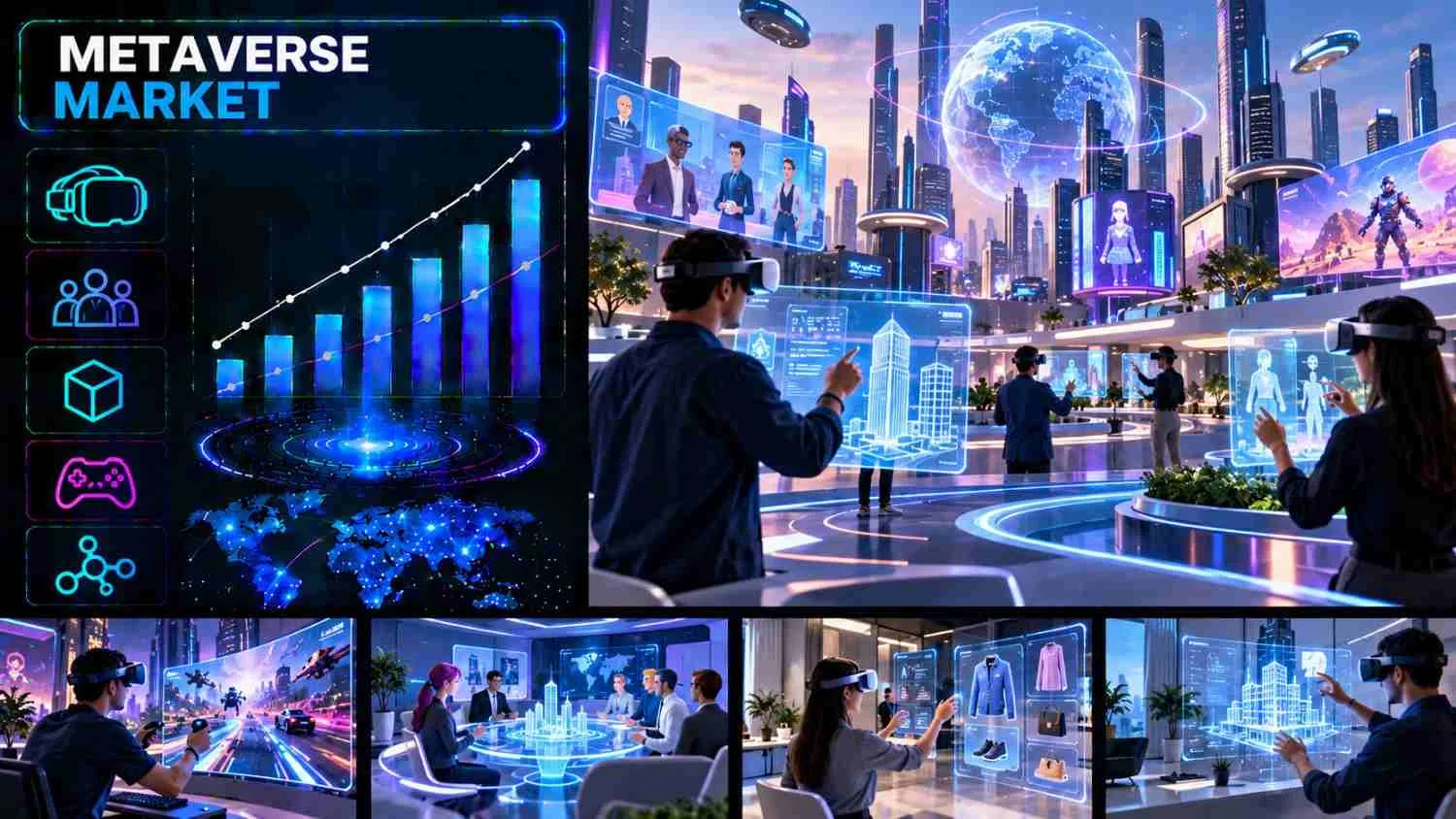
IMARC Group, a leading global market research and management consulting firm, has published its latest market intelligence report on the metaverse market. The global metaverse market size was valued at USD 180.8 Billion in 2025. Looking forward, IMARC Group estimates the market to reach USD 2,609.5 Billion by 2034, exhibiting a CAGR of 34.53% from 2026-2034, driven by advances in virtual reality, augmented reality, mixed reality, blockchain and cloud computing, rising demand for immersive experiences across gaming and social media, wider 5G and internet connectivity, and the growing adoption of virtual collaboration and digital asset ownership worldwide.
The metaverse market is experiencing strong growth momentum as immersive technologies move from experimental pilots into everyday commercial use. Consumers are spending more time in virtual worlds for gaming, socializing and shopping. Enterprises are using the same environments for remote collaboration, training, product design and customer engagement. Better connectivity, more capable headsets and scalable cloud infrastructure are making these experiences more accessible. Cross-sector partnerships between technology firms, financial institutions, manufacturers and urban planners are widening the range of real-world applications.
How AI is Reshaping the Future of the Metaverse Market
- AI-Powered Content Creation and Virtual World Generation: Generative AI tools are helping developers and creators build 3D environments, avatars, objects and interactive scenarios faster and at lower cost. This shortens development cycles for gaming studios, virtual event organizers and brands building immersive storefronts, and it lets smaller creators take part in a space once dominated by large studios.
- Intelligent Avatars and Personalized Immersive Experiences: AI-driven digital humans and conversational agents are making virtual environments more responsive and lifelike. They can guide shoppers through virtual stores, support customers in virtual banking lounges, and act as tutors in education and training settings. Real-time personalization based on user behavior raises engagement and session duration across platforms.
- AI-Enabled Moderation, Security and Digital Twin Optimization: Machine learning systems are being used to monitor user interactions, detect fraud and protect digital assets in persistent virtual worlds. Combined with digital twin simulations, AI also helps urban planners, manufacturers and enterprises test layouts, workflows and scenarios virtually before committing capital in the physical world.
Grab a sample PDF of this report: https://www.imarcgroup.com/metaverse-market/requestsample
Metaverse Market Trends and Drivers:
The global metaverse market is witnessing steady expansion, fueled by the convergence of immersive hardware, high-speed connectivity and new digital business models. Gaming remains the entry point for mainstream adoption, but demand now extends to retail, education, finance, events and industrial design. Improving network infrastructure is a foundational enabler. In the United States, there are about 216 million active 5G devices, which supports low-latency, high-fidelity virtual experiences. In the European Union, 94% of households have internet access, giving immersive platforms a broad base of connected users. In India, average monthly data consumption stands at 20.27 GB per user, which signals how quickly digital engagement is deepening in emerging markets. Saudi Arabia reports 49.89 million active cellular connections, which highlights the scale of mobile-first participation in the Middle East.
Remote work and virtual collaboration are reinforcing enterprise demand. Around 35% of US employees work remotely all the time, and organizations are exploring virtual offices, immersive meetings and simulation-based training to keep distributed teams productive. Virtual events are a related growth area. About 93.2% of surveyed respondents considered their virtual event a success, which gives organizers confidence to invest in hybrid and fully digital formats. These events cut travel costs, widen audience reach and open new sponsorship and ticketing revenue. They also link to sustainability goals by offering virtual alternatives to physical activities.
Digital asset ownership and wider digital transformation spending are opening further revenue streams. The global digital transformation market is valued at USD 809.1 Billion, and Brazil alone has invested USD 30.18 Billion in digital transformation. NFTs, virtual real estate and branded digital goods give creators and businesses ways to monetize virtual assets. At the same time, virtual storefronts and immersive retail experiences are changing how consumers discover and buy products, and applications in healthcare, real estate, education and urban planning are taking shape.
Ask an analyst for customized report: https://www.imarcgroup.com/request?type=report
Metaverse Industry Segmentation:
The report has segmented the market into the following categories:
Breakup By Component:
- Hardware
- Software
- Service
Hardware accounts for the largest component segment with about 41.0% of the market, driven by demand for VR headsets, AR glasses, haptic devices, sensors and high-performance computing equipment that make immersive experiences possible.
Breakup By Technology:
- Virtual and Augmented Reality
- Blockchain
- Mixed Reality
- Others
Virtual and augmented reality lead the technology segment with about 38.7% of the market, supported by falling device costs, richer content libraries and growing use across gaming, training, retail and healthcare.
Breakup By Application:
- Gaming
- Online Shopping
- Content Creation and Social Media
- Events and Conference
- Digital Marketing
- Testing and Inspection
- Others
Gaming is the leading application with about 28.5% of the market, as large, engaged player communities and persistent virtual worlds create fertile ground for virtual economies, in-game commerce and social interaction.
Breakup By Industry Vertical:
- BFSI
- Retail
- Media and Entertainment
- Education
- Aerospace and Defense
- Automotive
- Others
BFSI is a prominent industry vertical, as banks and financial institutions use virtual branches, lounges and customer engagement spaces to reach digitally native clients.
Breakup By Region:
- North America (United States, Canada)
- Asia Pacific
- Europe
- Latin America
- Middle East and Africa
North America dominates the global metaverse market with a share of over 43.8%, and the United States accounts for 86.70% of the regional market. This leadership is driven by a concentration of leading technology companies, strong venture investment, advanced 5G and cloud infrastructure, high consumer spending on gaming and entertainment, and early enterprise adoption of immersive collaboration tools.
Competitive Landscape:
The report provides a comprehensive analysis of the competitive landscape in the metaverse market with detailed profiles of all major companies, including:
- Alibaba Group Holding Limited
- Decentraland
- Electronic Arts Inc.
- Facebook Inc.
- Nextech AR Solutions Inc.
- Nvidia Corporation
- Roblox Corporation
- The Sandbox
- Unity Technologies
What Does The Full Report Cover?
If you are tracking the metaverse market for investment decisions, market entry planning, competitive benchmarking, or strategic advisory, IMARC Group’s report gives you everything in one place:
- Complete market sizing with revenue forecasts covering the full projection period
- Quantified growth driver analysis with impact scoring across component, technology, application, industry vertical and regional markets
- Sub-segment breakdowns for hardware, software, service, virtual and augmented reality, blockchain, mixed reality, gaming, online shopping, digital marketing and other applications, with individual share data
- Regional and country-level insights across North America, Asia Pacific, Europe, Latin America and the Middle East and Africa
- Competitive profiles of leading companies with strategic landscape assessment
- Porter’s Five Forces, value chain analysis, and pricing intelligence
- Latest innovation trends covering immersive hardware, blockchain-based digital ownership, mixed reality platforms and virtual collaboration tools shaping market competition and user adoption across key regional markets
Recent News and Developments in Metaverse Market
- December: E3S and BizzTech partnered on an Urban Metaverse for urban planning. The project shows how immersive digital twins can help city authorities visualize and test infrastructure decisions virtually.
- June: HSBC India unveiled a metaverse lounge for nonresident Indians. The lounge extends virtual banking services to a global customer base and reflects growing BFSI interest in immersive engagement.
- May: ZF introduced an Employer Branding Metaverse platform. The platform uses a virtual environment to showcase the company’s culture and attract talent.
- March: LG Electronics and Meta announced an XR partnership. The collaboration combines display and consumer electronics expertise with a leading immersive platform. In the same month, Cornerstone OnDemand acquired XR technology and staff from Talespin to strengthen immersive learning, and Verse World partnered with Azerion to expand its virtual world offering.
Note: If you require specific details, data, or insights that are not currently included in the scope of this report, we are happy to accommodate your request. As part of our customization service, we will gather and provide the additional information you need, tailored to your specific requirements. Please let us know your exact needs, and we will ensure the report is updated accordingly to meet your expectations.
Key Questions This Report Answers
- What is the current global metaverse market size and what is its projected value?
- Which component segment holds the largest share in the global metaverse market?
- What are the key drivers of global metaverse market growth?
- Which region dominates the global metaverse market and why?
- How are virtual and augmented reality, blockchain, mixed reality and AI reshaping product development and competitive strategies in the metaverse industry?
- Who are the top companies in the global metaverse market and what are their competitive strategies?
- What are the investment and market entry opportunities across gaming, online shopping, events, digital marketing and industry-specific metaverse applications?
About Us:
IMARC Group is a global management consulting firm that helps the world’s most ambitious changemakers to create a lasting impact. The company provides a comprehensive suite of market entry and expansion services. IMARC offerings include thorough market assessment, feasibility studies, company incorporation assistance, factory setup support, regulatory approvals and licensing navigation, branding, marketing and sales strategies, competitive landscape and benchmarking analyses, pricing and cost research, and procurement research.
Media and Sales Contact
IMARC Group
Email: [email protected]
United States: +1-201-971-6302
India: +91-120-433-0800
United Kingdom: +44-753-714-6104