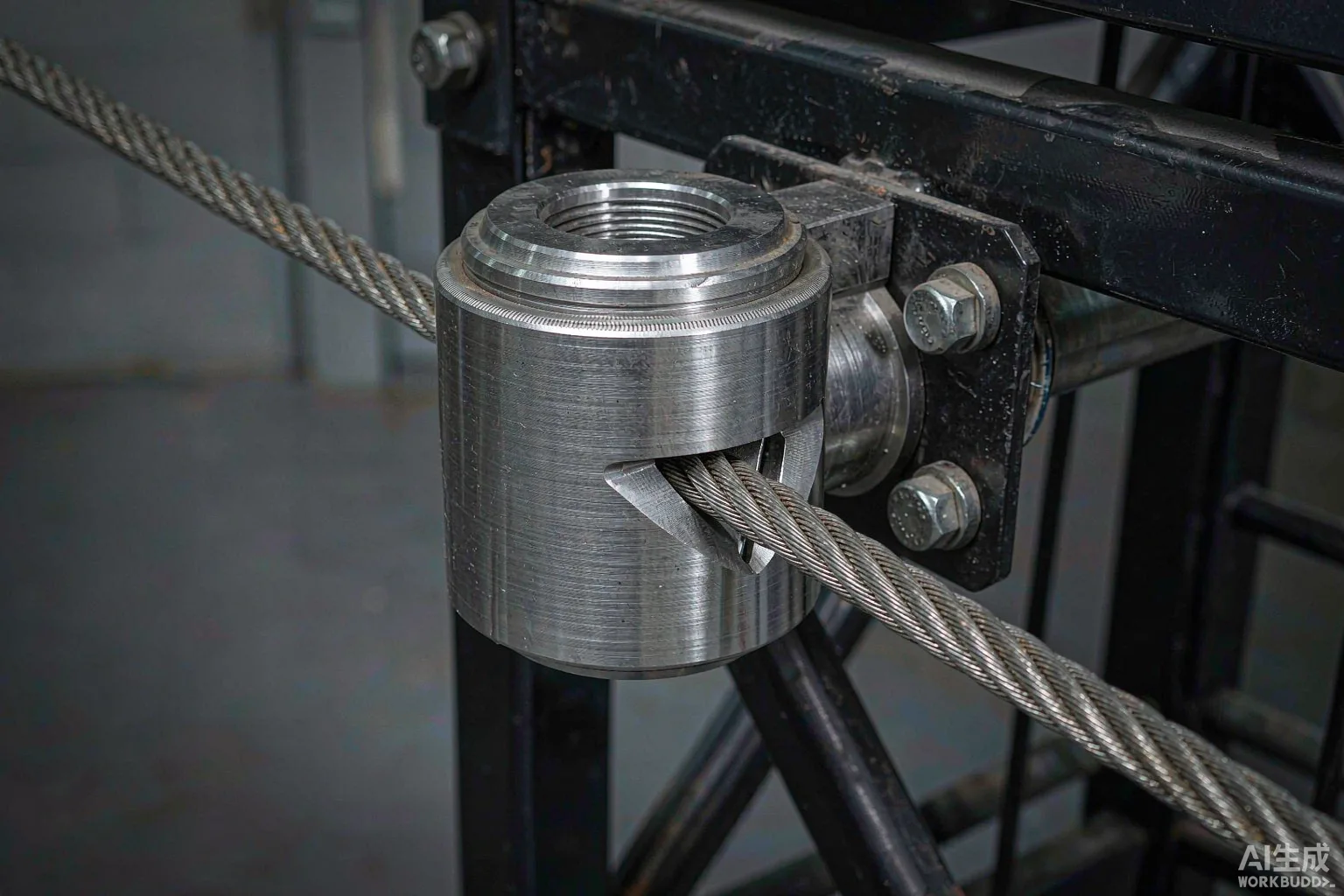
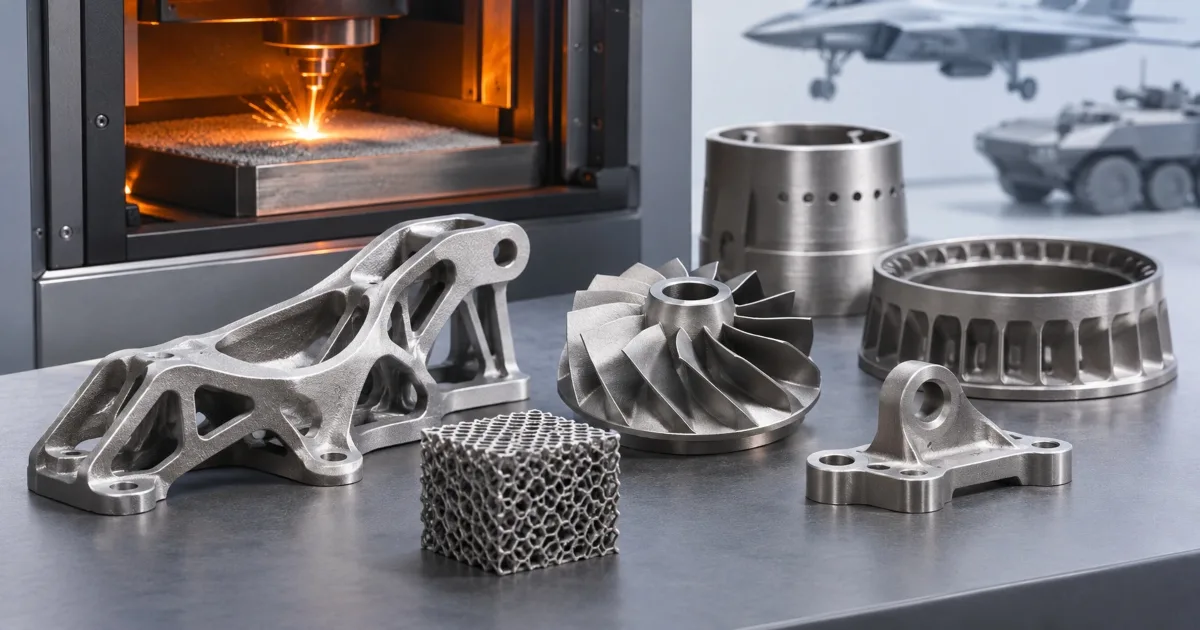
Aerospace and defence programs run on long qualification cycles, strict traceability and parts that often need to be supported for decades after a platform enters service. That combination makes metal 3D printing a genuinely useful tool for an Australian prime or Tier 1-3 supplier, not because it's a novelty, but because it solves specific problems: parts that are hard to source, geometry that traditional machining can't reach economically, and a growing reluctance to depend on an overseas supply chain for components that could be made onshore instead.
Quick answer: DMLS (Direct Metal Laser Sintering) and SLM (Selective Laser Melting) are laser-based metal powder bed processes capable of producing metal 3D printed parts in titanium, stainless steel, Inconel and aluminium. Turnaround generally runs 5 to 7 business days plus finishing, with cost ranging from around A$300 for a simple part to well over A$10,000 for large or complex components. For defence and aerospace buyers, the deciding factor is usually less about unit cost and more about qualification, traceability and whether a part can be reliably reproduced to the same standard every time it's ordered.
What DMLS and SLM Actually Are
Both DMLS and SLM build metal parts by fusing successive layers of fine metal powder with a laser, inside an inert, oxygen-controlled chamber, the same category of process behind Zeal's own metal 3D printing service. The terms are often used interchangeably, but there is a technical distinction: DMLS, as originally developed, partially sinters the powder particles together, while SLM fully melts them into a continuous metallurgical bond. In practice, most modern industrial machines operate closer to true melting regardless of which term the vendor uses, so the practical difference between a DMLS-labelled and an SLM-labelled part from a reputable provider is usually small. What matters more for an aerospace or defence buyer is the material, the machine's process control, and the post-processing that follows, not the acronym on the spec sheet.
Why Aerospace and Defence Programs Are Turning to Metal 3D Printing
Three things make metal additive manufacturing a fit for this sector specifically. First, weight reduction: lattice structures and topology-optimised geometry can cut mass from a bracket or housing in ways a machined part can't match, which matters directly on anything that flies. Second, part consolidation: several machined and fastened components can often be redesigned as a single printed part, reducing assembly time, failure points and inventory. Third, and increasingly the most relevant consideration for defence specifically, is sparing support for legacy platforms: when the original manufacturer of a decades-old aircraft or vehicle component no longer exists or no longer stocks the part, a 3D printing solution Australia-wide can reproduce it from a scan or an engineering drawing without waiting on an obsolete supply chain. That sovereign-manufacturing angle is part of a broader shift CSIRO's Lab22 innovation centre has pointed to, describing metallic additive manufacturing as "the fastest growing manufacturing technology globally," with the local market projected to be worth $10 billion by 2030. Zeal's own aerospace and defence service page covers this sparing and prototyping work in more detail.
Material and Qualification Considerations
Titanium, stainless steel, Inconel and aluminium cover most aerospace and defence applications: titanium for strength-to-weight-critical structural parts, Inconel for high-temperature components, stainless steel and aluminium for a broader range of brackets, housings and tooling. Feedstock cost is one area of active local research. CSIRO has developed a low-cost titanium wire for additive manufacturing made from titanium scrap, which its researchers describe as significantly less expensive than conventionally produced titanium feedstock, though no exact figure has been published; it's a genuine reason to expect the cost gap for titanium to narrow over time rather than assume today's pricing holds indefinitely.
Qualification matters more in this sector than almost any other application of metal 3D printing. As the additive manufacturing industry matures, Standards Australia has pointed to standardisation around terminology, quality control and process consistency (formalised in frameworks like AS ISO/ASTM 52900) as an increasingly important differentiator between providers. For a prime or subcontractor, that means asking a provider for material certificates, process documentation and repeatability evidence before a part is specified onto a program, not after.
Cost and Turnaround for Metal Components
As a national guide, metal 3D printed parts typically start from around A$300 for a simple component and can climb well past A$10,000 for large, complex or heavily post-processed parts. Turnaround generally runs 5 to 7 business days, plus any additional finishing such as heat treatment, stress relief or wire cutting to separate the part from the build plate. Full technology-by-technology ranges are in Zeal's 3D printing cost guide. Because there's no tooling investment, a single replacement part for an out-of-production platform is quoted through the same transparent process as a small production batch, which matters for defence sparing specifically, where order quantities are often one or a handful rather than hundreds.
What to Look for in a Metal 3D Printing Solution
Not every provider that lists metal printing on a capabilities page runs it at the depth a defence or aerospace program needs. Worth confirming before specifying a supplier onto a program:
- Whether metal processes run in-house rather than being brokered to a third party.
- What post-processing (heat treatment, stress relief, wire cutting) is handled on site.
- What material certification and traceability documentation comes with each part.
- Whether there's a genuine no-minimum-order policy for low-volume sparing work.
- Whether the same provider also runs plastic processes in-house, useful when a program needs metal end-use parts and plastic jigs, fixtures or prototypes from a single supplier. Zeal's materials range spans both.
Frequently Asked Questions
Q1. What's the difference between DMLS and SLM?
DMLS was originally a partial-sintering process and SLM a full-melting one, but most modern industrial machines operate close to full melting regardless of the label. For most buyers, the material, process control and post-processing offered by a provider matter more than which term is used.
Q2. How much does metal 3D printing cost for an aerospace or defence component?
As a national guide, simple metal parts typically start from around A$300, climbing well past A$10,000 for large, complex or heavily finished components. Qualification and documentation requirements, not just geometry, often drive the final cost for defence and aerospace work.
Q3. Can metal 3D printing support obsolete or legacy aircraft and defence parts?
Yes. Because there's no tooling or mould required, a single replacement part can be reproduced from a scan or drawing without the setup cost or minimum order quantity a traditional manufacturing process would demand, making it well suited to sparing for platforms whose original suppliers no longer exist.
Q4. How long does metal 3D printing take in Australia?
Turnaround is generally 5 to 7 business days, plus any additional post-processing such as heat treatment or stress relief, before delivery.
The Bottom Line
For Australian primes and their suppliers, metal 3D printing has moved past being an experimental alternative to machining and into a genuine sparing, prototyping and part-consolidation tool, provided it's sourced from a provider that treats qualification and traceability as seriously as the program itself does. Cost and turnaround are usually the easy part of the conversation; the harder, more important one is whether a supplier can prove a part will perform the same way every time it's ordered.
This article was contributed by the team at Zeal 3D, an Australia-based 3D printing service running metal 3D printing (DMLS/SLM) alongside five plastic processes in-house, with 45+ materials and no minimum order quantity, serving aerospace, defence and industrial customers nationally.