
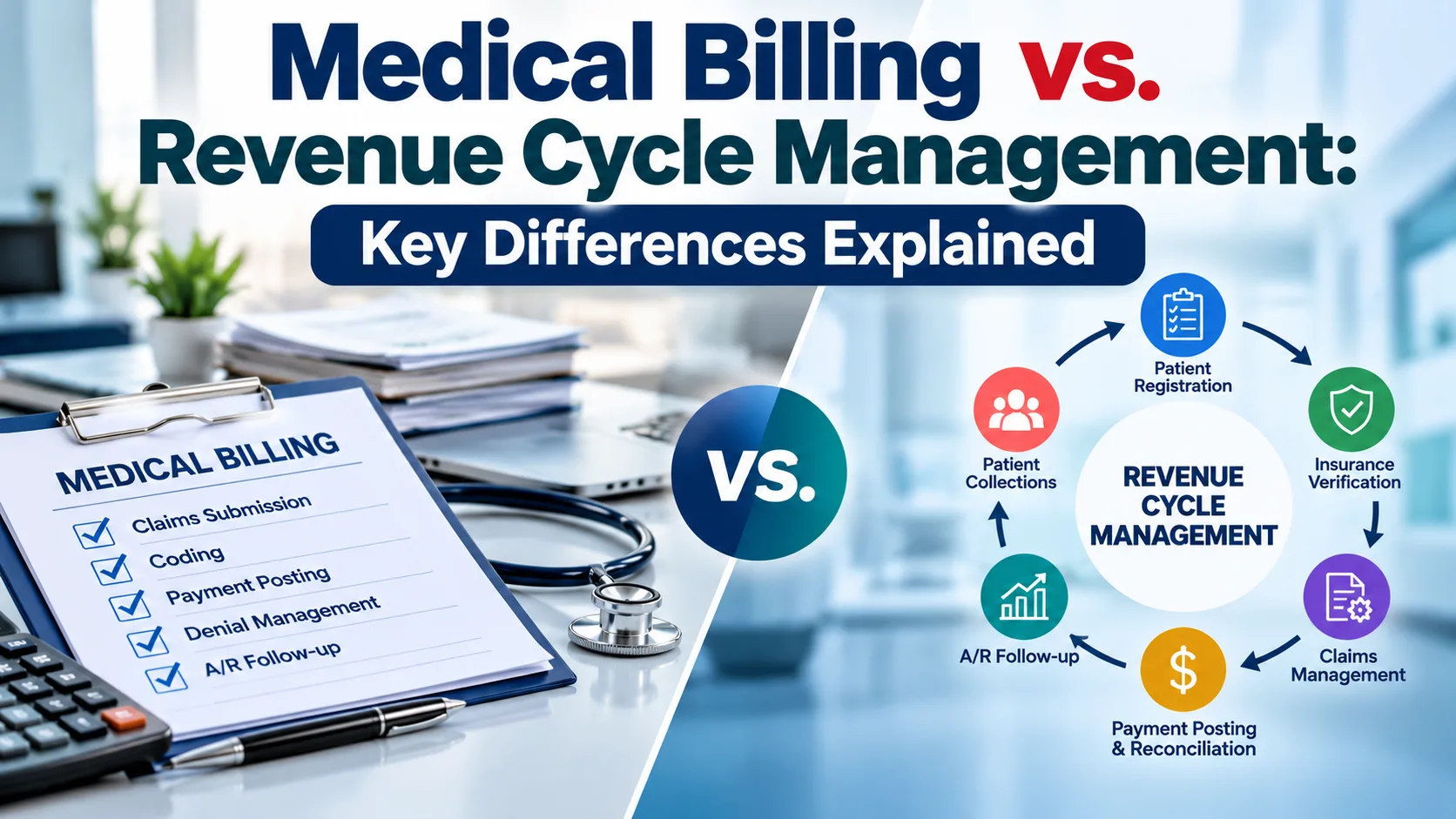
Medical Billing vs. Revenue Cycle Management: Key Differences Explained
Healthcare practices depend on accurate billing and efficient financial operations to receive payment for the services they provide. However, managing healthcare revenue involves much more than preparing insurance claims and waiting for reimbursements. Patient registration, insurance verification, medical coding, claim submission, denial management, payment posting, and accounts receivable follow-up all contribute to a practice's financial performance.
Two terms frequently used in healthcare administration are medical billing and revenue cycle management (RCM). Although they are closely connected, they do not mean exactly the same thing. Medical billing is one important part of the revenue cycle, while RCM covers a broader range of financial and administrative activities from the patient's first interaction with a practice through final payment.
Understanding the difference can help physicians, clinics, hospitals, and independent healthcare providers choose the right operational support. Some practices may need help with claim submission and payment follow-up, while others require a complete system that manages the financial process from appointment scheduling to final account resolution.
This guide explains medical billing vs. revenue cycle management, their key differences, how they work together, and when healthcare providers should consider outsourcing each service.
What Is Medical Billing?
Medical billing services is the process of preparing, submitting, tracking, and managing healthcare claims to obtain payment from insurance companies and patients. It translates documented medical services into claims that payers can review and process.
When a physician treats a patient, the services provided must be documented, coded, and converted into billing information. The billing team uses this information to prepare claims, submit them to the appropriate insurance payer, monitor responses, post payments, and follow up on outstanding balances.
The primary objective is to help healthcare providers receive appropriate reimbursement for the services they have delivered.
Key Activities Included in Medical Billing
Medical billing typically involves several connected tasks.
1. Charge Entry
Charge entry involves recording the services and procedures provided during a patient encounter. The billing team uses information from clinical documentation and coding records to prepare charges for claim submission.
Accurate charge entry helps ensure that billable services are captured and represented correctly.
2. Medical Coding Coordination
Medical coding converts diagnoses, procedures, and other documented healthcare services into standardized codes.
Common code sets include:
- ICD-10-CM for diagnoses
- CPT for procedures and services
- HCPCS Level II for certain supplies, services, and other items
Coding must be supported by the medical record and follow applicable coding guidelines. Depending on the practice and vendor agreement, coding may be performed by a dedicated coding team or coordinated with the billing department.
3. Claim Preparation and Submission
Once the required information is available, the billing team prepares the insurance claim.
Before submission, claims may be checked for missing information, incorrect codes, modifier issues, and payer-specific requirements. Claims are then transmitted electronically through the appropriate submission channel.
4. Payment Posting
After an insurance company processes a claim, payment information and adjustments are recorded in the practice management system.
Payment posting helps providers understand what was reimbursed, what was adjusted, and what balance remains outstanding.
5. Denial and Rejection Follow-Up
Claims may be rejected or denied for several reasons, including incorrect information, missing documentation, coding issues, eligibility problems, or authorization requirements.
The billing team reviews the issue, determines whether a correction or appeal is appropriate, and follows up with the payer.
6. Accounts Receivable Management
Accounts receivable (A/R) refers to payments that remain outstanding.
A/R follow-up involves reviewing unpaid claims, checking payer status, investigating delays, and taking appropriate action to resolve outstanding balances.
7. Patient Billing
After insurance processing, some balances may become the patient's responsibility. Billing teams may prepare statements, update account balances, and support patient payment follow-up according to the practice's policies.
In short, medical billing focuses on turning documented healthcare services into claims, managing payer responses, and helping practices collect the payments they are owed.
What Is Revenue Cycle Management?
Revenue cycle management is a broader process that manages the financial journey of a patient's healthcare encounter. It begins before the patient receives care and continues through claim processing, insurance reimbursement, patient payments, and final account resolution.
RCM connects different departments and administrative activities to help ensure that financial information is accurate throughout the patient journey.
Unlike a billing-only process, revenue cycle management also addresses issues that can occur before a claim is created. For example, an inactive insurance policy, missing authorization, or incorrect patient information may cause a claim problem later. An effective RCM workflow aims to identify these issues earlier.
Main Stages of Revenue Cycle Management
Revenue cycle management is commonly organized into three stages: front-end, middle, and back-end processes.
1. Front-End Revenue Cycle Activities
The front end begins when a patient contacts the healthcare practice and continues through registration and financial clearance.
Common activities include:
- Appointment scheduling
- Patient registration
- Demographic information collection
- Insurance eligibility verification
- Benefits verification
- Copayment and deductible review
- Referral coordination
- Prior authorization support
- Patient financial communication
These activities help practices identify potential billing problems before services are delivered.
For example, if a patient's insurance coverage is inactive, the practice can investigate the issue before the appointment rather than discovering it after a claim has been denied.
2. Middle Revenue Cycle Activities
The middle stage connects clinical services with financial documentation.
It generally includes:
- Patient encounter documentation
- Clinical documentation review
- Charge capture
- Medical coding
- Documentation queries when appropriate
- Charge reconciliation
Accurate documentation is essential because the information recorded by the provider supports coding and billing.
If services are not documented correctly or charges are missed, the practice may experience claim delays, inaccurate reimbursement, or compliance concerns.
3. Back-End Revenue Cycle Activities
The back end focuses on claim processing, reimbursement, and outstanding balances.
Activities may include:
- Claim preparation and submission
- Claim status monitoring
- Payment posting
- Denial management
- Appeals and corrected claims
- Accounts receivable follow-up
- Patient statements
- Payment reconciliation
- Financial reporting
Medical billing plays a major role in this stage, but RCM also connects back-end results to earlier processes.
For example, if multiple claims are denied because of missing authorization, the RCM team can investigate the front-end workflow and recommend changes to prevent similar problems.
Medical Billing vs. Revenue Cycle Management: Key Differences
The biggest difference between medical billing and RCM is the scope of responsibility.
Medical billing focuses on claims and payments, while revenue cycle management covers the complete financial process associated with patient care.
The following comparison explains how the two functions differ.
Comparison factorMedical BillingRevenue Cycle ManagementScopeFocuses mainly on claims and reimbursement activitiesCovers the full financial journey of a patient encounterStarting pointOften begins with charge capture and billing preparationBegins with scheduling and patient registrationEligibility verificationMay be included depending on the agreementCommonly included in front-end operationsPrior authorizationMay be handled as an additional serviceOften included in broader RCM workflowsMedical codingSupports claim preparation and accuracyConnects clinical documentation with billingClaim submissionCore responsibilityOne component of the complete processPayment postingCommon billing responsibilityIncluded in back-end revenue operationsDenial managementReviews and follows up on denied claimsAlso analyzes root causes to prevent recurring problemsA/R follow-upTracks and works outstanding claimsConnects A/R results with broader financial performanceReportingOften focuses on claims, payments, and outstanding balancesCan include operational and financial performance across the cycleMain objectiveManage claim processing and payment collectionImprove the efficiency and performance of the complete revenue cycleThe Difference in Simple Terms
Think of medical billing as one department responsible for helping a practice get paid for services already provided.
RCM looks at the entire process that makes payment possible.
For example, a billing team may identify that an insurance company denied a claim because authorization information was missing. The team can review the claim and take the appropriate next step.
An RCM approach also asks why the authorization was missing. Was it not checked during scheduling? Was the request submitted too late? Was the authorization information not entered correctly?
By addressing the underlying workflow, the practice may prevent similar problems in future encounters.
How Medical Billing and RCM Work Together
Medical billing and revenue cycle management should not be viewed as competing services. Medical billing is an essential part of the broader revenue cycle.
A practice cannot manage its financial operations effectively if claims are not prepared and submitted accurately. At the same time, accurate claims alone cannot solve every financial problem.
Consider a typical patient visit.
A patient schedules an appointment with a specialist. The front desk collects insurance information and checks coverage. If authorization is required, the practice coordinates the approval process. The patient receives care, and the provider documents the services performed.
The coding team reviews the documentation, and the billing team prepares and submits the claim. The payer processes the claim and sends payment information. The billing team posts the payment and follows up on any remaining balance.
Each activity contributes to the final financial outcome.
If the patient information was incorrect at registration, the claim may be rejected. If authorization was not obtained, the payer may deny the service. If coding does not match the documentation, the claim may require correction.
This is why billing and RCM need to work together.
An organized revenue cycle connects front-office staff, clinical teams, coding professionals, billing specialists, and financial managers. It helps the practice understand where problems occur and how different departments can prevent them.
Why Medical Billing Alone May Not Be Enough for Some Practices
Medical billing support can be valuable, but some practices need help beyond claim submission and payment posting.
A practice may submit claims on time and still experience financial problems because the underlying issues occur earlier in the patient journey.
Here are some situations where a broader RCM approach may be useful.
1. Frequent Eligibility-Related Denials
If claims are repeatedly denied because of inactive coverage or incorrect insurance information, the issue may begin during registration.
A broader RCM workflow can include eligibility verification before appointments and establish a process for resolving coverage discrepancies.
2. Missing Prior Authorizations
Certain services may require prior authorization from the payer.
When authorization requirements are not identified early, claims may be delayed or denied. RCM support can help coordinate authorization workflows and improve communication between scheduling and clinical teams.
3. Incomplete Patient Registration
Incorrect names, member IDs, dates of birth, or subscriber information can create problems during claim processing.
An RCM approach emphasizes accurate patient information collection and verification before services are delivered.
4. Repeated Claim Denials
When the same denial reasons appear regularly, correcting individual claims may not solve the underlying problem.
RCM teams can review denial trends and identify whether issues are related to documentation, coding, eligibility, authorization, or internal processes.
5. Limited Financial Reporting
Some practices focus mainly on the number of claims submitted and payments received.
However, management may also need information about denial patterns, A/R aging, reimbursement trends, and collection performance.
A broader RCM approach can provide a more complete view of financial operations.
Benefits of Medical Billing Services for Healthcare Providers
Professional medical billing support can help practices manage claim-related responsibilities and maintain a consistent reimbursement workflow.
Improved Claim Preparation
A structured billing process includes reviewing claim information before submission. This may help identify missing details, coding inconsistencies, and common errors.
Accurate claim preparation can reduce avoidable rework.
Consistent Payer Follow-Up
Insurance claims require ongoing monitoring. Without regular follow-up, unpaid claims may remain unresolved for extended periods.
A dedicated billing team can establish routines for reviewing claim status and addressing outstanding issues.
Better Payment Posting
Accurate payment posting helps practices maintain reliable financial records.
It also makes it easier to identify discrepancies between expected and received payments.
Reduced Administrative Pressure
Billing involves detailed administrative work that can take time away from other practice responsibilities.
External billing support may help reduce the workload placed on in-house employees.
Improved Visibility Into Outstanding Claims
A/R reports and claim status updates help providers understand which balances remain unpaid and where additional follow-up may be required.
Flexible Operational Support
Depending on the agreement, practices may outsource selected billing tasks or a larger portion of their revenue cycle.
This flexibility can be useful for practices with changing patient volumes or staffing needs.
Benefits of Revenue Cycle Management Services
RCM focuses on improving the complete financial workflow rather than addressing only individual claims.
1. Better Coordination Across Departments
The revenue cycle involves several teams. Scheduling, registration, clinical documentation, coding, billing, and financial operations all affect reimbursement.
An organized RCM process helps these departments work with consistent information and defined responsibilities.
2. Earlier Identification of Problems
Some billing problems begin before a patient receives care.
Eligibility verification, authorization checks, and accurate registration can help identify issues before they affect claim submission.
3. More Effective Denial Prevention
Denial management is not limited to correcting unpaid claims.
A broader approach examines recurring denial reasons and looks for changes that may prevent similar errors in the future.
4. Improved Financial Monitoring
RCM reporting can help management evaluate the performance of different revenue cycle stages.
For example, a practice may identify that claim submission is timely but payment delays are increasing. This information can help direct attention toward payer follow-up and A/R management.
5. Support for Long-Term Operational Improvements
RCM connects financial results with everyday administrative processes.
Instead of treating each problem separately, practices can review workflows and make improvements that support more consistent operations.
Medical Billing vs. RCM: Which Service Does Your Practice Need?
The right option depends on where your practice experiences the greatest challenges.
Some healthcare providers have efficient registration and authorization workflows but struggle with claim submission and payment follow-up. Others experience problems throughout the entire patient financial journey.
When Medical Billing Support May Be Enough
A billing-focused arrangement may be suitable when:
- Patient registration is already well managed.
- Insurance verification is handled internally.
- Authorization workflows are established.
- The main challenge is claim preparation and submission.
- Payment posting and A/R follow-up need additional support.
- The practice wants to outsource selected billing tasks.
For example, a small physician practice may have an experienced front-office team but lack sufficient staff to manage claims and payer follow-up. In this situation, billing support may address the main operational gap.
When Full RCM Support May Be More Appropriate
A broader RCM arrangement may be worth considering when:
- Eligibility problems regularly affect claims.
- Authorization issues create payment delays.
- Registration errors occur frequently.
- Denials repeat for the same reasons.
- Billing and front-office teams lack coordination.
- Management needs broader financial reporting.
- The practice wants support across multiple revenue cycle stages.
For example, a multi-provider clinic may struggle with registration, authorization, coding, claim submission, and A/R management. A coordinated RCM arrangement may help address these connected challenges.
Can a Practice Use Both?
Yes. Many providers use billing and RCM services together because billing is part of the revenue cycle.
A vendor may offer claim submission, coding coordination, payment posting, denial management, eligibility verification, and other administrative services under one agreement.
The important point is to understand exactly what the vendor will manage. The terms used in a proposal do not automatically define the actual service scope.
In-House vs. Outsourced Medical Billing and RCM
Healthcare providers can manage billing and RCM internally, outsource selected activities, or work with an external partner for broader support.
Each approach has advantages and limitations.
FactorIn-House ManagementOutsourced SupportStaffingPractice hires and manages employeesVendor supplies assigned personnelDaily supervisionDirect internal managementRequires vendor coordinationTrainingPractice manages staff developmentVendor manages its team's trainingTechnologyPractice maintains its systemsVendor may use its own or integrated toolsFlexibilityDepends on available internal staffDepends on contract and vendor capacityService scopeDetermined by internal resourcesDefined by the service agreementCostSalaries, benefits, software, and overheadContract-based service feesReportingDepends on internal reporting capabilitiesDepends on vendor reporting and KPIsOutsourcing does not automatically guarantee better results. Practices should evaluate the vendor's experience, service scope, communication, technology, security practices, and performance reporting before making a decision.
What Should You Look for in Medical Billing and RCM Companies?
Choosing a vendor is an important decision because the company may handle financial information, communicate with insurance payers, and access protected health information.
When comparing medical billing companies, review more than pricing and marketing claims.
1. Relevant Specialty Experience
Ask whether the vendor has experience with your specialty.
Primary care, cardiology, orthopedics, behavioral health, dermatology, and gastroenterology may involve different coding, documentation, and payer requirements.
A vendor familiar with your practice type may be better positioned to understand its billing workflow.
2. Clearly Defined Services
Confirm which activities are included in the agreement.
Ask whether the vendor handles:
- Charge entry
- Medical coding
- Claim scrubbing
- Claim submission
- Payment posting
- Denial management
- Appeals
- A/R follow-up
- Eligibility verification
- Prior authorization
- Patient billing
- Financial reporting
Do not assume that every service is included simply because a company describes itself as a full-service provider.
3. Transparent Pricing
Ask how fees are calculated and which activities may create additional charges.
Common pricing structures include percentage-of-collections fees, per-claim charges, fixed monthly fees, and hybrid arrangements.
Compare the complete cost of the service rather than choosing the lowest advertised rate.
4. Reporting and Performance Metrics
Ask for sample reports and confirm how frequently they are provided.
Useful metrics may include:
- First-pass claim acceptance rate
- Clean claim rate
- Denial rate
- Days in A/R
- A/R aging
- Net collection rate
- Payment posting turnaround
- Denial resolution time
Make sure the vendor explains how each metric is defined and calculated.
5. Technology and EHR Compatibility
The vendor should understand the practice's EHR and practice management systems.
Discuss integration, data access, user permissions, reporting, and how information will be transferred securely.
6. HIPAA and Data Security
If a vendor handles protected health information on behalf of a covered entity, it may qualify as a business associate under HIPAA.
Practices should review the vendor's security safeguards, access controls, incident response procedures, and business associate agreement.
For guidance, healthcare organizations can review the U.S. Department of Health and Human Services resources on HIPAA business associates and the HIPAA Security Rule.
7. Communication and Accountability
Ask who will manage your account, how often you will receive updates, and how urgent issues will be escalated.
A good working relationship requires clear responsibilities and consistent communication.
Understanding the Role of Revenue Cycle Management Companies
Revenue cycle management companies provide support across multiple stages of the healthcare financial process.
Depending on the vendor, services may include front-end administrative support, coding coordination, claim submission, denial management, payment posting, A/R follow-up, and financial reporting.
However, service scope varies. Some providers specialize in particular stages of the revenue cycle, while others offer broader operational support.
When evaluating revenue cycle management companies, healthcare providers should determine whether the vendor can address the problems they actually experience.
For example, a practice with frequent authorization-related denials needs more than a company that only submits claims. It needs a process for identifying authorization requirements and coordinating the necessary steps before services are performed.
Similarly, a practice with growing A/R balances may need more consistent payer follow-up, denial analysis, and reporting.
The best arrangement is one that connects the vendor's responsibilities with the practice's operational needs.
What to Consider When Outsourcing Revenue Cycle Management
Outsourcing revenue cycle management can help practices access external billing and administrative support. However, the transition should be planned carefully.
Review Your Current Workflow
Before selecting a vendor, identify where delays and errors occur.
Review registration, eligibility verification, authorization, coding, claim submission, payment posting, denials, and A/R.
Define the Required Service Scope
Decide which tasks should remain in-house and which should be outsourced.
Some practices outsource the complete revenue cycle, while others use external support for coding, claims, denial management, or A/R follow-up.
Establish Clear Responsibilities
Document which team handles patient information, missing documentation, payer communication, claim corrections, and patient balance questions.
Clear responsibilities help prevent tasks from being overlooked.
Plan Data Access and System Integration
Discuss how the vendor will access the necessary systems and information.
Confirm user permissions, data transfer procedures, reporting access, and security requirements.
Set Reporting Expectations
Agree on which metrics will be monitored and how often reports will be delivered.
Regular reviews help both parties identify problems and assess progress.
Monitor the Transition
During onboarding, review claim activity, payment posting, outstanding balances, and communication processes.
A planned transition helps the practice identify workflow gaps before they become larger operational problems.
How to Evaluate the Performance of a Billing or RCM Partner
Whether you choose billing-only support or a broader RCM arrangement, performance should be evaluated using clearly defined metrics.
MetricWhat It MeasuresWhy It MattersFirst-pass acceptance rateClaims accepted on initial submissionHelps evaluate initial claim qualityClean claim rateClaims meeting the agreed clean-claim definitionHelps identify submission errorsDenial rateClaims denied by payersHelps monitor payment problemsDays in A/RAverage time outstanding receivables remain unpaidHelps assess collection speedA/R agingDistribution of unpaid balances by ageHighlights older outstanding claimsNet collection rateCollections compared with expected collectible reimbursementHelps assess collection performanceCharge lagTime between service delivery and charge entryHelps identify delays in the billing workflowPayment posting turnaroundTime between payment receipt and postingHelps assess financial record updatesThese metrics should be interpreted together rather than in isolation. For example, a strong first-pass acceptance rate does not necessarily mean that all claims are paid promptly. A practice should also review denial patterns, payer response times, A/R aging, and collection results.
How Stream RCM Supports Medical Billing and Revenue Cycle Management
Stream RCM provides medical billing and revenue cycle support designed to help healthcare providers manage administrative and financial responsibilities.
Its services cover several important stages of the reimbursement process, allowing practices to explore support based on their specific needs.
Medical Billing Services
Stream RCM supports billing workflows that include claim preparation, submission, payment posting, and follow-up activities.
Explore medical billing services to learn more about its billing support.
Medical Coding Services
Accurate coding helps connect clinical documentation with the information required for claim processing.
Stream RCM offers medical coding services to support coding-related billing requirements.
Medical Claim Submission Services
Claims need to be prepared and submitted according to applicable payer requirements and filing deadlines.
Learn more about Stream RCM's medical claim submission services.
Denial Management Services
Denied claims require review, correction, and follow-up. Stream RCM provides denial management services to help practices address these issues.
Insurance Eligibility Verification
Insurance verification helps practices identify coverage and benefit information before services are provided.
Explore insurance eligibility verification services.
Prior Authorization Services
When a payer requires approval before a service, authorization coordination becomes an important part of the administrative workflow.
Learn more about prior authorization services.
Revenue Cycle Management Services
For practices seeking broader support across the financial process, Stream RCM also offers revenue cycle management services.
The right service arrangement depends on your practice's specialty, patient volume, existing staff, and operational challenges. Providers should discuss their requirements with Stream RCM and confirm the exact services, responsibilities, pricing, and reporting arrangements before beginning.
Frequently Asked Questions
1. What is the main difference between medical billing and revenue cycle management?
Medical billing focuses on claim preparation, submission, payment posting, and follow-up. Revenue cycle management covers the broader financial process, including scheduling, registration, insurance verification, authorization, coding, billing, collections, and reporting.
2. Is medical billing part of revenue cycle management?
Yes. Medical billing is an important component of RCM. It primarily supports the claim and payment stages, while RCM connects billing with the other administrative and financial activities involved in receiving payment for healthcare services.
3. Do small medical practices need revenue cycle management?
Small practices may benefit from RCM when they experience recurring eligibility problems, authorization delays, denials, or growing A/R balances. The level of support should depend on the practice's needs, budget, and existing administrative capabilities.
4. What services are included in revenue cycle management?
Services may include patient registration, insurance eligibility verification, prior authorization, charge capture, medical coding, claim submission, payment posting, denial management, A/R follow-up, patient billing, and financial reporting. The exact scope varies by provider.
5. Can a medical billing company also provide RCM services?
Yes. Many vendors offer both billing and broader RCM support. However, practices should review the service agreement to confirm which front-end, middle, and back-end activities are actually included.
6. Is outsourcing revenue cycle management better than managing it in-house?
It depends on the practice. Outsourcing may provide access to specialized staff and additional operational support, while in-house management offers direct supervision. Practices should compare total costs, service quality, communication, technology, and internal staffing needs.
7. How do I choose between a billing company and an RCM company?
Identify where your financial workflow needs the most support. If your main challenges involve claims and payment follow-up, billing support may be sufficient. If problems also occur during registration, eligibility verification, authorization, and reporting, broader RCM support may be more appropriate.
8. What is the relationship between medical coding and billing?
Medical coding converts documented diagnoses and procedures into standardized codes. Billing uses relevant coding and patient information to prepare and submit claims to payers and manage reimbursement.
9. What KPIs should I monitor when outsourcing billing or RCM?
Common metrics include first-pass acceptance rate, clean claim rate, denial rate, days in A/R, A/R aging, net collection rate, charge lag, and payment posting turnaround. Providers should agree on consistent definitions and reporting schedules.
10. Does RCM include patient billing?
Yes. Patient billing and the management of outstanding patient balances can be included in a broader RCM arrangement. The exact responsibilities depend on the vendor agreement and the practice's policies.
Final Thoughts
Medical billing and revenue cycle management are closely related, but they serve different purposes. Medical billing focuses on preparing claims, managing payer responses, posting payments, and following up on outstanding balances. RCM covers the complete financial journey, beginning with patient scheduling and registration and continuing through final payment and account resolution.
For healthcare providers, understanding this difference makes it easier to select the right operational support. A practice with an established front office may only need help with claim submission and A/R follow-up. A practice experiencing problems across registration, eligibility, authorization, coding, billing, and collections may benefit from a broader RCM approach.
Stream RCM offers medical billing, coding, claim submission, denial management, eligibility verification, prior authorization, and revenue cycle management support.
If you want to improve your billing workflow or explore broader financial operations support, visit Stream RCM to learn more and discuss your practice's requirements.