
Medical Billing Services in Arizona vs Maine: How State Payer Rules Change Your Revenue Cycle
A claim that sails through in one state can stall in another, even when the care, the codes, and the clinic look identical. Medicaid design, Medicare Advantage penetration, patient demographics, and local payer habits all shape how quickly and how fully a practice gets paid. Arizona and Maine make a useful comparison because they sit at opposite ends of the map in almost every way. One is a fast-growing, metro-heavy Sun Belt state with managed Medicaid. The other is a rural, older, state-run Medicaid market with one of the heaviest Medicare Advantage shares in the country. This guide explains how those differences affect your revenue cycle and what your billing process should do about them, whether you rely on medical billing services in Arizona, medical billing services in Maine, or both.
Why State Rules Matter More Than Most Practices Realize
Most billing playbooks are written as if payers behave the same everywhere. They don't. Each state sets its own Medicaid rules, each Medicare Administrative Contractor publishes its own local coverage policies, and each market has its own mix of commercial carriers. A front office that works well in one setting can lose revenue quickly when the payer mix changes. The areas where state differences hit hardest are eligibility checks, prior authorization, filing deadlines, denial patterns, and the portals your staff must use every day.
Medicaid: Managed Care in Arizona, State-Run in Maine
The clearest difference is how each state delivers Medicaid.
In Arizona, AHCCCS covered 1,771,977 members as of August 1, 2026, down from roughly 1.94 million in August 2025, a drop of about 9 percent in a year. Because almost all Medicaid enrollment in Arizona runs through private health plans, a practice effectively bills many different organizations, each with its own authorization rules, portals, and claim edits. The biggest risk is billing the wrong plan, which is why verifying the specific health plan on every visit matters so much.
In Maine, MaineCare works differently. The state's Office of MaineCare Services implements the program and oversees it for members and providers, so practices deal largely with one program rather than a field of competing plans. Enrollment has grown substantially: from about 330,000 people in 2018 to 476,000 in March 2026, after peaking at 495,000 in September 2024. One agency means fewer payer-specific surprises, but it also means state policy changes land on every claim at once. Recent examples include a portal transition and coming eligibility changes. Providers have been told that an upgraded system with a new MaineCare Partner Portal replaces the Health PAS Online Portal in October 2026, and the state has outlined changes taking effect January 1, 2027, including work requirements. Practices that don't track these updates risk rejected claims and unexpected coverage gaps among their patients.
What this means for billing: in Arizona, plan identification and plan-specific rules drive results. In Maine, portal readiness, prior authorization requirements, and eligibility churn drive results. Both states reward front-end verification before the visit rather than after the denial.
Medicare and Medicare Advantage: Same Program, Different Pressures
Medicare is a major payer in both states, but the mix differs.
Arizona had about 1.54 million Medicare residents as of December 2025, and roughly 51 percent were in Medicare Advantage. Maine is smaller but even more Advantage-heavy. Maine had 388,058 Medicare enrollees as of February 2026, and nearly 59 percent of them were in Medicare Advantage plans. Maine also has a larger share of younger Medicare patients: 11 percent of its Medicare beneficiaries were under 65 in early 2026, which usually signals disability-related coverage with its own documentation needs.
For practices, a high Advantage share changes the daily workflow. Plan networks, prior authorizations, referral rules, and appeal routes all vary by plan, and plans change from year to year. In Maine, the market has been unsettled: reporting on 2026 describes plans with reduced benefits and higher out-of-pocket costs, and patients whose plans were discontinued may arrive with new coverage they haven't fully understood. Original Medicare adds its own timeline too. Original Medicare claims generally must be filed within one calendar year of the date of service, while Advantage and Medicaid plans may set shorter or different deadlines. Tracking a single universal deadline is one of the most common ways practices lose money in either state.
Commercial and Special Payers
Commercial coverage looks different in each state. Arizona practices commonly see Blue Cross Blue Shield of Arizona, UnitedHealthcare, Aetna, Cigna, and Humana, plus workers' compensation carriers and TRICARE for military families. Maine practices more often work with Anthem Blue Cross and Blue Shield, Harvard Pilgrim, Community Health Options, Aetna, Cigna, and regional Medicare Advantage plans such as Martin's Point. The names change, but the lesson doesn't: each carrier has its own fee schedule, prior authorization list, and appeal window, and a payer-by-payer reference guide pays for itself.
Geography and Patient Mix
Where patients live also shapes billing.
Arizona is concentrated and growing. Maricopa County alone has roughly 4.7 million residents, with Pima County at about 1.1 million, so metro practices face high volumes, heavy competition, and fast-moving payer rules. Winter visitors add another layer because patients arrive with out-of-state or Medicare Advantage coverage that must be checked for network status before the visit. Rural Arizona counties and tribal communities bring their own programs, including Indian Health Service coordination.
Maine is the opposite. Its 16 counties are largely rural, and MaineCare members live in all of them. The state is consistently among the oldest in the country, so a large share of claims go to Medicare, Medicare Advantage, and MaineCare. Practices are often small, with one or two people covering scheduling, front-desk duties, and billing, so a single absence can slow claims for weeks. Seasonal residents and summer visitors add eligibility complexity in much the same way winter visitors do in Arizona.
A Side-by-Side Snapshot
- Medicaid model: Arizona uses private managed care plans under AHCCCS. Maine uses MaineCare, overseen directly by the state.
- Medicaid scale: Arizona has about 1.77 million AHCCCS members. Maine has about 476,000 MaineCare members.
- Medicare Advantage share: roughly 51 percent in Arizona and nearly 59 percent in Maine.
- Biggest billing risk: billing the wrong plan in Arizona, and portal changes and eligibility churn in Maine.
- Practice profile: metro volume and seasonal patients in Arizona, small rural practices and an older population in Maine.
- Seasonal factor: winter visitors in Arizona and summer residents and visitors in Maine.
How Your Billing Workflow Should Change by State
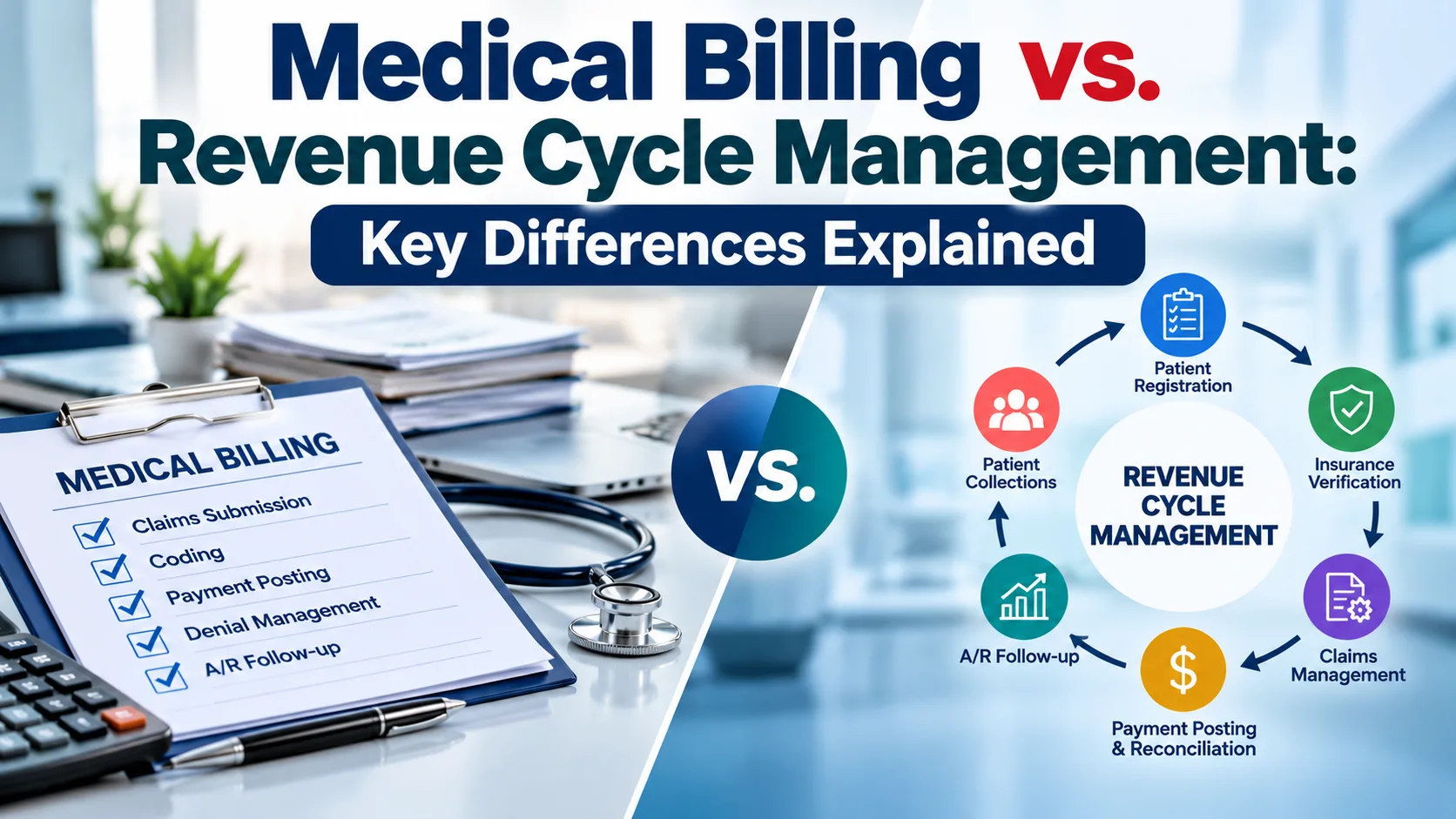
The same eight-step workflow applies everywhere, but the emphasis shifts.
- Eligibility and benefits verification: In Arizona, confirm the exact AHCCCS health plan and any out-of-state coverage. In Maine, confirm MaineCare status and whether the patient has switched Medicare plans.
- Prior authorization: Track plan-specific lists in Arizona. In Maine, watch both MaineCare requirements and Medicare Advantage rules, which can change at the start of each plan year.
- Coding and documentation: Use specialty-trained coders in both states, and make sure documentation supports medical necessity under the local policies that apply to your Medicare Administrative Contractor.
- Claim submission and filing deadlines: Build payer-specific timelines into your work queues rather than relying on one calendar.
- Denial management: Group denials by payer and root cause. In Arizona, expect plan-specific patterns. In Maine, expect patterns tied to eligibility, authorization, and portal issues.
- A/R follow-up: Prioritize by value and age, and assign different follow-up routes for Medicaid, Medicare Advantage, and commercial claims.
- Patient billing: Rural and older patients often need clear, patient-friendly statements and more than one payment option.
- Reporting: Review denial rates and days in A/R by payer, not just in total, so you can see which state-specific rule is costing you.
Common Mistakes in Both States
- Treating all Medicaid the same. Arizona's plan-based model and Maine's state-run model reward different habits.
- Assuming Medicare means Original Medicare. With more than half of beneficiaries in Advantage plans in both states, plan type has to be checked at every visit.
- Relying on a single filing deadline for every payer.
- Ignoring policy and portal updates until claims start bouncing.
- Letting aging balances sit because the office is short-staffed.
How to Choose a Billing Partner
Look for a partner who can explain the difference between billing AHCCCS plans and MaineCare, shows you reporting by payer, works inside your existing EHR, and puts every fee in writing. Be wary of promises built around large percentage gains that can't be verified. Providers Care Billing supports practices with a structured, payer-aware workflow, whether you need medical billing services in Arizona, medical billing services in Maine, or help with both.
Frequently Asked Questions
- How is Medicaid billing different in Arizona and Maine? Arizona delivers Medicaid through AHCCCS and private health plans, so practices bill multiple plans with their own rules. Maine runs MaineCare through a state office, so practices work with one program but must follow state-wide policy and portal changes.
- Which state has more Medicare Advantage patients? Maine has the higher share, at nearly 59 percent of Medicare beneficiaries, compared with roughly 51 percent in Arizona.
- Do seasonal patients affect billing in both states? Yes. Arizona has winter visitors and Maine has summer residents and tourists. Both bring out-of-state coverage that needs verification before the visit.
- Can one billing company support practices in both states? Yes, as long as it tracks payer rules, deadlines, and portals by state instead of using one generic process.
Get a Free Billing Review
If denials, slow payments, or payer complexity are holding your practice back, Providers Care Billing can help. Contact our team for a free review of your current billing performance and a clear plan for improving it. Your patients deserve your full attention, and your practice deserves to be paid fully and on time.