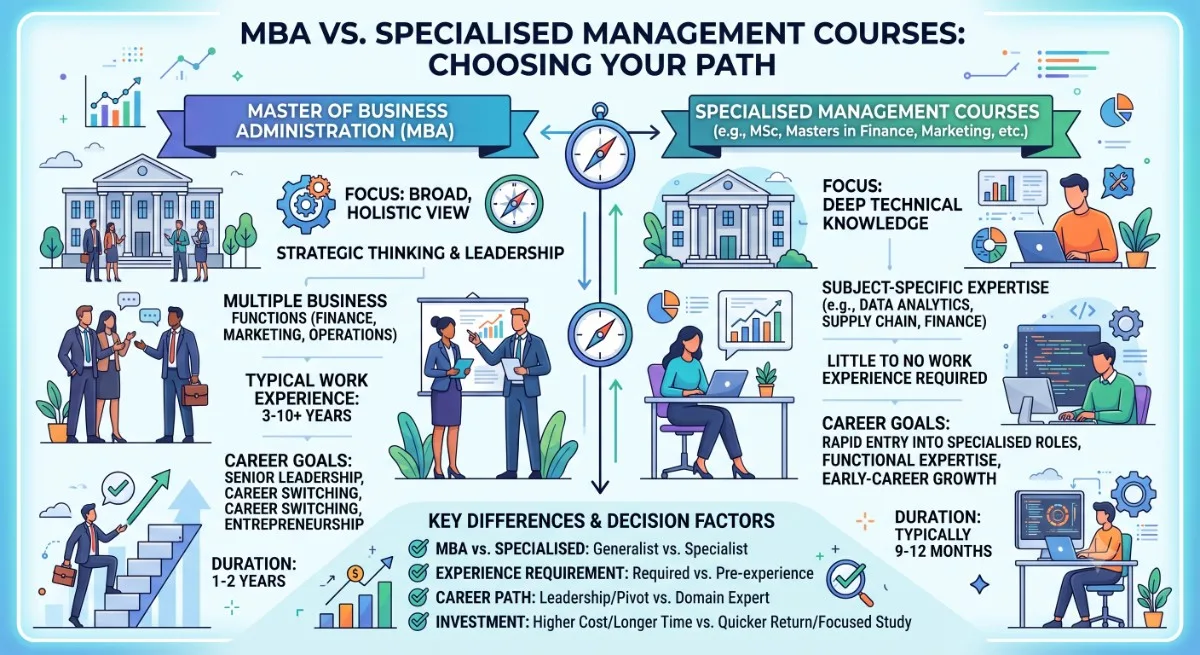
Choosing a management programme is an important career decision. While an MBA remains one of the most recognised management qualifications, students today can also choose specialised programmes focused on areas such as project management, entrepreneurship, logistics, supply chain management, business analytics and other emerging business functions.
So, which option is better?
There is no single answer.
The right choice depends on your career goals, interests, preferred industry and the type of skills you want to develop.
Understanding the difference between a broad MBA and a specialised management course can help you make a more informed decision.
What Is an MBA?
A Master of Business Administration provides broad exposure to different areas of business and management.
Rather than concentrating entirely on one function, an MBA generally covers multiple disciplines, helping students understand how different parts of an organisation work together.
Common areas include:
- Marketing
- Finance
- Human resources
- Operations
- Business strategy
- Organisational behaviour
- Business analytics
- Entrepreneurship
- Digital transformation
- Managerial economics
This multidisciplinary approach can be useful for students who want flexibility in their future career.
For example, someone may begin their career in marketing and later move into business development or general management. A broad understanding of business functions can make such transitions easier to navigate.
What Is a Specialised Management Course?
A specialised management course focuses more deeply on a particular business function, industry or professional area.
Examples include:
- Project Management
- Logistics and Supply Chain Management
- Innovation and Entrepreneurship
- Business Analytics
- Agri-Business Management
- Finance
- Marketing
- Human Resource Management
Instead of gaining broad exposure across every major management discipline, students pursuing a specialised programme typically spend more time developing knowledge relevant to a particular field.
This can be particularly useful when someone already has a clear career direction.
MBA vs Specialised Management Courses: The Key Difference
The simplest way to understand the difference is:
MBA = broader management knowledge
Specialised management course = deeper focus in a specific area
An MBA can provide a foundation across multiple business functions, while a specialised programme can help develop expertise in a particular management domain.
Neither approach is automatically better.
The better option depends on what you want to do after completing your studies.
When Should You Consider an MBA?
An MBA may be suitable if you want a broad understanding of business and are still evaluating which management function best matches your interests.
For example, you may be interested in business but not yet know whether you want to build a career in finance, marketing, operations or human resources.
An MBA gives you exposure to multiple areas before you make that decision.
It can also be useful for individuals interested in:
- General management
- Business development
- Consulting
- Marketing
- Finance
- Human resources
- Operations
- Entrepreneurship
- Leadership roles
The broader curriculum can provide a foundation for understanding how organisations make decisions and create value.
When Does a Specialised Management Course Make More Sense?
A specialised programme can be particularly relevant when you already have a specific professional goal.
Suppose you want to build a career in supply chain management.
A programme focused specifically on logistics and supply chain can provide concentrated exposure to procurement, transportation, inventory, warehousing, distribution and supply-chain strategy.
Similarly, someone interested in launching a business may benefit from a programme focused on innovation and entrepreneurship.
The more clearly defined your career objective is, the more valuable specialisation can become.
Comparing the Learning Experience
The learning experience can differ considerably between broad and specialised programmes.
MBA
An MBA generally exposes students to multiple business functions.
Students may study finance alongside marketing, operations, human resources and strategy.
This can encourage cross-functional thinking.
Specialised Management Programme
A specialised programme concentrates on one particular area.
Students spend more time examining the concepts, tools, challenges and practices associated with that field.
This can provide greater depth within a specific domain.
Which Option Offers Greater Career Flexibility?
If flexibility is your priority, an MBA can have an advantage.
Because students gain exposure to several business functions, they can consider different career directions.
For example, an MBA graduate could potentially pursue opportunities in marketing, finance, operations, consulting or business development depending on their skills and experience.
Specialised management courses can provide a more targeted career direction.
A graduate specialising in supply chain management, for example, may focus primarily on procurement, logistics, operations and supply-chain roles.
Therefore:
Choose broader management education when you want flexibility.
Choose specialised management education when you have a clearly defined professional direction.
MBA and Entrepreneurship
Entrepreneurship is another area where the difference becomes interesting.
An MBA can provide exposure to several business functions that entrepreneurs need to understand.
A founder needs to think about marketing, finance, operations, human resources, customers and strategy.
A specialised entrepreneurship programme, on the other hand, can provide deeper exposure to opportunity identification, innovation, venture creation, business models and startup development.
KCT Business School offers an MBA in Innovation, Entrepreneurship & Venture Development, demonstrating how an MBA pathway can also be combined with a specialised entrepreneurial focus.
This type of programme can be relevant for students interested in building businesses while developing broader management capabilities.
Specialisation and the Changing Business Environment
Business roles are becoming increasingly specialised.
Companies need professionals who understand specific areas such as analytics, project management, supply chains, digital transformation and entrepreneurship.
At the same time, businesses also need managers who understand how these functions connect.
For example, a supply-chain manager needs operational expertise but also needs to understand finance, technology and customer expectations.
A marketing manager needs knowledge of customer behaviour but increasingly works with data and technology.
This is why both breadth and depth have value.
What About Business Analytics?
Business analytics provides a good example of a specialised management field.
Modern organisations generate large quantities of data.
Managers need to understand how to interpret this information and use it to make better decisions.
A specialised analytics-focused programme can provide deeper exposure to data interpretation, analytical tools and business intelligence.
An MBA, meanwhile, can provide broader management knowledge while introducing students to analytics as one component of decision-making.
If your goal is specifically to work in business analytics, a specialised programme may be attractive.
If you want to combine analytics with broader management responsibilities, an MBA may provide greater flexibility.
MBA vs Specialised Courses: A Simple Comparison

This comparison shows why the decision should be based on individual career objectives rather than simply choosing the programme that appears more popular.
How to Decide Which Path Is Right for You
Before choosing between an MBA and a specialised management course, ask yourself five questions.
1. Do I Know My Career Direction?
If you already know exactly which business function interests you, a specialised programme may be worth considering.
If you are still evaluating your options, an MBA can provide broader exposure.
2. Do I Want Flexibility?
If you want the flexibility to move between business functions, broader management education may be more suitable.
3. Do I Prefer Depth or Breadth?
Think about whether you would rather understand many areas of business or develop deeper expertise in one specific field.
4. What Industry Interests Me?
Certain industries may benefit from specialised knowledge.
For example, logistics, supply chain, project management and entrepreneurship each involve specific tools and practices.
5. What Kind of Role Do I Want?
Think beyond the qualification itself.
Do you want to become a marketing manager, business analyst, entrepreneur, project manager, supply-chain professional or general business manager?
Your desired role should influence your programme choice.
Management Education at KCT Business School
KCT Business School in Coimbatore provides management education across multiple areas.
Its two-year full-time MBA is designed to develop business-ready professionals with capabilities in areas such as analytical thinking, leadership, decision-making and entrepreneurship.
The institution also offers specialised management pathways, including MBA in Innovation, Entrepreneurship & Venture Development, MBA in Project Management, MBA in Logistics and Supply Chain Management, and MBA in Agri-Business Management. (kctbs.ac.in)
This range illustrates an important point: management education does not have to follow a single career path.
Students can consider broad management education or select a programme that aligns more closely with a particular professional interest.
Broad Knowledge and Specialised Expertise Can Work Together
The MBA-versus-specialisation debate does not necessarily have to be viewed as an either-or decision.
Modern managers often need both breadth and depth.
A professional may begin with broad management knowledge and later develop expertise in analytics, finance, marketing, supply chains or another area.
Likewise, someone with specialised expertise can develop broader business knowledge through professional experience, certifications and additional management education.
Career development is rarely a straight line.
Interests can change. Industries evolve. New technologies create new roles.
The ability to keep developing your skills can therefore be just as important as the initial programme you choose.
Final Thoughts
Choosing between an MBA and a specialised management course ultimately comes down to your career goals.
An MBA can be a strong option for students who want broad exposure to business, greater career flexibility and an understanding of multiple management functions.
A specialised management programme can be more suitable for students who already have a clear professional direction and want deeper knowledge in a particular field.
There is no universal “best” choice.
The right path is the one that matches your interests, strengths, career plans and preferred area of business.
Before making a decision, compare the curriculum, learning methodology, industry exposure, faculty expertise, practical projects and career relevance of each programme.
A well-chosen management education can provide more than a qualification. It can build the knowledge, analytical thinking and professional capabilities needed to navigate an increasingly complex business environment.