For graduates interested in business, administration, leadership, or entrepreneurship, a Master of Business Administration can provide a broader understanding of how organisations function and how management decisions influence their performance.
What Does an MBA Programme Offer?
An MBA is a postgraduate management programme that introduces students to different aspects of business and organisational management. Rather than concentrating on a single technical area, management education generally brings together subjects related to business operations, finance, marketing, human resources, strategy, communication, and decision-making.
The programme can be useful for graduates from different academic backgrounds because management concepts are applicable across industries. Whether a student is interested in technology, banking, manufacturing, retail, services, or entrepreneurship, an understanding of business processes can add value to their professional profile.
The programme's stated outcomes include applying management theories to business problems, developing data-based decision-making abilities, understanding ethical and global aspects of business, and identifying entrepreneurial opportunities.
Learning Beyond Textbooks
One of the important aspects students can consider while selecting an MBA programme is how much opportunity they receive to apply what they learn. Management concepts are often easier to understand when students can relate them to actual business situations.
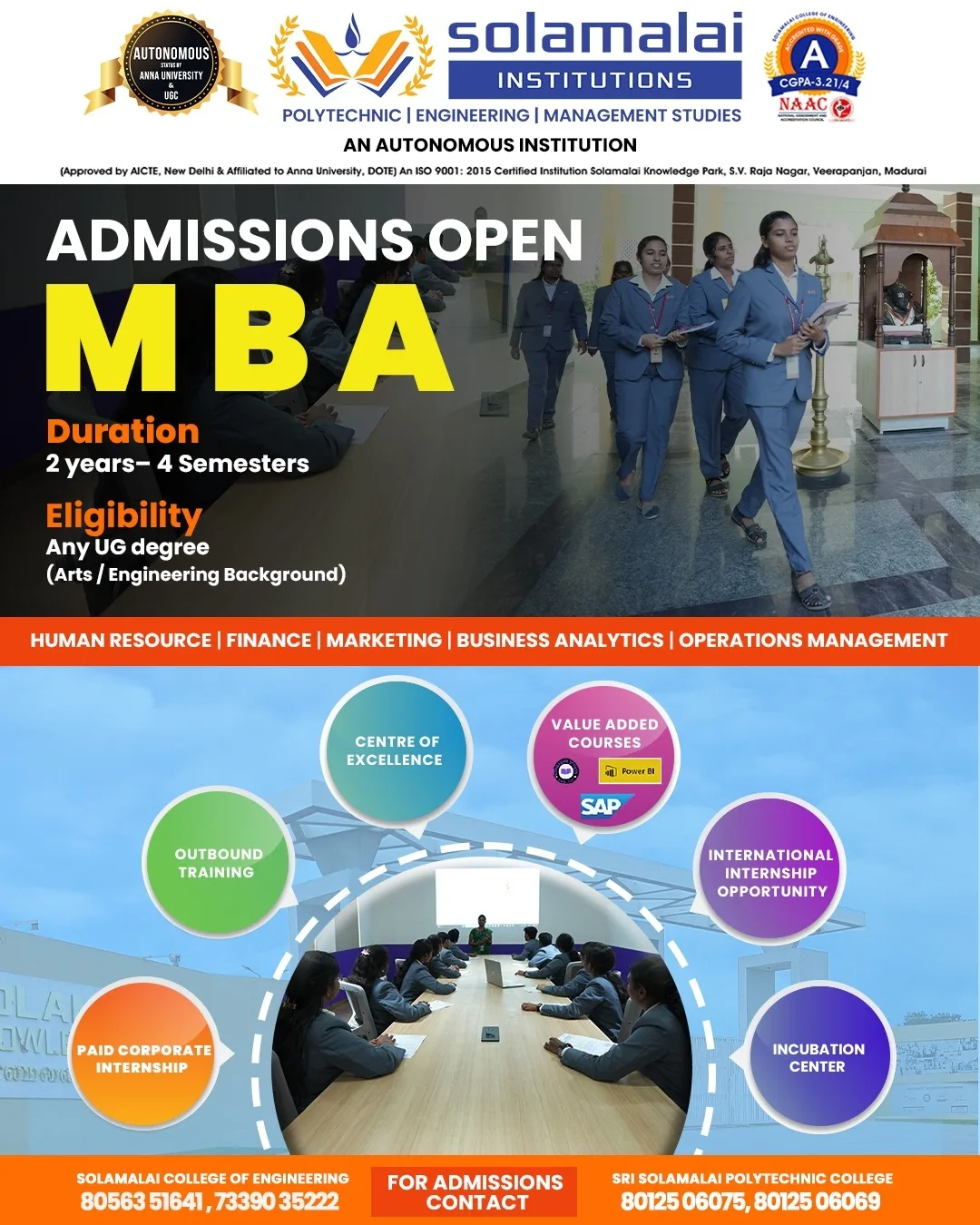
The MBA programme at Solamalai College of Engineering includes activities such as experiential learning, outbound training, industrial visits, CEO interactions, and startup mentoring. These activities can expose students to different perspectives on business and workplace practices. The department also highlights startup mentoring and funding opportunities as part of its management education initiatives.
Industrial visits, for example, can help students observe how organisations manage production, employees, marketing, operations, and other functions.
Such experiences do not replace academic learning. Instead, they can complement classroom discussions by giving students practical examples to connect with management theories.
Building Skills Alongside Academic Knowledge
A management graduate needs more than knowledge of business terminology. Communication, teamwork, analytical thinking, presentation ability, leadership, and decision-making are relevant in many professional settings.
An MBA programme can provide several opportunities to develop these skills through group activities, presentations, projects, case-based discussions, and academic assignments. Working with classmates on projects can also help students become familiar with delegation, coordination, deadlines, and collaborative problem-solving.
Understanding Different Areas of Management
Management is a broad field, and an MBA gives students the opportunity to understand how different business functions are connected.
Marketing deals with understanding customers, markets, products, branding, sales, and business growth. Students interested in communication and customer-facing roles may find this area particularly relevant.
Finance focuses on financial planning, budgeting, investment, accounting information, and understanding the financial performance of an organisation. Basic financial knowledge is useful even for managers who do not work directly in finance.
Human resources is concerned with people within an organisation. Recruitment, training, employee development, performance management, and workplace relationships are among the areas associated with HR.
Operations focuses on the processes involved in producing goods or delivering services. It involves planning, resource utilisation, quality, productivity, and process improvement.
Business strategy looks at the broader direction of an organisation. It involves analysing markets, competitors, opportunities, risks, and internal capabilities before making important decisions.
Entrepreneurship introduces students to the process of identifying opportunities, developing business ideas, understanding customers, and considering how a venture can be built and sustained.
Understanding these areas can help students identify the type of management career that matches their interests.
Why Consider an MBA in Madurai?
Madurai is an established educational centre in Tamil Nadu, students access to undergraduate and postgraduate programmes across several disciplines. Choosing to pursue an MBA in the city can allow students to continue their higher education while remaining connected to the region.
For students comparing an MBA course in Madurai, the decision does not have to depend on a single factor. Course structure, faculty experience, infrastructure, practical learning opportunities, student activities, industry interaction, and career support can all be considered.
It is understand the curriculum, check admission requirements, and learn about the activities conducted by the department before making a final decision.
Developing an Industry-Oriented Outlook
Business environments continue to change with technology, changing customer expectations, new business models, and global competition. Managers are increasingly expected to understand data, communicate effectively, work with diverse teams, and respond to changing situations.
The MBA programme describes its vision around innovation, ethical leadership, global perspectives, and developing industry-ready professionals.
The department also maintains a placement and training structure that includes communication, aptitude, and soft-skills training. The placement team lists an MBA faculty member among its department coordinators, while external training organisations are also associated with the training activities.
This type of supporting environment can be useful for students who want to work on their professional readiness alongside their academic studies.
Career Possibilities After an MBA
An MBA does not restrict graduates to one particular profession. The skills developed through management education can be applied in different sectors and organisational functions.
The employment opportunities across areas including information technology, banking, FMCG, manufacturing, and financial consulting.
Depending on their interests and skills, graduates may explore roles related to marketing, human resources, finance, operations, business development, administration, sales, consulting, or entrepreneurship.
Career outcomes can vary depending on individual qualifications, specialisation, experience, communication skills, industry requirements, and the organisation offering the role. Therefore, students should view an MBA as a foundation for professional development rather than a guarantee of a particular job.
Choosing the Right MBA Programme
Students comparing MBA programmes can create a simple checklist before making their choice:
- Review the eligibility and admission requirements.
- Understand the curriculum and subjects covered.
- Check the learning and assessment methods.
- Look for opportunities for projects and practical exposure.
- Explore industry interaction and industrial visits.
- Review student development and training activities.
- Understand the available career support.
- Consider campus facilities and learning resources.
- Check the programme's approach to entrepreneurship and innovation.
- Compare the overall learning environment with personal career goals.
Taking time to review these factors can make the selection process more informed.
A Management Education Path in Madurai
An MBA can be a useful postgraduate option for graduates who want to understand business from a wider perspective. It can introduce students to multiple management functions while giving them opportunities to develop communication, analytical, leadership, and decision-making skills.
For students exploring an MBA course in Madurai, Solamalai College of Engineering offers a management programme supported by academic learning, experiential activities, industry interaction, and professional development initiatives. The Department of Management Studies also records student participation in conferences, startup programmes, project expos, and other academic and extracurricular activities.
Ultimately, the right MBA programme depends on what a student wants from postgraduate education. Reviewing the curriculum, learning opportunities, eligibility, facilities, and career support can help students make a choice that aligns with their interests and future plans.