Understanding Maxillofacial Trauma
Maxillofacial trauma refers to injuries affecting the facial bones, jaw, and surrounding structures. Road accidents, sports injuries, falls, workplace incidents, and physical trauma are some of the common causes. Depending on the force involved, a patient may experience fractures of the mandible, maxilla, cheekbone, orbital region, nasal area, or other parts of the facial skeleton.
Treating these injuries involves more than simply bringing broken bones together. The facial skeleton plays an important role in appearance, speech, chewing, breathing, and eye function. For this reason, fracture treatment generally aims to restore both the structure and function of the affected area.
Why Internal Fixation Matters
Some facial fractures can be managed without surgery, particularly when the bones remain stable and properly aligned. However, displaced, unstable, or complex fractures may require open reduction and internal fixation (ORIF). During this procedure, the surgeon repositions the fractured bone fragments and secures them using plates and screws.
Internal fixation provides mechanical stability while the bone heals. It can also help maintain the intended alignment after surgery, reducing unwanted movement at the fracture site. The choice of fixation method depends on factors such as fracture location, pattern, bone quality, soft-tissue condition, and the patient's overall clinical situation.
Role of Maxillofacial Plates
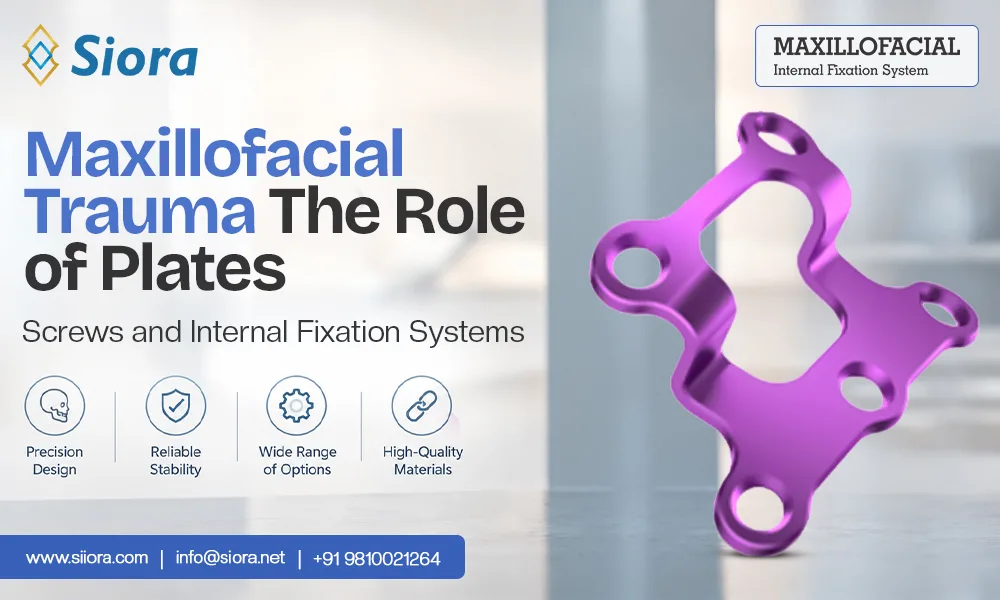
Maxillofacial plates are designed to support different areas of the facial skeleton. Their shape, thickness, hole configuration, and contour can vary according to the anatomical region and fixation requirement.
For example, smaller plates may be suitable for areas where soft-tissue coverage is limited and a low-profile implant is desirable. Other fracture patterns may require stronger fixation or specially contoured plates that correspond more closely to the anatomy.
An appropriately selected plate can help maintain fracture reduction and provide stability during the healing period. Anatomical contouring is particularly important in facial surgery because even relatively small changes in bone position can affect facial symmetry or function.
Importance of Maxillofacial Screws
Screws work together with plates to secure bone fragments. Depending on the fixation system and surgical technique, screws may be used to achieve stable fixation across the fracture site.
Screw selection involves considerations such as diameter, length, thread design, bone thickness, and the location of the fracture. The surgeon must also consider nearby anatomical structures, including nerves, teeth, blood vessels, and the orbit.
Accurate screw placement is therefore an important part of successful internal fixation. The objective is not simply to use more hardware, but to achieve appropriate stability with careful positioning.
Internal Fixation Systems for Complex Fractures
Modern maxillofacial fixation systems commonly include a range of plates, screws, and compatible instruments. These systems can support the management of fractures involving different facial regions and provide surgeons with options based on the individual injury.
Low-profile designs can be particularly useful in areas where implant prominence may be a concern. Titanium is also widely used in maxillofacial implants because of its established use in orthopedic and craniofacial applications, strength, and biocompatibility.
Supporting Functional and Structural Recovery
The purpose of internal fixation extends beyond holding a fracture together. Stable fixation can support the restoration of facial anatomy while allowing the healing process to progress. In appropriate cases, this may help patients regain functions such as chewing, speaking, and normal jaw movement.
However, every maxillofacial injury is different. Treatment decisions should be based on clinical examination, imaging findings, fracture characteristics, and the surgeon's assessment.
Conclusion
Plates, screws, and internal fixation systems have become important tools in the surgical management of maxillofacial trauma. By providing controlled and stable fixation, they can help surgeons restore fractured facial bones while considering both functional requirements and facial anatomy. Continued development of trauma implant designs and fixation systems is helping provide more adaptable solutions for the varied challenges presented by maxillofacial fractures.