d notifications. Buyers and sellers need to communicate, and both need timely alerts about orders, bookings, and changes.
Ratings and reviews. These create trust between strangers and give honest sellers a reputation advantage.
Admin dashboard. Your team needs tools to manage users, resolve disputes, review listings, issue refunds, and view reports.
Anything beyond this list, such as loyalty programs, advanced analytics, or AI recommendations, can come in later phases once real usage shows what matters.
How Marketplace Architecture Works
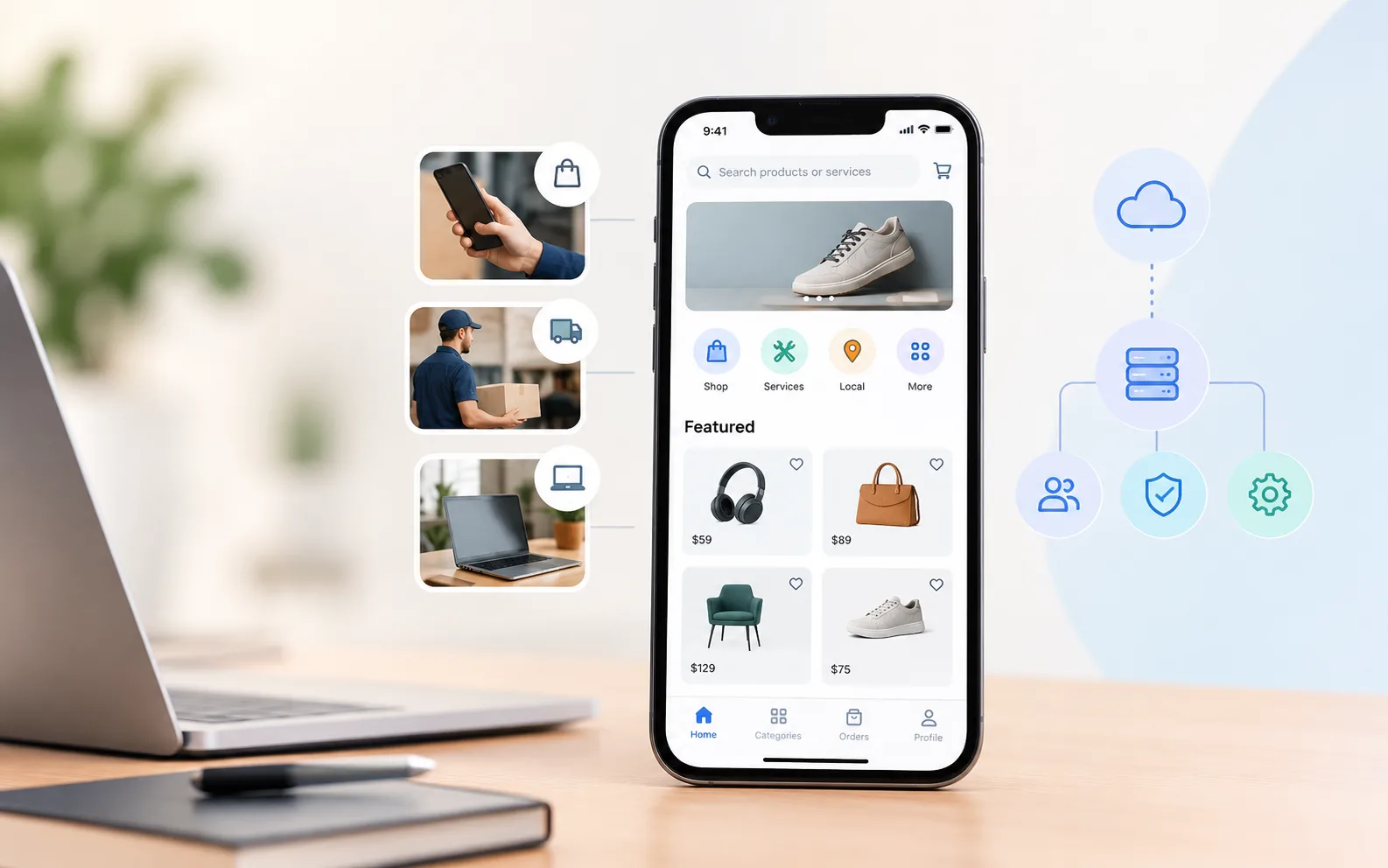
Behind the screens, a marketplace is a set of connected systems. You do not need to be an engineer, but understanding the layers helps you ask better questions.
The front end is what users see, usually a mobile app, a web app, or both. Cross-platform frameworks let one codebase serve iOS and Android, which keeps costs manageable for most marketplaces.
The back end holds the business logic: accounts, listings, bookings, commissions, and rules. It exposes this logic to the front end through APIs.
The database stores users, listings, orders, messages, and transactions. Marketplaces have highly related data, so structured relational databases are a common and reliable choice.
Third-party services handle specialized jobs. Payment processors manage money movement, mapping services handle location, email and push services deliver notifications, and cloud hosting keeps everything running.
Infrastructure is the hosting and deployment layer. It must handle traffic spikes, protect data, and recover from failures without disrupting transactions.
A well-built marketplace keeps these layers modular. That way, you can replace a payment provider or add a new feature without rewriting everything.
What Marketplace App Development Services Include
When you hire a team, the work should cover more than writing code. Comprehensive marketplace app development services usually span the following stages:
- Discovery and strategy. Defining your model, target users, revenue approach, and priority features.
- UX and UI design. Mapping user journeys for each role and designing interfaces that are easy to use on any device.
- Architecture planning. Choosing technology, designing the data model, and planning integrations.
- Development. Building the front end, back end, admin tools, and integrations in iterative sprints.
- Quality assurance. Testing functionality, security, performance, and real-world scenarios across devices.
- Deployment. Launching to app stores and production servers with monitoring in place.
- Maintenance and growth. Fixing issues, updating dependencies, and building new features based on user behavior.
If a proposal skips discovery or post-launch support, treat it as a warning sign. Those stages are where many marketplace projects are won or lost.
Marketplace Software Development vs. App Development
You may notice that providers use different terms. A marketplace software development company often takes a broader view than one that only builds mobile apps. The distinction matters.
An app is the visible product on a phone or browser. Marketplace software includes everything underneath: the engine that manages vendors, calculates commissions, runs payouts, handles disputes, and produces reports. Many marketplaces start as an app and then outgrow it, needing deeper software capabilities such as vendor management portals, multi-currency support, or integrations with accounting and logistics tools.
When you speak with potential partners, ask whether they can support both layers. A team that can build the polished customer experience and the operational software behind it will save you from stitching together multiple vendors later.
Choosing a Marketplace App Development Agency
Not every development firm understands marketplaces. Building one is meaningfully harder than building a single-user app because you are managing two or more audiences with competing needs. A specialist marketplace app development agency will have already solved problems like split payments, vendor verification, and review integrity.
Here is a practical way to evaluate candidates:
Look for relevant case studies. Ask for examples of two-sided platforms, not just generic apps. Ask what went wrong and how it was handled, because honest answers reveal real experience.
Test their questions. A strong team will challenge your assumptions about scope, revenue, and launch strategy. If they agree with everything, they may not be thinking deeply enough.
Review their process. Look for clear phases, regular demos, and transparent communication. You should always know what is being built and why.
Clarify ownership. Confirm that you will own the source code, designs, and data.
Ask about security and compliance. Payments, personal data, and identity verification all carry obligations that need to be designed in from the start.
Plan for the long term. Ask what support, hosting guidance, and ongoing development look like after launch.
Common Mistakes to Avoid
A few patterns repeat in marketplace projects that struggle.
Building too many features before proving anyone will transact. Ignoring the supply side and focusing only on buyers. Treating payments as a simple plugin when they involve holding and splitting funds. Skipping the admin panel, which leaves operations teams without tools. Launching broadly instead of dominating one niche or location first.
Avoiding these does not require a large budget. It requires clear priorities and a partner who has seen them before.
Final Thoughts
A marketplace succeeds when it makes trust and transactions effortless for everyone involved. That depends on thoughtful product design, sound architecture, and a development team that understands the unique demands of connecting multiple user groups.
If you are ready to move from research to planning, a dedicated marketplace app development company can help you define your model, scope a launch-ready first version, and build a platform that scales with your growth.