The United States has become one of the fastest-growing markets for Secure Service Access (SSA), driven by rapid digital transformation across industries and the increasing demand for stronger cybersecurity frameworks. As organizations continue to embrace cloud computing, hybrid work environments, and remote access models, the need for secure, seamless, and scalable access to applications and data has become a top priority.
Businesses across sectors such as healthcare, finance, manufacturing, retail, and government are investing heavily in Secure Service Access solutions to strengthen their security posture, improve operational efficiency, and ensure compliance with evolving regulatory standards. The growing complexity of cyber threats, combined with the need for strategic alignment between IT and business operations, has accelerated the adoption of SSA solutions throughout the U.S.
Click here for more information : https://qksgroup.com/market-research/market-forecast-secure-service-access-2026-2030-worldwide-7376
What is Secure Service Access (SSA)?
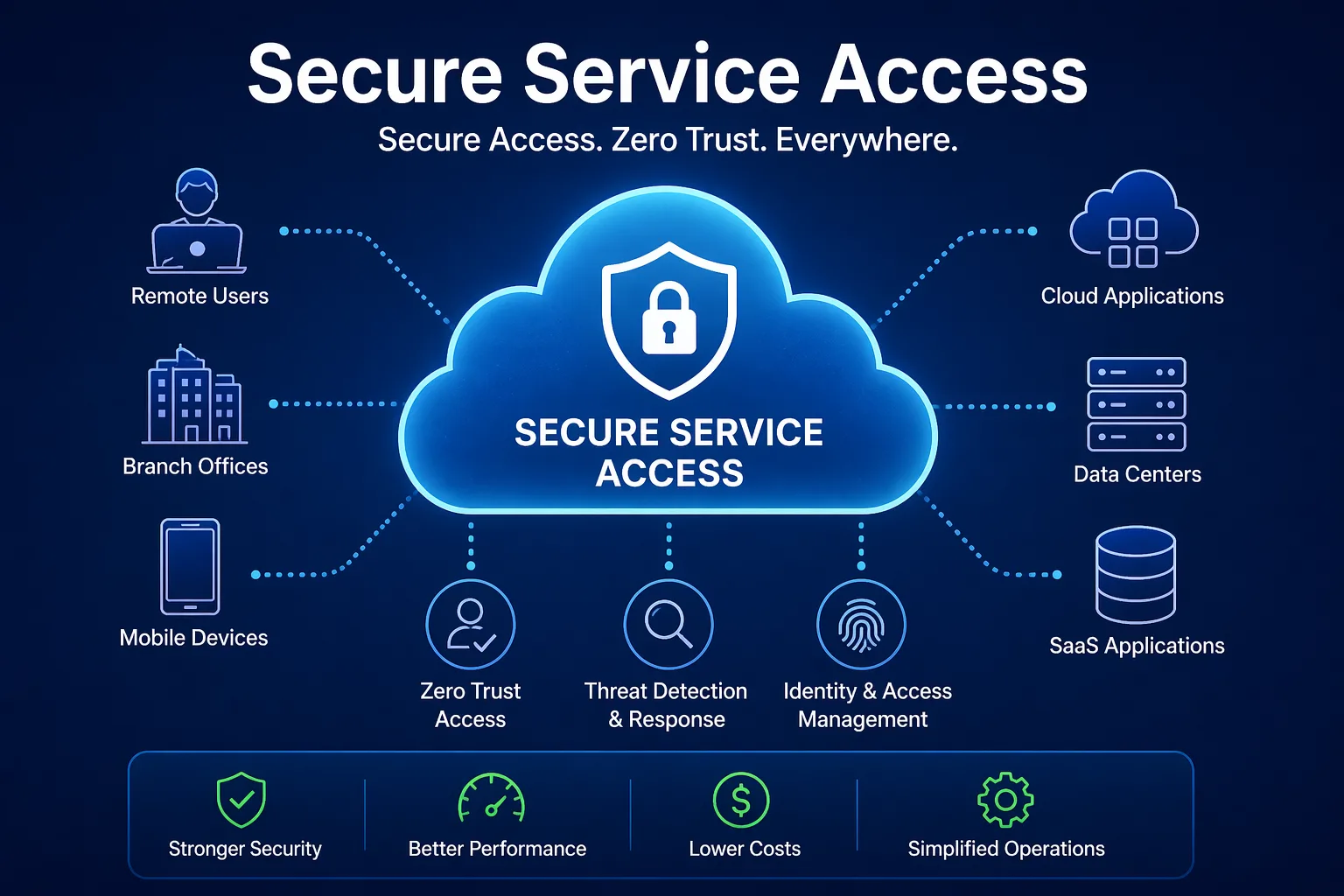
QKS Group defines Secure Service Access (SSA) as a cloud-native security platform that provides secure access to applications and data from anywhere by enforcing zero-trust security policies and integrating with Identity and Access Management (IAM) systems.
An SSA product includes core technologies such as:
- Secure Access Service Edge (SASE)
- Zero Trust Network Access (ZTNA)
- Extended Detection and Response (XDR)
These capabilities help organizations shift their security focus from traditional data centers and network perimeters to users, devices, applications, and workloads distributed across multiple environments. This modern approach ensures stronger protection, better visibility, and simplified security operations.
Why Secure Service Access is Growing Rapidly in the U.S.
The U.S. market is witnessing exceptional growth in Secure Service Access adoption due to several critical factors.
1. Rise of Hybrid Work and Remote Access
The modern workforce demands secure access from anywhere. Employees now work from offices, homes, and remote locations, requiring organizations to provide seamless yet highly secure access to enterprise applications. SSA solutions ensure secure remote connectivity without compromising security.
2. Increasing Cybersecurity Threats
Cyberattacks such as ransomware, phishing, credential theft, insider threats, and advanced persistent threats (APTs) continue to rise across the United States. Traditional perimeter-based security models are no longer sufficient. SSA helps businesses adopt a zero-trust architecture where no user or device is trusted by default.
3. Cloud-First Business Strategies
Organizations are rapidly migrating workloads to the cloud. As SaaS applications and multi-cloud environments become standard, businesses need cloud-native security platforms that provide visibility and control across distributed infrastructures. SSA enables secure cloud access with centralized policy enforcement.
4. Cost Optimization and Simplified Security
Managing multiple standalone security tools can be expensive and inefficient. SSA consolidates networking and security functions into a unified platform, reducing operational complexity, lowering infrastructure costs, and improving IT productivity.
5. Regulatory Compliance Requirements
Industries such as healthcare, banking, and government must comply with strict security and privacy regulations. SSA supports compliance by improving access control, monitoring user activity, and enforcing policy-driven security measures.
Key Benefits of Secure Service Access Solutions
Organizations implementing Secure Service Access (SSA) solutions gain several strategic advantages.
Click here for market share report : https://qksgroup.com/market-research/market-share-secure-service-access-2025-worldwide-6817
Enhanced Security Posture
SSA enforces zero-trust security policies, continuous authentication, and contextual access controls to minimize unauthorized access and lateral movement across networks.
Improved User Experience
Users gain fast, secure, and seamless access to applications regardless of location, improving employee productivity and customer satisfaction.
Better Visibility and Threat Detection
With integrated XDR capabilities, security teams gain real-time visibility into threats across endpoints, networks, and cloud environments, enabling faster incident response.
Scalability for Digital Growth
SSA platforms support business expansion by providing flexible, cloud-native infrastructure that scales with organizational needs.
Stronger Business Agility
Organizations can adapt quickly to changing business demands while maintaining strong security governance across distributed environments.
The Future of Secure Service Access in the U.S.
As digital transformation accelerates, Secure Service Access will become a foundational element of enterprise cybersecurity strategy. Organizations are moving beyond legacy VPNs and traditional network security toward intelligent, identity-driven, cloud-native security platforms.
Future innovations in AI-driven threat detection, behavioral analytics, and autonomous security operations will further strengthen SSA capabilities. Businesses that invest early in Secure Service Access will be better positioned to protect critical assets, support innovation, and maintain competitive advantage.
Conclusion
Secure Service Access (SSA) is redefining how organizations secure users, applications, and data in today’s distributed business environment. By combining SASE, ZTNA, and XDR into a unified cloud-native platform, SSA helps businesses improve cybersecurity, reduce complexity, and enable secure digital transformation.
As cyber threats evolve and business operations become increasingly decentralized, Secure Service Access solutions are no longer optional—they are essential for sustainable growth, regulatory compliance, and long-term business success.