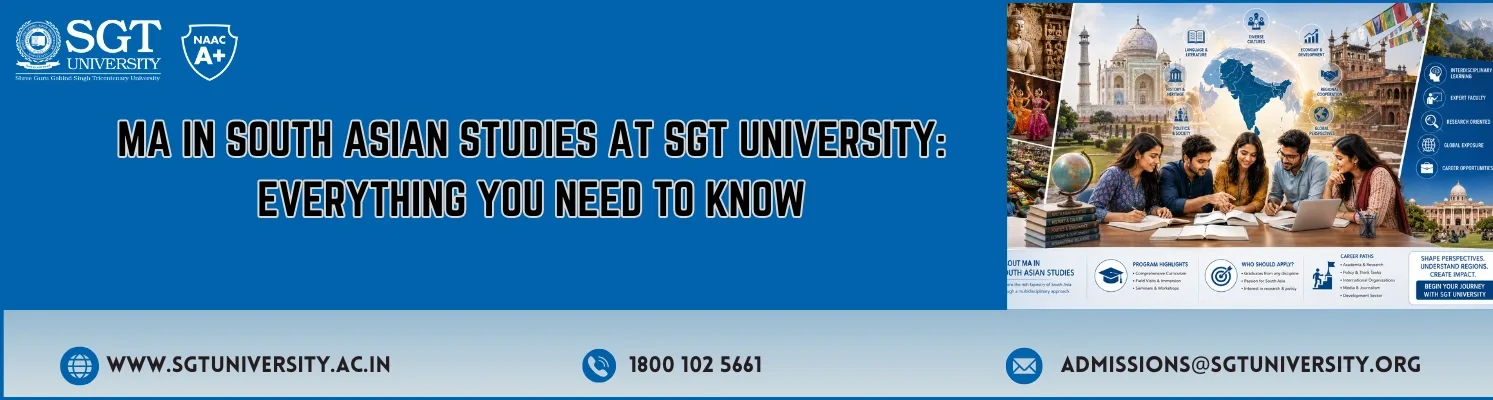
If you've ever asked yourself, "Why does India work the way it does?" this degree is just for you.
South Asia is home to nearly two billion people, multiple languages, ancient civilisations, and some of the world's most complex democracies. Yet most university programmes treat this region as a footnote, a few chapters in a history book, or a module in a political science course; that's it. The MA in South Asian Studies at SGT University is built on the belief that this region deserves dedicated, serious, and research-driven study.
This is not a degree that asks you to memorise facts. It is a degree that asks you to think about power, about identity, about how India became what it is today, and what it might become tomorrow. Whether you are interested in history, politics, culture, or economics, this programme provides the fundamentals to engage more deeply with South Asia than most graduates ever do.
Table of Contents
- What is South Asian Studies?
- Why Study South Asia Now?
- About the School of Humanities, Social Sciences and Liberal Arts at SGT University
- Programme Details at SGT University
- What Will You Study?
- How Is the Programme Taught?
- Eligibility and Admission Process
- Fees and Scholarships
- What Can You Do After This Degree?
- Life at SGT University
- Conclusion
- FAQs
What is South Asian Studies?
South Asian Studies is an interdisciplinary field that looks at the countries and cultures of South Asia, primarily India, but also in relation to Pakistan, Bangladesh, Sri Lanka, Nepal, and the broader region through multiple lenses. These include history, political science, economics, sociology, cultural studies, and literature.
What makes it "interdisciplinary" is that it does not belong to one department or one way of thinking. A South Asianist might read the colonial-era archives one week and analyse contemporary policy documents the next. They might study a Mughal painting alongside a modern election result. The connecting thread is always the region and the questions it raises about civilisation, governance, identity, and change.
At the postgraduate level, South Asian Studies allow one to ask better questions and answer them with rigour.
Why Study South Asia Now?
India is one of the fastest-growing major economies in the world. It has the largest population on the planet. It is a nuclear state, a democracy, a civilisational hub, and a space where tradition and modernity collide every single day. And yet, the serious academic study of India is not as a case study in someone else's theory, but on its own terms, it remains surprisingly rare.
There is a growing demand for people who genuinely understand South Asia: in foreign policy, development work, media, business, and academia. Think tanks, international organisations, NGOs, government ministries, and cultural institutions all need people who can read the region clearly and communicate about it well.
Beyond career value, there is an intellectual urgency to understanding South Asia. From the question of how a billion-person democracy functions, to how partition shaped modern identity, to how caste and class interact in economic life, these are among the most important questions of our time. A programme in South Asian Studies puts you at the centre of those conversations.
The School of Humanities, Social Sciences and Liberal Arts at SGT University
School of Humanities, Social Sciences and Liberal Arts (HSLA) at SGT University is built on a clear vision: to develop critical thinkers, ethical leaders, and socially responsible professionals. The school combines interdisciplinary education with real-world research and industry collaboration, preparing graduates for careers in media, education, public policy, and the creative industries.
HSLA includes two departments, the Department of English and Humanities and the Department of Liberal Studies and Social Sciences, alongside a Centre for Foreign Languages. The faculty includes professors, associate professors, and research-track faculty across these departments.
The MA in South Asian Studies is offered jointly by HSLA and the Advanced Study Institute of Asia (ASIA) at SGT University, which gives it a distinctly research-led character. The programme is not just a humanities degree; it is a space for serious intellectual inquiry into one of the world's most consequential regions.
You can explore more about SGT University's accreditations and rankings here.
More info :https://sgtuniversity.ac.in/hsla/blogs/ma-south-asian-studies