Introduction
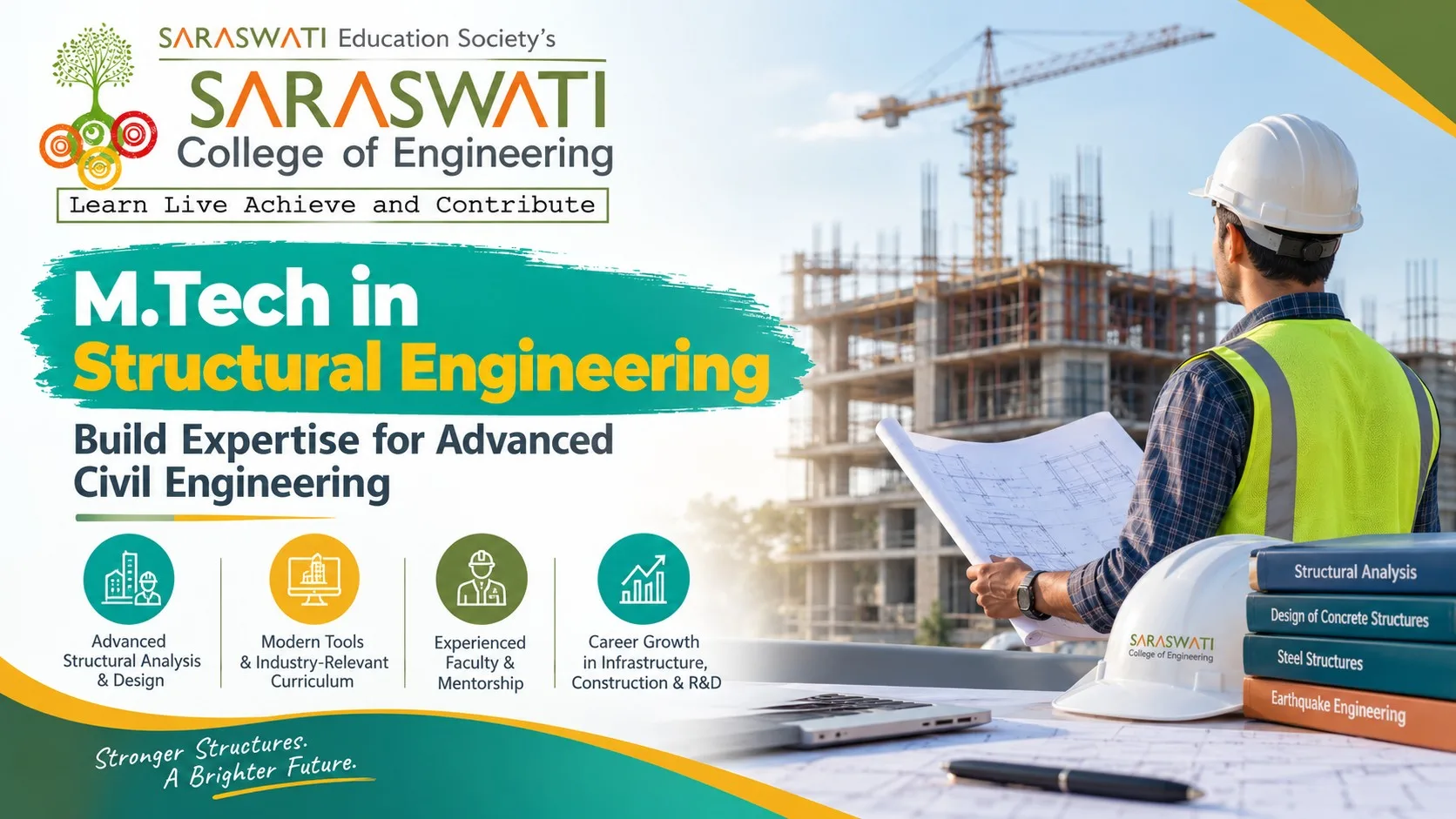
M.Tech in Structural Engineering is a postgraduate pathway for civil engineering graduates seeking advanced structural design skills. The field focuses on analysing and designing buildings, bridges, and other structures.
This article explains the programme duration, eligibility, syllabus, fees, practical learning, career roles, and salary factors. It also covers the structural engineering programme at SCOE and its academic facilities.
SCOE offers M.E. (Civil)-Structural Engineering as a two-year postgraduate programme with four semesters. The programme combines advanced civil engineering knowledge with practical learning, projects, laboratories, and industry-oriented preparation.
Key Takeaways
- SCOE offers M.E. (Civil)-Structural Engineering.
- The programme duration is two years.
- Students complete four semesters.
- The course has an intake of 18 seats.
- Eligibility is 50% marks for open-category candidates.
- Reserved-category eligibility percentage is 45%.
- The programme covers advanced structural engineering concepts.
- The University of Mumbai provides the revised structural engineering syllabus.
- Career options include structural and project engineering roles.
What Is M.Tech in Structural Engineering?
M.Tech in Structural Engineering focuses on the analysis, design, and performance of structures.
Students study advanced methods used to understand how structures respond to different loads and conditions.
At SCOE, the programme is offered as M.E. (Civil)-Structural Engineering. It runs for two years and includes four semesters.
The programme can help civil engineering graduates develop skills in:
- Structural analysis
- Structural design
- Advanced concrete technology
- Numerical methods
- Finite element analysis
- Prestressed structures
- Bridge design
- Multi-storey building analysis
- Geotechnical engineering
- Research and project work
M.Tech in Structural Engineering syllabus: What Does It Include?
The M.Tech in structural engineering syllabus is designed around advanced structural analysis and design.
The University of Mumbai’s revised 2022 syllabus covers Semesters I to IV. It includes subjects such as Theory of Elasticity and Elastic Stability, Advanced Prestressed Concrete Structures, Advanced Geotechnical Engineering, and Advanced Numerical Methods.
Other important areas include:
- Finite Element Analysis
- Analysis of Composite Structures
- Advanced Concrete Technology
- Design of Bridge Structures
- Analysis and Design of Multi-storey Buildings
- Advanced structural design concepts
- Research-oriented project work
The exact subject structure can change with university revisions. Students should check the latest university syllabus before admission.
Eligibility for Structural Engineering at SCOE
Students should meet the prescribed postgraduate admission requirements.
SCOE eligibility includes :
- 50% marks for the open category
- 45% marks for reserved categories
- Entrance examination route as specified by the institute
- Related engineering qualification requirements
The programme has an intake of 18 students.
Candidates should verify current admission rules before applying.
M.Tech in Structural Engineering Syllabus and Practical Learning
The M.Tech in structural engineering syllabus becomes more useful when students connect theory with engineering applications.
Practical learning can involve:
- Structural modelling
- Load analysis
- Structural design calculations
- Computer-based analysis
- Research projects
- Case studies
- Laboratory experiments
- Technical presentations
SCOE’s civil engineering department involves advanced technical expertise, practical experience, research, and industry-oriented learning. It also provides project-based training and internship-related resources.
Why Structural Engineering Skills Matter
Structural engineers help ensure that structures remain safe, stable, and functional.
Their work can contribute to:
- Residential buildings
- Commercial buildings
- Industrial structures
- Bridges
- Infrastructure projects
- Transportation structures
- Water-related structures
- Large-scale construction projects
Structural engineering also requires knowledge of safety standards, materials, loads, construction methods, and structural behaviour.
Why Choose SCOE for Structural Engineering?
Saraswati College of Engineering, or SCOE, was established in 2004. The institute is located in Kharghar, Navi Mumbai, and is recognised among the Top Engineering Colleges in Mumbai, offering industry-oriented programmes and opportunities for technical and professional development.
Its structural engineering programme offers several relevant features:
- Two-year postgraduate programme: Students complete four semesters.
- Specialised structural focus: The programme is dedicated to structural engineering.
- Small intake: The programme intake is limited to 18 seats.
- Project-based learning: SCOE provides project-related academic resources.
- Internship exposure: The department provides internship-related information.
- Experienced faculty: Faculty resources are available through the department.
- Industry orientation: The programme focuses on advanced engineering skills.
- Research environment: SCOE promotes research and innovation across engineering disciplines.
- Placement support: The institute has a dedicated training and placement cell.
The institute also has major infrastructure and construction organisations among its structural engineering recruiters. These include Larsen & Toubro, Reliance Infrastructure, DLF, Tata Projects, HCC, Essar Group, Jaypee Group, and GMR Infrastructure.
Career Opportunities After Structural Engineering
There are several career areas for graduates specialising in structural engineering. These roles span construction, infrastructure, design, and specialised civil engineering domains.
Students can explore roles such as:
- Structural Engineer: Analyse and design safe, stable structures.
- Civil Engineer: Plan, supervise, and manage civil construction projects.
- Project Engineer: Coordinate engineering activities, resources, timelines, and site execution.
- Geotechnical Engineer: Study soil and foundation conditions for construction projects.
- Marine Engineer: Work on engineering projects involving marine infrastructure.
- Traffic Engineer: Apply engineering principles to traffic flow and transportation systems.
- Water Resources Engineer: Work on water supply, drainage, hydraulic, and related infrastructure projects.
M.Tech in Structural Engineering Salary and Growth: What Influences It?
The M.Tech in structural engineering salary can increase with experience, specialisation, and responsibility. SCOE has an average salary of ₹7–10 LPA for its M.E. Civil-Structural Engineering programme. Entry-level Structural Engineer is around ₹4–8 LPA for Structural Engineer roles.
Industry and Employer
Impact
Structural engineers working with large infrastructure, engineering consultancy, EPC, and multinational firms may access different salary levels.
For example, industry based structural engineering salaries are approximately
- ₹5–9 LPA at Larsen & Toubro
- ₹5–7 LPA at AECOM
- ₹6–8 LPA at Thornton Tomasetti.
Leadership-Level Growth
With substantial experience, structural engineers can progress into:
- Senior Structural Engineer: ₹8–16 LPA
- Lead Structural Engineer: Around ₹15–31 LPA
- Structural Engineering Manager: Around ₹18–20 LPA
- Senior Project Manager: Around ₹13–30 LPA
- Principal Structural Engineer: Around ₹18–29 LPA
Skills Students Should Build During the Programme
Students can improve employability by combining academic knowledge with practical and technical skills.
- Structural Analysis
- Design Principles
- Engineering Mathematics
- Numerical Methods
- Finite Element Concepts
- Structural Modelling
- STAAD.Pro and Structural Software
- BIM
- Construction Knowledge
- Technical Documentation
- Project Management
- Communication and Teamwork
Research and Project Opportunities
Postgraduate study provides an opportunity to explore focused engineering problems.
Students can select projects related to:
- Earthquake-resistant structures
- Sustainable construction
- Composite structures
- High-rise buildings
- Bridge structures
- Prestressed concrete
- Structural health monitoring
- Advanced construction materials
- Numerical modelling
Research projects can help students understand how engineering theory applies to real structures.
Conclusion
M.Tech in Structural Engineering provides advanced knowledge for graduates who want to specialise in structural design and analysis. The programme covers advanced engineering concepts, numerical methods, structural analysis, and project-based learning.
SCOE offers M.E. (Civil)-Structural Engineering as a two-year postgraduate programme with four semesters. Its academic resources, project exposure, internship opportunities, and industry orientation support specialised learning. Students should review the latest university syllabus and admission notification before applying.