Commerce and finance are among the most important fields in today’s business-driven economy. A Master of Commerce (M.Com) degree helps students gain advanced knowledge in accounting, finance, taxation, business management, economics, and related areas. It is a popular postgraduate qualification for individuals looking to improve their career opportunities in banking, education, finance, accounting, and corporate sectors.
Many graduates and working professionals search for flexible education options to continue their studies while managing jobs or personal responsibilities. One such option that attracts attention is the M.Com One Sitting Degree.
A one sitting degree is often promoted as a quicker way to complete a postgraduate qualification. However, students should understand the concept, recognition, eligibility, career opportunities, and important factors before selecting any such program.
What Is an M.Com One Sitting Degree?
A Master of Commerce (M.Com) is a postgraduate program that provides advanced knowledge of commerce-related subjects, including accounting, financial management, business laws, taxation, economics, and corporate practices.
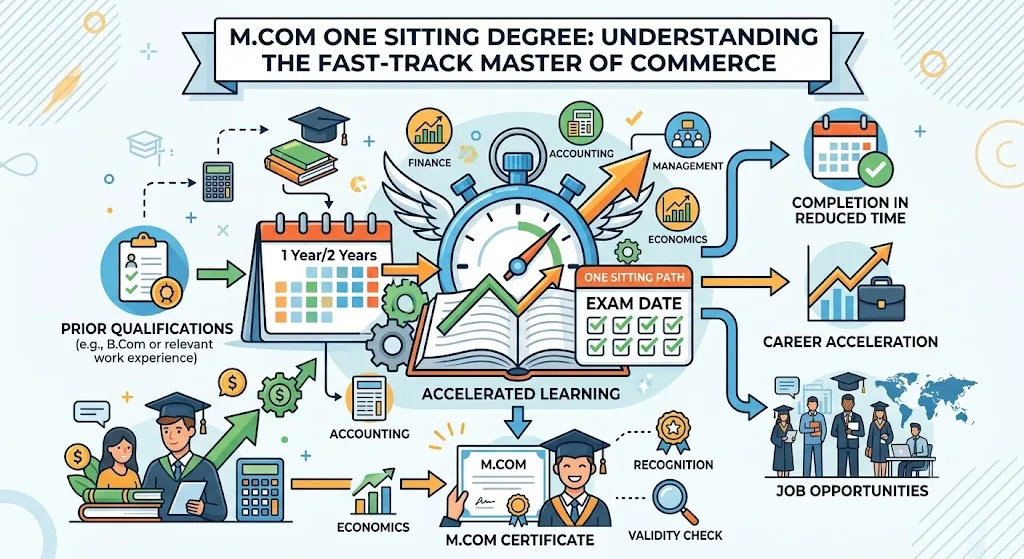
The term M.Com One Sitting Degree generally refers to programs that claim to allow candidates to complete an M.Com qualification in a single academic sitting or through an accelerated learning process.
Such programs are often targeted at working professionals, individuals with education gaps, and candidates who want to enhance their qualifications for career growth. However, the validity of any degree depends on the recognition status of the university and whether the program follows approved academic standards.
Students should always verify the credibility and acceptance of the qualification before enrollment.
Why Do Students Consider M.Com One Sitting Programs?
There are several reasons why learners look for flexible M.Com options:
1. Career Advancement
Professionals working in accounting, finance, banking, or business fields may pursue an M.Com degree to improve their knowledge and qualify for better career opportunities.
2. Completing Higher Education
Some students discontinue their postgraduate education due to professional commitments, financial issues, or personal reasons. Flexible learning options may help them continue their academic journey.
3. Professional Growth
An M.Com qualification can help individuals strengthen their understanding of financial concepts, business operations, and management practices.
4. Preparation for Further Opportunities
A postgraduate commerce degree can support preparation for competitive exams, professional certifications, teaching careers, and advanced studies.
Benefits of an M.Com Degree
A recognized M.Com degree provides several academic and professional benefits:
Advanced Commerce Knowledge
Students gain deeper understanding of accounting principles, financial systems, taxation, business management, and economic concepts.
Improved Career Prospects
An M.Com qualification can help graduates explore opportunities in finance, banking, education, corporate services, and government sectors.
Development of Analytical Skills
The program improves financial analysis, research abilities, decision-making skills, and problem-solving capabilities.
Foundation for Further Studies
M.Com graduates may pursue research programs, professional courses, and specialized certifications depending on their career goals.
Popular M.Com Specializations
Students can choose from various areas of commerce based on their interests, including:
- Accounting and Finance
- Banking and Insurance
- Taxation
- Business Management
- Economics
- Financial Management
- International Business
- Corporate Accounting
Each specialization provides knowledge useful for different professional roles.
Career Opportunities After M.Com
A recognized M.Com qualification can open opportunities in multiple sectors:
Accountant
M.Com graduates can work in accounting roles involving financial records, reporting, auditing support, and business transactions.
Financial Analyst
Professionals can analyze financial data, prepare reports, and support business decision-making processes.
Banking Professional
Commerce graduates can explore opportunities in banking and financial services after meeting relevant eligibility requirements.
Teacher or Lecturer
Candidates interested in academics can pursue teaching careers after completing required qualifications and eligibility conditions.
Tax Consultant
M.Com graduates with knowledge of taxation can work in tax planning, compliance, and financial advisory roles.
Corporate Professional
Organizations hire commerce specialists for roles in finance departments, administration, and business operations.
Is an M.Com One Sitting Degree Valid?
The validity of an M.Com One Sitting Degree depends on the recognition and approval status of the university and the specific program.
Before choosing such a course, students should check:
- Whether the university is officially recognized.
- Whether the program follows required academic regulations.
- Whether the degree is accepted by employers and educational institutions.
- Whether examinations, assessments, and academic procedures are properly conducted.
Candidates should avoid programs that promise instant qualifications without meeting proper educational requirements.
Things to Consider Before Choosing an M.Com Program
Check University Recognition
Always verify the recognition status and credibility of the institution offering the M.Com degree.
Review Course Structure
A quality M.Com program should include subjects, examinations, assignments, research activities, and proper academic evaluation.
Match the Program With Career Goals
Choose a specialization that supports your professional plans, whether in accounting, finance, banking, teaching, or business management.
Be Careful With Unrealistic Claims
A valuable postgraduate qualification requires genuine learning and academic standards. Candidates should research thoroughly before admission.
Difference Between Regular M.Com and Fast-Track Options
A regular M.Com program provides structured learning through classes, assignments, examinations, research work, and interaction with faculty members. These activities help students build strong commerce and financial skills.
Fast-track options may offer flexibility, but students should ensure that the qualification is recognized and suitable for their career objectives.
The importance of a degree depends on its authenticity, educational quality, and acceptance in professional fields.
Future Scope of M.Com Education
The demand for commerce and finance professionals continues to increase as businesses expand and financial systems become more complex. Skilled professionals are required in accounting, taxation, banking, investment, corporate finance, and education sectors.
With the growth of digital finance and global business operations, commerce graduates have opportunities to develop careers in both traditional and emerging fields.
A recognized M.Com degree combined with practical skills can provide a strong foundation for professional success.
Conclusion
An M.Com One Sitting Degree may seem like an attractive option for individuals seeking a faster postgraduate qualification, but candidates should carefully verify the recognition and credibility of any program before enrolling.
A genuine M.Com degree provides advanced commerce knowledge, professional skills, and career opportunities in finance, accounting, business, and education sectors. Choosing a recognized and reliable program is essential for achieving long-term academic and professional goals.