
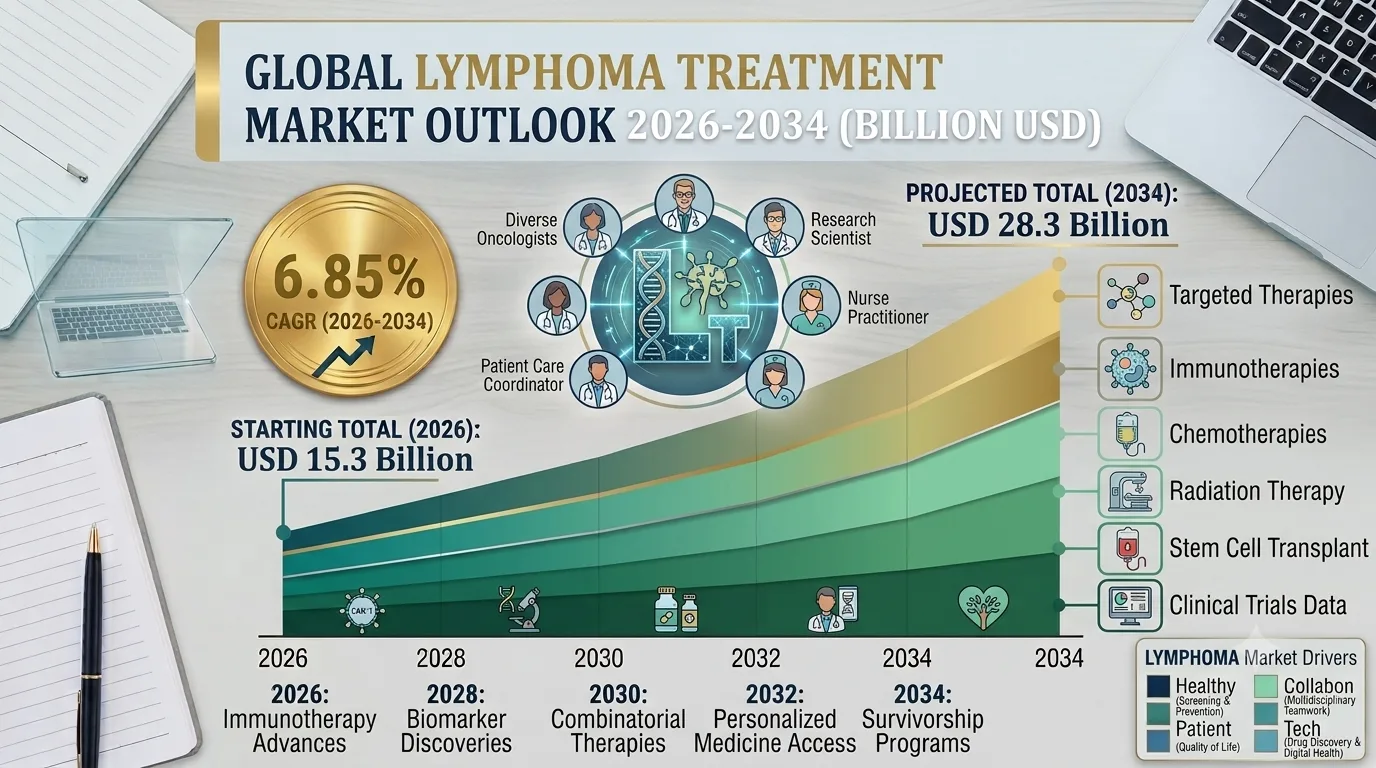
According to IMARC Group, the global lymphoma treatment market size reached USD 15.3 Billion in 2025 and is projected to reach USD 28.3 Billion by 2034, expanding at a CAGR of 6.85% during 2026–2034. This steady trajectory is driven by the rising prevalence of both Hodgkin and non-Hodgkin lymphoma, growing R&D investments, and increasing patient access to advanced therapeutic modalities globally.
Lymphoma Treatment Market: Industry Overview:
Lymphoma is a type of blood cancer that originates in the lymphatic system — a critical part of the body's immune defense. It is broadly classified into Hodgkin lymphoma (HL) and non-Hodgkin lymphoma (NHL), with NHL accounting for approximately 90% of all lymphoma cases worldwide. The diversity of lymphoma subtypes, ranging from indolent to aggressive forms, demands a wide spectrum of treatment approaches.
The treatment landscape includes multiple modalities:
● Chemotherapy: Drug combinations to destroy rapidly dividing cancer cells
● Radiation Therapy: High-energy beams to target localized tumors
● Immunotherapy: Harnessing the immune system through checkpoint inhibitors and monoclonal antibodies
● Targeted Therapy: Precision drugs like Imbruvica that block specific cancer cell pathways
● Biologic Therapy: Therapies derived from biological sources, including CAR-T cell treatments
Key drugs driving the market include Adcetris, Rituxan, Opdivo, Imbruvica, Keytruda, and Revlimid — each addressing specific lymphoma subtypes and lines of therapy. The evolution of these agents continues to redefine the treatment paradigm and directly influences the Lymphoma Treatment Market Share across therapeutic categories.
Global Market Overview & Lymphoma Treatment Market Statistics
Below are the key statistics from IMARC Group's comprehensive market analysis:
Report AttributeKey StatisticsBase Year2025Historical Period2020–2025Forecast Period2026–2034Lymphoma Treatment Market Size in 2025USD 15.3 BillionLymphoma Treatment Market Forecast in 2034USD 28.3 BillionLymphoma Treatment Market Growth Rate (2026–2034)6.85% CAGRLargest RegionNorth America
Request for a Sample Report for Detailed Lymphoma Treatment Market Insights: https://www.imarcgroup.com/lymphoma-treatment-market/requestsample
Key Market Drivers & Trends in 2026:
Several pivotal forces are shaping the lymphoma treatment market growth trajectory and fueling investment across the global oncology space:
1. Rising Prevalence of Lymphoma:
The global incidence of lymphoma is climbing steadily. According to the American Cancer Society, nearly 80,000 people were projected to be diagnosed with non-Hodgkin lymphoma in 2024 alone. Aging populations and improved diagnostic capabilities are key contributors, creating sustained demand for effective treatment solutions and driving Lymphoma Treatment Market Size expansion year over year.
2. Surging Focus on Personalized Medicine:
The paradigm shift toward precision oncology is one of the most significant trends reshaping the market. Tailoring lymphoma therapies based on a patient's genetic, molecular, and immunological profile is improving outcomes and reducing side effects. IMARC Group estimates the global precision medicine market reached USD 75.2 Billion in 2023, growing at a CAGR of 9.1% through 2032 — a momentum that is directly benefiting the lymphoma space.
3. Increasing R&D Investments:
Pharmaceutical companies and non-profit organizations are channeling significant capital into lymphoma research. In November 2023, the Leukemia & Lymphoma Society (LLS) committed USD 65 million in new awards to 78 research teams across seven countries. These investments accelerate the pipeline of novel therapies and contribute to Lymphoma Treatment Market Growth by expanding available treatment options.
4. Advancements in Immunotherapy and Targeted Agents:
The development of innovative immune checkpoint inhibitors — which block proteins that suppress immune response and thereby enhance T-cell activity against cancer cells — is a defining trend. Drugs like Opdivo (nivolumab) and Keytruda (pembrolizumab) have demonstrated efficacy in relapsed/refractory lymphoma, expanding market access and improving Lymphoma Treatment Market Share for the immunotherapy segment.
5. Increasing Awareness and Earlier Diagnosis:
Greater public awareness, expanding cancer screening programs, and access to advanced diagnostics are enabling earlier lymphoma detection. Earlier diagnosis typically translates to better treatment outcomes and longer patient journeys, both of which positively influence market demand and long-term revenue generation across the therapeutic value chain.
6. Growing Healthcare Expenditure:
Rising government and private spending on oncology care — especially in North America, Europe, and increasingly Asia Pacific — is enabling broader patient access to high-cost innovative therapies. This fuels overall Lymphoma Treatment Market Size growth by expanding the addressable patient pool and facilitating commercialization of next-generation treatment modalities.
Key Market Segmentation:
By Type:
Hodgkin Lymphoma (HL) — Representing approximately 10% of all lymphoma cases globally, Hodgkin lymphoma has a well-established treatment pathway and high cure rates in early stages. The availability of targeted agents like Adcetris (brentuximab vedotin) has significantly improved outcomes in relapsed/refractory HL.
Non-Hodgkin Lymphoma (NHL) — Dominant Segment: NHL accounts for approximately 90% of all lymphoma cases globally, and its incidence has increased over the past several decades. This segment commands the lion's share of the Lymphoma Treatment Market Share owing to disease heterogeneity, complex treatment pathways, and a broad pipeline of approved therapies.
By Test Type (Treatment Modality):
Chemotherapy: Standard-of-care for most lymphoma subtypes; combinations like CHOP and R-CHOP remain widely used across global markets.
Radiation Therapy: Delivered externally or internally, used primarily in early-stage or localized lymphoma for disease control.
Immunotherapy: The fastest-growing modality; includes monoclonal antibodies and immune checkpoint inhibitors that leverage the body's own immune defenses against cancer cells.
Targeted Therapy: Precision agents including BTK inhibitors (Imbruvica) that specifically attack cancer cell signaling pathways with minimal damage to healthy tissue.
Biologic Therapy: Includes emerging cell-based therapies such as CAR-T, representing the frontier of lymphoma treatment innovation and a key driver of future Lymphoma Treatment Market Growth.
By Drug
Leading drugs profiled in the IMARC Group report include:
● Adcetris (brentuximab vedotin) — HL and systemic anaplastic large cell lymphoma (sALCL)
● Rituxan (rituximab) — B-cell NHL and autoimmune indications
● Opdivo (nivolumab) — PD-1 checkpoint inhibitor; classical Hodgkin lymphoma
● Imbruvica (ibrutinib) — BTK inhibitor for several NHL subtypes
● Keytruda (pembrolizumab) — Broad-spectrum checkpoint inhibitor
● Revlimid (lenalidomide) — Immunomodulatory agent used in NHL
By End-Use / Region:
The market spans hospitals, oncology clinics, research institutions, and academic medical centers — each representing a distinct channel for treatment delivery and product adoption, influencing the overall lymphoma treatment market share across regions.
Regional Market Analysis:
Regional dynamics vary significantly across global markets, reflecting differences in disease burden, healthcare infrastructure, and access to novel therapies:
RegionKey HighlightsNorth America – LargestHigher NHL prevalence due to aging population; advanced healthcare infrastructure; strong emphasis on genomic profiling and targeted therapies; high healthcare spending enabling access to premium treatmentsEuropeGermany, France, UK, Italy, Spain, Russia; robust healthcare systems; increasing access to novel immunotherapies; supportive regulatory frameworks for oncology innovationAsia PacificChina, Japan, India, South Korea, Australia, Indonesia; rising lymphoma incidence due to aging populations, urbanization, and changing lifestyles; fast-growing digital health investmentLatin AmericaBrazil, Mexico; Brazil is the largest LatAm healthcare market; growing demand as healthcare infrastructure and cancer care access expandMiddle East & AfricaUAE, Saudi Arabia, South Africa; healthcare modernization programs; rising cancer burden driving treatment demand and market development
Connect for Detailed Segmentation Analysis – Speak to an Analyst: https://www.imarcgroup.com/request?type=report&id=3385&flag=C
Leading Players in the Lymphoma Treatment Industry:
The global lymphoma treatment market features a competitive landscape of leading pharmaceutical companies investing heavily in R&D, licensing agreements, and strategic acquisitions. Key companies covered in the IMARC Group report include:
● Abbott Laboratories
● Bristol-Myers Squibb Company
● Eli Lilly and Company
● F. Hoffmann-La Roche Ltd.
● Johnson & Johnson Services, Inc.
● Merck & Co., Inc.
● Novartis International AG
● Spectrum Pharmaceuticals, Inc.
● Takeda Pharmaceutical Company Limited
● Teva Pharmaceutical Industries Ltd.
The IMARC report includes a comprehensive competitive analysis covering market structure, player positioning, top winning strategies, a competitive dashboard, and a company evaluation quadrant.
Latest Industry Developments:
February 2024 – Knight Therapeutics Inc.
Knight Therapeutics launched Minjuvi (tafasitamab) through its Brazilian affiliate for the treatment of adult patients with relapsed or refractory diffuse large B-cell lymphoma — a major B-cell NHL subtype — marking a significant commercial milestone in Latin America.
March 2024 – GenFleet Therapeutics & BeiGene Switzerland
GenFleet Therapeutics and BeiGene Switzerland commenced a Phase Ib/II clinical trial combining GFH009 with BRUKINSA (zanubrutinib) for the treatment of diffuse large B-cell lymphoma, signaling continued momentum in combination therapy development.
November 2023 – The Leukemia & Lymphoma Society (LLS):
LLS granted USD 65 million in new awards to 78 research teams across seven countries, underscoring the scale of investment in blood cancer research and the breadth of the global scientific community working to advance lymphoma treatment.
About Us
IMARC Group is a leading global market research company providing data-driven insights and expert consulting services to businesses seeking to achieve their strategic objectives. With a multi-disciplinary team of industry experts, IMARC delivers thorough, reliable market intelligence across sectors including Technology, Construction, Healthcare, Energy, Food & Beverages, and more.
Contact Us
IMARC Group
United States: +1-201-971-6302
India: +91-120-433-0800
United Kingdom: +44-753-714-6104