
Introduction
Choosing the right sports bra for different workouts is just as critical as choosing the right footwear for your training. Wearing the wrong support level can lead to neck and back strain, tissue discomfort, and premature stretching of Cooper’s ligaments—the delicate connective tissue that gives breasts their natural lift and shape.
Sports bras are categorised into three primary levels: low support, medium support, and high support. The right choice depends on two core factors: your workout’s impact level and your cup size.
In this guide, we break down the mechanics behind each support level, examine compression versus encapsulation designs, and help you select the exact bra needed for your fitness routine.
WHAT DETERMINES SPORTS BRA SUPPORT?
During exercise, breast movement can occur in multiple directions, including vertical, horizontal and side-to-side movement. Sports bras are designed to reduce this movement and improve comfort during physical activity. If you're unsure why a sports bra is different from a regular bra, our guide to sports bra vs regular bra explains the key differences in support, fit and construction.
Sports bras control this movement using two primary engineering methods:
Compression designs use pressure against the body to help reduce breast movement, while encapsulation designs use individual cups to support each breast separately. Some sports bras combine both approaches. For more information, see our sports bra sizing guide.
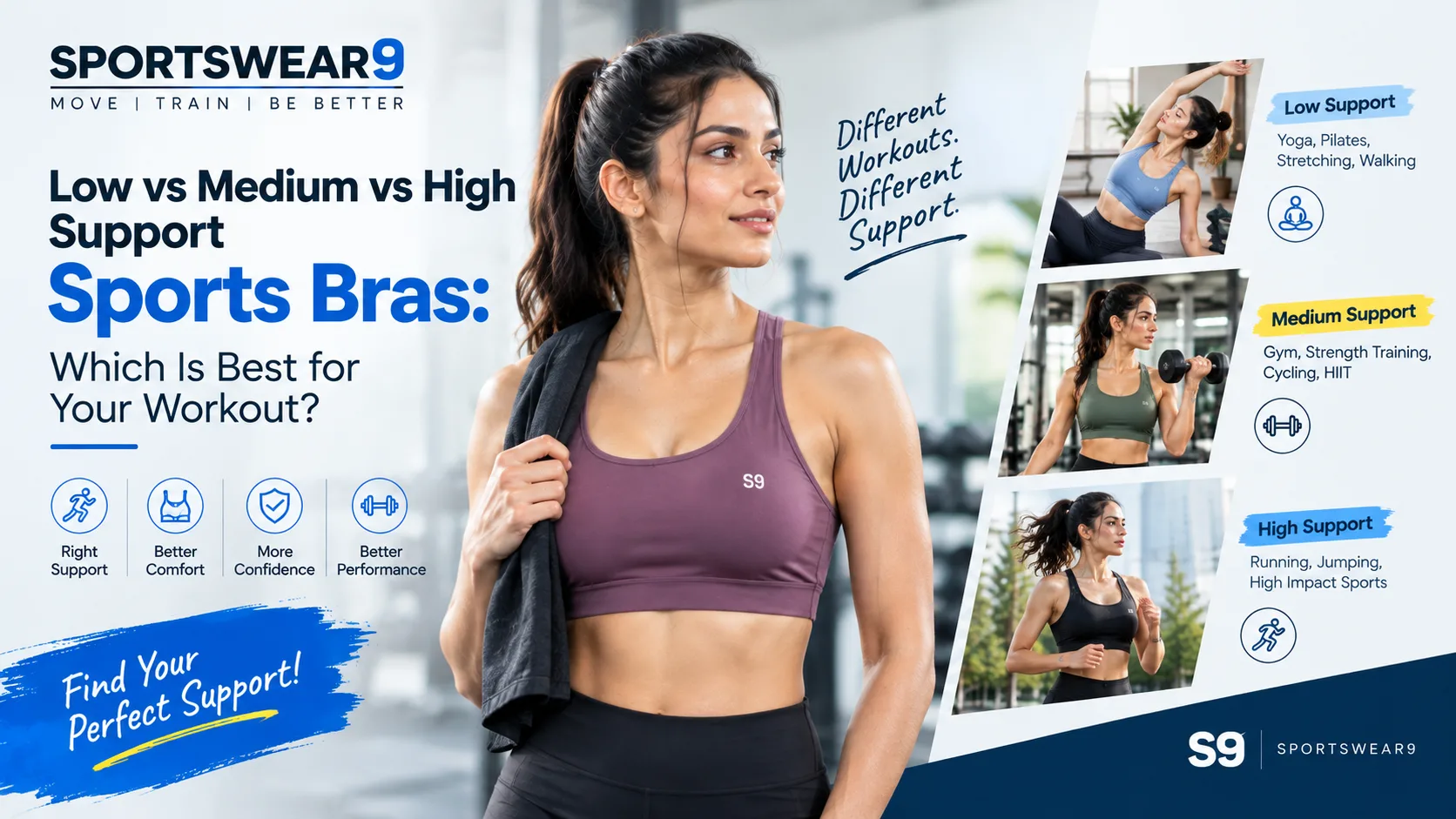
Support LevelBest ForMovement LevelMain BenefitLow SupportYoga, Pilates, stretching, walkingLight movementComfort and flexibilityMedium SupportGym, cycling, strength training, hikingModerate movementBalance of comfort and controlHigh SupportRunning, HIIT, jumping, aerobicsHigh-impact movementMaximum bounce control and stability
Low‑Support Sports Bra: Best for Light Workouts
A low‑support sports bra is designed for activities where there is breast movement.
Best workouts for low‑support sports bras
They can be suitable for:
- Yoga
- Pilates
- Stretching
- Meditation
- Light mobility exercises
- Walking
- Low‑intensity strength training
These sports bras are often lightweight and flexible, making them comfortable when maximum support is not necessary.
What to look for
When choosing a low‑support sports bra, consider:
- fabric
- Flexible construction
- Comfortable straps
- A secure but non‑restrictive band
- Good breathability
- Moisture‑managing material if you sweat during exercise
For yoga or stretching, flexibility may be more important than maximum compression. A sports bra that allows comfortable movement can make floor exercises and stretching easier.
Who Can Choose Low Support?
Low-support styles can work well for activities with minimal bouncing. However, if the sports bra feels uncomfortable during jumping or running, you may need a higher support level.
Medium‑Support Sports Bra: Best for Moderate Training
A medium‑support sports bra provides a balance between comfort and breast movement control. It is an option for gym and fitness activities.
Best workouts for medium support
Medium‑support sports bras can be suitable for:
- Strength training
- Weight training
- Gym workouts
- Cycling
- Dance workouts
- Hiking
- cardio
- walking
- Resistance training
For example, if your workout includes exercises such as squats, lunges, dumbbell exercises, machines, and moderate cardio, a medium‑support sports bra may provide a useful balance. For a closer comparison, see our guide to sports bras for gym vs running.
What makes medium support different?
Compared with low‑support styles, medium‑support sports bras may have:
- structured construction
- Wider bands
- secure straps
- Greater coverage
- Moderate compression
- Better movement control
The exact construction of a medium‑support sports bra varies between brands, so the label alone should not determine your choice. Pay attention to how the sports bra fits and how it performs during your workout.
Is Medium Support Good for the Gym?
Medium support can be a good choice for gym workouts that mainly involve strength training and do not include much jumping or high-impact movement. If your workout includes running, jumping, or HIIT, a high-support sports bra may be more suitable.
Assuming that padding equals support
Padding gives shape and coverage. It does not automatically give support.
Buying the size
A sports bra that's the wrong size can feel too tight, or it can feel too loose and not supportive.
Using the sports bra for all workouts
You might want levels of support for different workouts. A low‑support sports bra is often comfortable for yoga, while a high‑support sports bra is usually better for running.
High-Support Sports Bra: Best for Running, HIIT and Jumping
A high-support sports bra is designed for workouts with repeated impact, fast movement, and bouncing. It helps reduce breast movement and gives a more secure feel during intense exercise.
Best workouts for high-support sports bras
High-support sports bras are suitable for:
- Running
- HIIT
- Jump rope
- Aerobics
- Sprint training
- Boxing workouts
- High-impact cardio
- Cross-training
- Dance fitness with jumping movements
What to look for in a high-support sports bra
When choosing a high-support sports bra, look for:
- A firm underband
- Wide, adjustable straps
- Full coverage
- Strong compression or encapsulation support
- Moisture-wicking fabric
- Secure closure or racerback design
- Minimal bounce during movement
For running and HIIT, support and stability are more important than style alone. A high-support sports bra should feel secure without causing pain, digging, or restricted breathing.
How to Choose the Right Sports Bra Support Level
Start by identifying the type of exercise you do most often.
Low support: Yoga, Pilates, stretching, walking and light activities.
Medium support: Strength training, gym workouts, cycling and moderate-impact exercise.
High support: Running, HIIT, jumping, aerobics and other high-impact workouts.
If you participate in several types of exercise, you may benefit from having more than one sports bra with different support levels.
Frequently Asked Questions
Is high support better than low support?
Not necessarily. The best support level depends on your workout. High-support sports bras are generally better for high-impact activities such as running and HIIT, while low-support sports bras can be comfortable for yoga, stretching and other low-impact activities.
What support level is best for running?
High support is generally best for running. Running involves repeated impact and breast movement, so a high-support sports bra can provide better movement control and stability.
What support level is best for gym workouts?
Medium support is often suitable for strength-focused gym workouts. If your routine also includes running, jumping, or HIIT, a high-support sports bra may be more appropriate.
Is medium support enough for HIIT?
Medium support may not be enough for HIIT. Because HIIT can include jumping, fast movements and repeated impact, a high-support sports bra is usually a better choice for movement control and comfort.
Can I wear a low-support sports bra for yoga?
It is possible to wear a low‑support sports bra for yoga. Low support works well for yoga, stretching, Pilates, and other low‑impact activities.
Does a larger bust always require support?
Not necessarily. Breast size can influence the level of support you prefer, but workout intensity also matters. Someone may choose a low-support sports bra for yoga and a high-support sports bra for running, regardless of whether they have a smaller or larger bust.
How do I know if my sports bra has enough support?
A sports bra provides enough support when it feels secure without causing pain, excessive pressure or restricted breathing. During movement, there should be minimal unwanted bouncing, and the band and straps should stay comfortably in place. Try movements similar to your workout before deciding whether the support level is right for you.
Final Thoughts
Deciding between medium and high support sports bras is easier when you think first about the workout, not how the sports bra looks.
For yoga, stretching, and light activities, low support gives the flexibility and comfort you want. For strength training, cycling, and moderate gym workouts, medium support strikes a balance. For running,g HIIT, jumping, ng and other high‑impact workouts, high support is usually the choice.
The right sports bra for a woman should give the support you need while staying comfortable, secure, breathable, and suitable for movement.
If you are building a workout wardrobe, match your sports bra with gym tops for women, gym leggings and other workout clothes that fit your training routine. Match the sports bra with gym leggings, gym tops for women, and other workout clothes that fit your training routine. Sportswear9 can help you put together an activewear wardrobe for workouts.