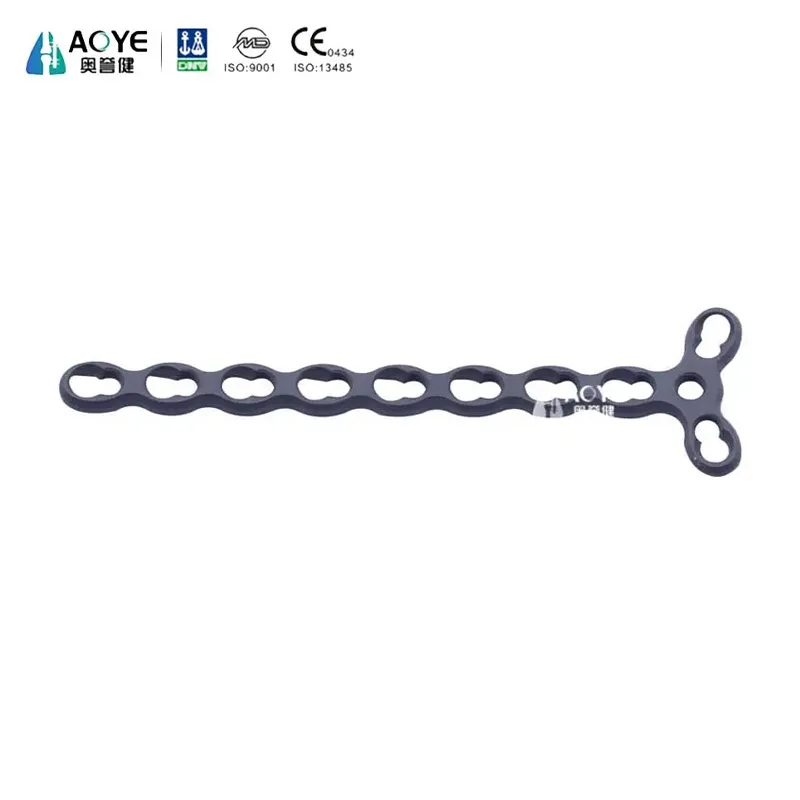
Non-Locking Plate (DCP / LC-DCP / Reconstruction)
The screw threads through the plate's compression hole and into the bone. As the screw is tightened, the screw head pulls the plate against the bone surface, generating friction. This friction is what holds the bone fragments in place.
Stability depends on:
Bone quality (cortical thickness, density)
Plate-bone contact area
Screw torque and axial preload
In osteoporotic bone, screws can toggle and pull out — a phenomenon called screw cut-out — leading to fixation failure.
Locking Plate (LCP)
The locking screw head has machine threads that match threaded conical holes in the plate. When the screw is fully inserted and tightened, it locks into the plate, creating a single rigid beam construct.
Stability is independent of bone quality because load is transferred through the screw-plate junction, not via bone-plate friction. This makes locking plates the preferred choice for osteoporotic and metaphyseal fractures.
Side-by-Side Comparison
Indications for Locking Plate
Osteoporotic fractures — fixed-angle construct resists screw pull-out in weak cancellous bone.
Periarticular fractures — distal radius, distal femur, proximal tibia, proximal humerus, calcaneus, tibial plateau; locked cluster of screws supports metaphyseal fragments.
Metaphyseal comminution — bridge plating avoids devascularization of fragments.
Minimally invasive plate osteosynthesis (MIPO) — sub-muscular insertion without bone contact.
Periprosthetic fractures — locking screws can angle around existing implants.
Revision of failed conventional fixation — locked construct provides secondary stability.
Indications for Non-Locking Plate
Diaphyseal fractures with good bone quality — compression aids primary healing.
Simple two-part fractures — anatomic reduction with interfragmentary compression.
Pediatric fractures — non-locking allows easier removal and accommodates growth.
Cost-sensitive settings — non-locking implants are 30-50% cheaper.
Hybrid Technique (Most Common in Modern Practice)
The LCP combi-hole design enables a hybrid approach:
Place one or two non-locking cortical screws near the fracture to draw the bone to the plate and achieve compression.
Place locking screws at the ends of the plate (far from the fracture) for fixed-angle stability.
This combines interfragmentary compression (aids primary bone healing) with fixed-angle anchorage (protects against varus collapse).
The hybrid technique is the most widely used LCP strategy for diaphyseal-metaphyseal junction fractures.
Bridge Plating and MIPOMinimally invasive plate osteosynthesis (MIPO) relies on locking plate principles. The technique:
Make small incisions proximal and distal to the fracture.
Create a sub-muscular tunnel along the bone.
Insert the plate through the tunnel without exposing the fracture.
Lock screws proximally and distally through the small incisions.
MIPO preserves the fracture hematoma and soft-tissue envelope, which accelerates biological healing and reduces infection risk. Locking plates are mandatory for this technique because the plate does not contact the bone — only the locking screws anchor it.
Disadvantages and Pitfalls of Locking PlatesHigher cost — typically 1.5-2x non-locking plates.
Limited contourability — once bent, the locking holes may no longer align with the locking screw threads. Use dedicated plate benders; never use pliers.
Cold welding — over-torquing or cross-threading can weld the locking screw into the plate, complicating removal. Use a torque-limiting driver and the manufacturer's recommended torque (3.0-4.0 Nm for 3.5 mm screws, 4.0-5.0 Nm for 4.5 mm screws).
Stress shielding — rigid locked constructs may shield load from the bone, especially when used across long segments in young patients with good bone quality. Consider hybrid fixation in these cases.
Not a substitute for reduction — locking plates preserve reduction but do not create it. Indirect reduction techniques (table, distracter, percutaneous clamps) are still required.
Decision AlgorithmIs the bone quality adequate (cortical > 2 mm, healthy)?
├── Yes
│ └── Is the fracture simple (2-part, transverse/short oblique)?
│ ├── Yes → Non-locking plate (DCP / LC-DCP) with compression
│ └── No → LCP with hybrid compression + locking
└── No (osteoporotic / poor quality)
└── Always use locking plate (LCP)
└── Add bone cement or bone graft augmentation for severe defects
Is the fracture periarticular (within 5 cm of joint)?
├── Yes → Locking plate (anatomic periarticular LCP)
└── No (diaphyseal) → Continue above
Is MIPO planned?
├── Yes → Locking plate (mandatory)
└── No → Either based on the above
Complication Differences
AOYE manufactures complete locking and non-locking plate families for orthopedic trauma:
All plates are available in Ti-6Al-4V ELI (ASTM F136) or 316L stainless steel. OEM/ODM, CE marking (MDR 2017/745), and ISO 13485 certification are standard. Low MOQ (50 units per SKU) is available.
Request a quotation at [email protected].
Frequently Asked QuestionsWhat is the difference between locking and non-locking plates?

A non-locking plate relies on friction between plate and bone for stability. A locking plate uses screws that thread into the plate hole, creating a fixed-angle construct whose stability is independent of bone quality. Locking plates are preferred in osteoporotic bone and periarticular fractures.
Can locking and non-locking screws be used in the same plate?
Yes, if the plate has combi-holes (LCP design). The combi-hole accepts both screw types. The hybrid technique combines compression near the fracture with fixed-angle anchorage at the plate ends.
When is a locking plate necessary?
A locking plate is necessary or strongly preferred for comminuted periarticular fractures, osteoporotic bone, metaphyseal comminution, bridge plating in MIPO, periprosthetic fractures, and revision of failed conventional fixation.
What are the disadvantages of locking plates?
Locking plates are more expensive, cannot be easily contoured (locking screws must align), may contribute to stress shielding if used across long bone segments, and may experience cold welding during removal if over-torqued.
Does AOYE offer both locking and non-locking plates?
Yes. AOYE manufactures full lines of LCP (locking with combi-holes) and DCP / LC-DCP (dynamic compression) systems in titanium and stainless steel. OEM/ODM services, CE marking, and ISO 13485 certification are standard.