Artificial intelligence (AI), high-performance computing (HPC), and GPU-intensive workloads are changing the way modern data centers are designed and operated. As computing power increases, so does the amount of heat generated by servers, processors, and accelerators. This creates a critical challenge for data center operators: how can they support growing computing demands without allowing cooling infrastructure to become a bottleneck?
Traditional air cooling continues to serve many enterprise IT environments effectively. However, as rack densities increase and AI workloads become more demanding, organizations need to evaluate whether their existing cooling architecture can support future growth.
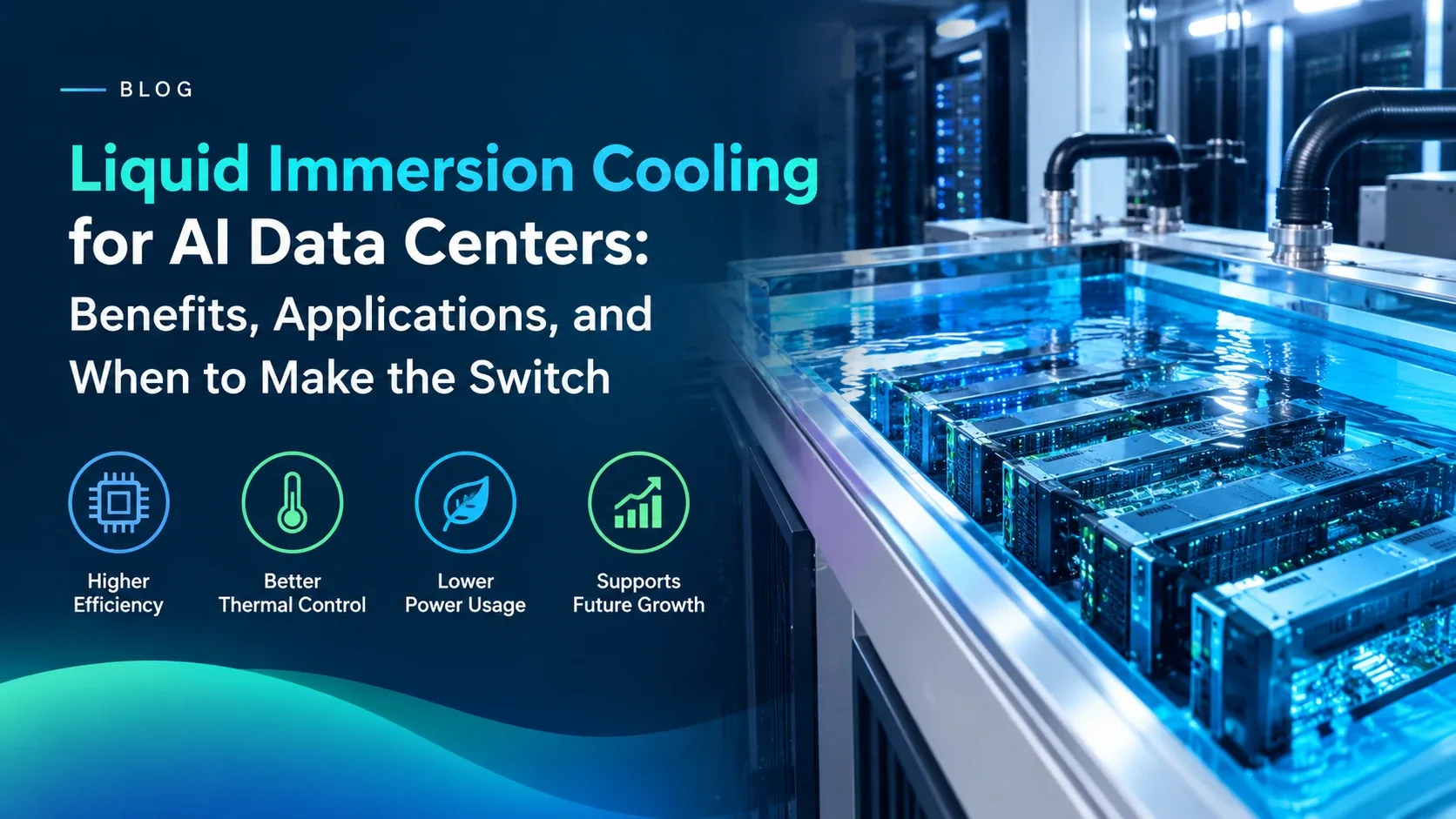
This is where liquid immersion cooling for AI data centers is gaining attention. By submerging server hardware in a specially formulated dielectric liquid, immersion cooling enables heat to be captured directly from the equipment rather than relying primarily on airflow through server racks.
But is immersion cooling the right choice for every data center? Understanding how the technology works, where it delivers value, and what organizations need to consider before implementation can help decision-makers make more informed infrastructure investments.
What Is Liquid Immersion Cooling?
Liquid immersion cooling is a data center cooling method in which compatible IT equipment is immersed in a dielectric fluid designed to absorb heat without conducting electricity under its intended operating conditions.
Unlike conventional air cooling, which moves air through servers and uses fans to manage component temperatures, immersion cooling brings the cooling medium into direct contact with the immersed hardware.
As the servers operate, their components generate heat. The dielectric fluid absorbs this heat, which is subsequently transferred to a heat-rejection system.
Immersion cooling generally falls into two categories:
1. Single-phase immersion cooling
In single-phase systems, the dielectric fluid remains in its liquid state during normal operation. Heat absorbed by the fluid is transported through a circulation and heat-exchange system.
This approach is relevant to organizations exploring high-density computing, AI infrastructure, HPC environments, and certain enterprise deployments.
2. Two-phase immersion cooling
In two-phase systems, the dielectric fluid changes from liquid to vapor as it absorbs heat. The vapor then condenses, releasing heat through the system's heat-rejection mechanism.
Two-phase systems have different equipment, fluid-management, and operational requirements, making it important to evaluate their suitability for the intended deployment.
The right approach depends on workload characteristics, infrastructure compatibility, operational requirements, and long-term scalability.
Why Are AI Data Centers Exploring Immersion Cooling?
AI infrastructure places new demands on data center thermal management. GPUs and other accelerators can generate substantial amounts of heat within relatively concentrated physical spaces.
As computing density rises, removing heat efficiently becomes increasingly important to maintaining stable operating conditions and supporting planned infrastructure expansion.
Several factors are driving interest in immersion cooling.
1. Managing High-Density Computing
Traditional cooling architectures must deliver sufficient airflow and maintain appropriate temperature conditions across server racks. As rack power increases, meeting these requirements can become more complex.
Immersion cooling offers an alternative by capturing heat directly at the hardware level. This can reduce dependence on room-level airflow for the immersed equipment and support deployments designed around higher thermal loads.
For operators planning AI clusters or HPC infrastructure, evaluating cooling requirements alongside rack density can help prevent thermal constraints from limiting deployment plans.
2. Reducing Dependence on Server Fans
Air-cooled servers typically use fans to move air across heat-generating components. Immersion-cooled configurations can reduce or eliminate the need for conventional server fans, depending on the hardware and system design.
Reducing fan-related power consumption can contribute to overall infrastructure efficiency. However, the total result depends on the pumps, heat exchangers, cooling distribution systems, and other equipment required by the complete installation.
3. Supporting Future Infrastructure Expansion
Cooling requirements should be evaluated before additional computing capacity is installed, rather than only after thermal limitations appear.
Immersion cooling can offer an alternative architecture for facilities where airflow management, rack density, or available mechanical capacity presents a challenge.
A well-planned deployment should consider future hardware refreshes, expansion requirements, maintenance procedures, and the integration of cooling equipment with existing infrastructure.
4. Evaluating Space and Facility Requirements
As rack densities increase, conventional cooling approaches may require additional airflow management, mechanical equipment, or infrastructure modifications.
Immersion cooling changes how heat is captured and transported, potentially creating opportunities to simplify parts of the cooling architecture.
Actual space savings depend on system configuration, service clearances, heat rejection, fluid storage, and the wider facility design. These factors should be assessed as part of a complete engineering evaluation.
Immersion Cooling vs. Traditional Air Cooling
Air cooling and immersion cooling solve the same fundamental problem: removing heat from IT equipment. However, they approach that problem differently.
Air cooling uses fans, airflow pathways, and heat exchangers to maintain equipment temperatures. Immersion cooling uses dielectric fluid to capture heat directly from compatible immersed components.
Air cooling remains appropriate for many conventional enterprise workloads, networking equipment, storage systems, and existing lower-density infrastructure.
Immersion cooling may be worth evaluating when AI or HPC deployments create higher thermal demands, when airflow becomes increasingly difficult to manage, or when a facility needs a different approach to supporting computing density.
The decision should not be based on technology trends alone. Operators need to compare capital expenditure, operating costs, energy use, maintenance requirements, hardware compatibility, and future expansion plans.
For a broader discussion of these considerations, read our related article on data center cooling systems and when air cooling reaches its limits.
What Should You Consider Before Adopting Immersion Cooling?
Although immersion cooling offers potential advantages, successful implementation requires more than selecting a cooling tank or rack.
Organizations should evaluate several practical considerations before committing to a deployment.
Hardware Compatibility
Not every server configuration is automatically suitable for immersion. Components, materials, connectors, storage devices, and other hardware elements must be assessed for compatibility with the chosen fluid and operating conditions.
Organizations should work with equipment manufacturers and cooling solution providers to establish appropriate hardware configurations.
Fluid Selection and Management
The dielectric fluid is a critical part of the cooling system. Its thermal characteristics, compatibility, maintenance requirements, and expected service life should be considered during system selection.
Fluid handling, monitoring, contamination control, and replacement procedures should also form part of the operational plan.
Heat Rejection and Facility Integration
Immersion cooling does not eliminate the need to reject heat from the facility. The absorbed heat must still be transferred to an appropriate heat-rejection system.
The design must account for local climate, available infrastructure, cooling-water requirements where applicable, and the site's overall thermal-management strategy.
Maintenance and Serviceability
Maintenance practices differ between air-cooled and immersion-cooled environments.
Teams may need revised procedures for server installation, hardware removal, fluid handling, equipment servicing, and incident response. Staff training and clearly documented maintenance processes are important considerations.
Total Cost of Ownership
The financial evaluation should extend beyond the initial purchase price.
A meaningful comparison includes cooling equipment, facility modifications, power consumption, maintenance, hardware lifecycle costs, deployment timelines, and expected expansion needs.
The most appropriate solution is the one that meets the organization's performance and operational requirements over its intended lifecycle.
Where Can Immersion Cooling Deliver Value?
Liquid immersion cooling is relevant to several computing environments where thermal management is an important infrastructure consideration.
AI and machine learning infrastructure: Training and inference workloads can place substantial demands on GPUs and other accelerators. Immersion cooling provides an alternative for compatible high-density deployments.
High-performance computing: Scientific research, simulation, and other compute-intensive applications can benefit from cooling architectures designed around concentrated thermal loads.
Enterprise data centers: Organizations modernizing their infrastructure can assess immersion cooling where higher rack density, facility constraints, or future expansion requirements justify evaluating alternative technologies.
Edge computing and industrial environments: Some factories, remote facilities, and distributed computing sites need local processing for real-time analytics, machine vision, and AI-assisted operations. Integrated cooling platforms may be relevant where conventional data center infrastructure is difficult to deploy.
In each case, the suitability of immersion cooling depends on the computing workload, environmental conditions, available space, maintenance capabilities, and the design of the complete system.
How GRC Supports High-Density and Edge Computing
As organizations explore alternatives to conventional cooling, purpose-built solutions can help align thermal management with computing requirements.
GRC develops liquid immersion cooling solutions for applications spanning AI, HPC, enterprise computing, and edge infrastructure.
Its solution portfolio includes ICEraQ and ICEtank platforms, designed for immersion-cooled computing deployments. GRC also offers ICEraQ NANO for use cases involving distributed and industrial edge computing, subject to the requirements of the specific deployment.
For organizations evaluating immersion cooling, the important first step is to understand the workload, rack power requirements, existing infrastructure, and expected growth.
A solution assessment can then establish whether immersion cooling is appropriate and identify the system configuration and supporting infrastructure required.
How Do You Know When It Is Time to Move Beyond Air Cooling?
There is no single rack-density threshold at which every data center must transition to liquid cooling. The decision depends on the equipment, cooling architecture, environmental conditions, and deployment objectives.
However, several indicators suggest that it may be time to evaluate alternative cooling approaches:
- Planned server upgrades will substantially increase rack power density.
- Existing cooling equipment is approaching its practical capacity.
- Airflow management and hot-spot control are becoming more difficult.
- Facility upgrades are adding complexity or extending deployment timelines.
- AI or HPC requirements exceed what the current architecture can support efficiently.
- New edge deployments require compact, purpose-built infrastructure.
These indicators should prompt a structured review of cooling options rather than an automatic technology switch.
For more guidance on identifying cooling constraints and comparing available architectures, explore our article on data center cooling strategies for the next generation of AI infrastructure.
Conclusion: Building a Cooling Strategy for the Next Generation of AI
The growth of AI, HPC, and distributed computing is making thermal management a central consideration in data center planning.
Traditional air cooling remains valuable across many applications, but increasing rack densities and evolving computing requirements mean that organizations need to assess their cooling architecture against their future infrastructure roadmap.
Liquid immersion cooling offers a different approach to heat capture, with potential benefits for compatible high-density computing environments. Its suitability, however, depends on hardware compatibility, facility integration, operating requirements, and the economics of the complete deployment.
For organizations considering their next infrastructure investment, the objective should be to select a cooling architecture that supports performance, reliability, operational efficiency, and future growth.
GRC's immersion cooling solutions provide an option to evaluate for AI, HPC, enterprise, and industrial edge computing applications.
Planning a high-density AI or edge computing deployment? Contact GRC to discuss your cooling requirements and explore whether immersion cooling is the right fit for your infrastructure.