
Television technology has evolved dramatically over the last two decades. From bulky CRT televisions to modern Smart TVs with internet connectivity, the way people experience entertainment has completely changed. Yet one term continues to dominate the television market: LED TV.
Most Indian consumers have heard the term countless times. Whether shopping online or visiting an electronics store, televisions are often described as LED TVs, Smart LED TVs, Full HD LED TVs, or Android LED TVs.
But what exactly is LED TV technology?
How does it work?
And why has it become the standard for modern televisions?
This guide explains LED TV technology in simple terms so that Indian consumers can make smarter purchasing decisions without getting confused by technical jargon.
What Is an LED TV?
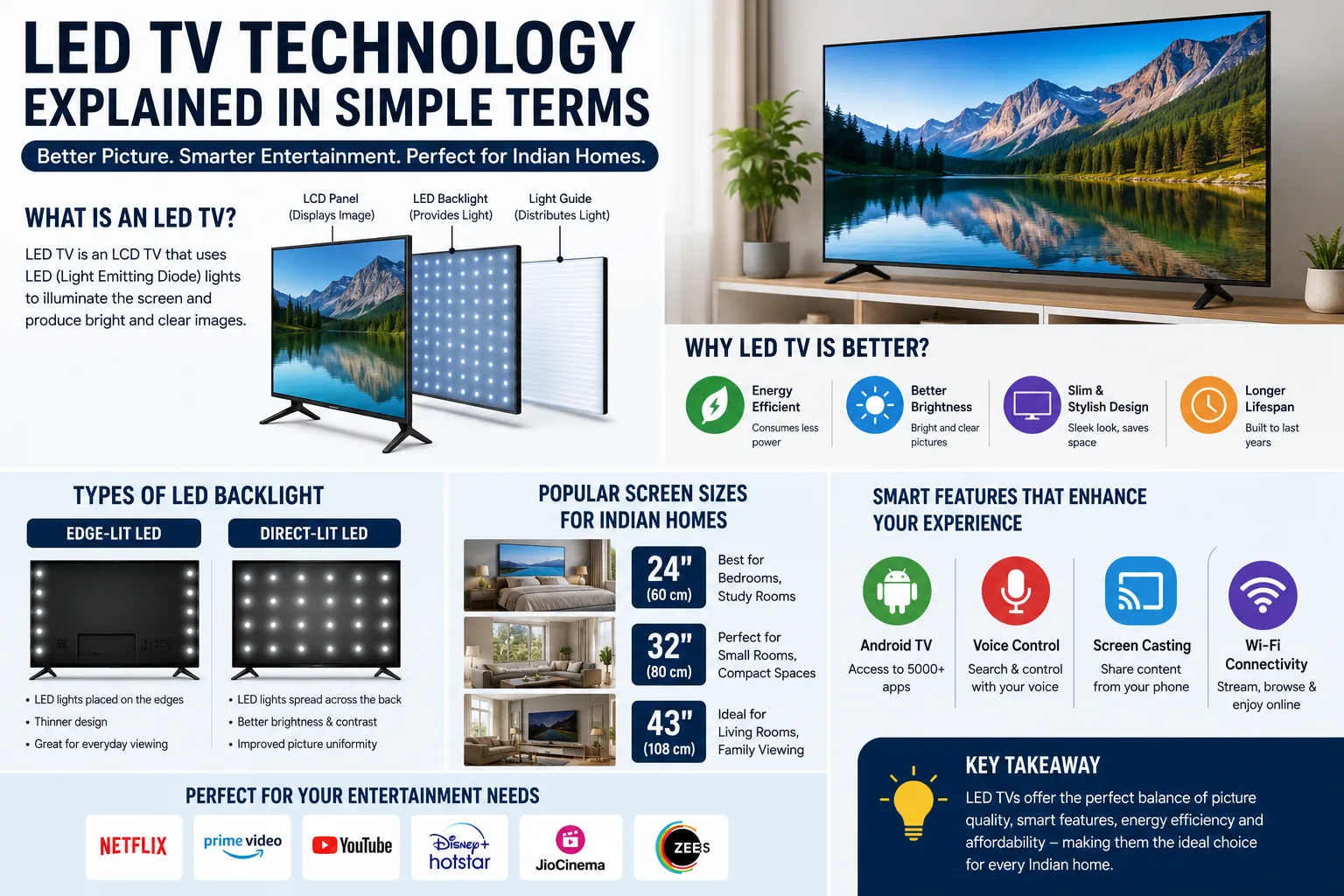
An LED TV is essentially an LCD television that uses LED lights to illuminate the display.
LED stands for Light Emitting Diode.
These tiny LED lights are placed behind the television screen and provide the brightness required to display images.
The LCD panel creates the picture, while the LED lighting makes the picture visible.
This combination creates:
- Brighter displays.
- Better picture quality.
- Lower power consumption.
- Slim television designs.
Most televisions available today are LED televisions because they offer excellent performance while remaining affordable.
How Does an LED TV Work?
To understand LED TV technology, imagine the television as two separate layers.
The first layer is the LCD panel, which creates colors and images.
The second layer consists of LED lights positioned behind the panel.
When electricity passes through these LEDs, they illuminate the display and allow viewers to see pictures on the screen.
The LEDs adjust brightness levels depending on the content being displayed.
Bright scenes receive more illumination, while darker scenes receive less.
This process creates:
- Better contrast.
- Improved brightness.
- More vibrant images.
Although the technology sounds complicated, the principle itself is relatively simple.
LED lights provide the illumination that brings images to life.
Why LED TVs Became Popular in India
The growth of LED TV India has been driven by several important factors.
First, LED televisions consume less electricity compared to older technologies. Lower power consumption is especially important for Indian households where energy efficiency matters.
Second, LED televisions are significantly thinner and lighter than traditional televisions.
Third, manufacturers can produce LED TVs at affordable prices, making them accessible to a large number of consumers.
Finally, LED technology supports modern features such as:
- Full HD displays.
- Smart TV platforms.
- Android TV.
- Voice control.
- OTT applications.
This combination of affordability, performance, and modern features has made LED TVs the preferred choice in India.
LED TV vs Old LCD TV
Many people believe LED TVs and LCD TVs are completely different technologies.
In reality, LED TVs are actually an improved version of LCD televisions.
Traditional LCD televisions used fluorescent lighting systems called CCFLs (Cold Cathode Fluorescent Lamps).
LED televisions replaced these older lighting systems with LEDs.
The advantages include:
- Better brightness.
- Improved energy efficiency.
- Slimmer designs.
- Better color performance.
- Longer lifespan.
This is why LED technology eventually replaced traditional LCD televisions in the market.
Edge-Lit and Direct-Lit LED Technology
LED televisions generally use two lighting methods.
Edge-Lit LED
In edge-lit televisions, LED lights are positioned around the edges of the screen.
This design allows manufacturers to produce thinner televisions.
Edge-lit TVs offer:
- Slim profiles.
- Modern designs.
- Lower manufacturing costs.
However, brightness distribution may sometimes be less uniform.
Direct-Lit LED
In direct-lit televisions, LEDs are positioned directly behind the screen.
This arrangement offers:
- Better brightness.
- Improved contrast.
- More uniform lighting.
Many modern Smart TVs use direct lighting to improve picture quality.
Full HD LED TVs Explained
Resolution plays an important role in picture quality.
A Full HD Smart TV offers a resolution of 1920 × 1080 pixels.
This provides:
- Sharper images.
- Better detail.
- Improved clarity.
- Enhanced OTT streaming quality.
For most Indian households, Full HD remains one of the most practical resolutions.
It is particularly beneficial for:
- 32 inch Smart TV
- 43 inch Smart TV
Full HD continues to provide an excellent balance between affordability and viewing experience.
How LED TVs Support Smart Features
Modern LED televisions are no longer just display devices.
Today's Smart TV India market combines LED technology with software platforms such as Android TV.
This allows televisions to support:
- OTT applications.
- YouTube.
- Voice control.
- Google Assistant.
- Screen casting.
- Internet browsing.
The LED panel provides the display, while the operating system provides smart functionality.
Together, they create the Smart TV experience that consumers enjoy today.
Android TV and LED Technology
One of the biggest developments in recent years has been the growth of Android TV India.
Android TV allows users to:
- Download applications.
- Stream OTT content.
- Search using voice commands.
- Access Google services.
- Receive software updates.
When combined with LED display technology, Android TV creates affordable Smart TVs that offer both excellent picture quality and smart entertainment.
This combination has transformed television usage in Indian homes.
Why LED TVs Are Ideal for Indian Homes
Several factors make LED televisions suitable for Indian consumers.
First, they consume less electricity, reducing energy costs.
Second, they offer excellent brightness levels, which is important in Indian homes where rooms often receive significant natural light.
Third, they are available across multiple screen sizes, including:
- 24 inch Smart TV
- 32 inch Smart TV
- 43 inch Smart TV
This flexibility allows consumers to choose televisions according to room size and budget.
LED technology offers practical solutions for a wide variety of home environments.
Sound Technology in Modern LED TVs
Picture quality is only one part of home entertainment.
Modern LED televisions increasingly include:
- Dolby Audio.
- DTS sound.
- Enhanced speakers.
These technologies improve:
- Dialogue clarity.
- Bass performance.
- Movie experiences.
- Sports viewing.
Consumers today expect both excellent visuals and immersive sound.
As a result, audio technology has become an important component of modern LED TVs.
LED TVs and OTT Streaming
The rise of OTT platforms has significantly increased the popularity of Smart LED televisions.
Consumers now use televisions for:
- Netflix.
- Prime Video.
- YouTube.
- JioCinema.
- Disney+ Hotstar.
LED TVs provide the brightness and clarity required for streaming content.
Combined with Android TV, they deliver a complete entertainment experience.
This shift has transformed televisions from channel-viewing devices into connected entertainment systems.
Common Myths About LED TVs
Many buyers believe:
- Bigger screens always provide better quality.
- Higher prices guarantee better performance.
- All LED TVs offer identical picture quality.
These assumptions are not always correct.
The overall experience depends on:
- Screen size.
- Resolution.
- Software.
- Sound quality.
- Viewing distance.
- Smart features.
Consumers should evaluate the complete television experience rather than focusing only on marketing claims.
The Future of LED Television Technology
LED technology continues to evolve.
Manufacturers are improving:
- Brightness.
- Energy efficiency.
- Color reproduction.
- Smart features.
- Connectivity.
Future televisions will likely integrate:
- Artificial intelligence.
- Better voice assistants.
- Smarter recommendations.
- Improved gaming experiences.
Despite these advancements, LED technology will continue to remain the foundation of affordable home entertainment.
Final Thoughts
Understanding LED TV technology does not require technical expertise.
In simple terms, LED televisions use LED lights to illuminate the screen, creating brighter, clearer, and more energy-efficient displays.
Combined with modern software platforms like Android TV India, LED televisions now provide:
- Smart entertainment.
- OTT streaming.
- Voice control.
- Better picture quality.
- Affordable pricing.
Whether you choose a 24 inch Smart TV, 32 inch Smart TV, or 43 inch Smart TV, understanding how LED technology works helps you make a better buying decision.
Because the best television is not the one with the most complicated specifications.
It is the one that delivers the best experience for your home and your lifestyle.