
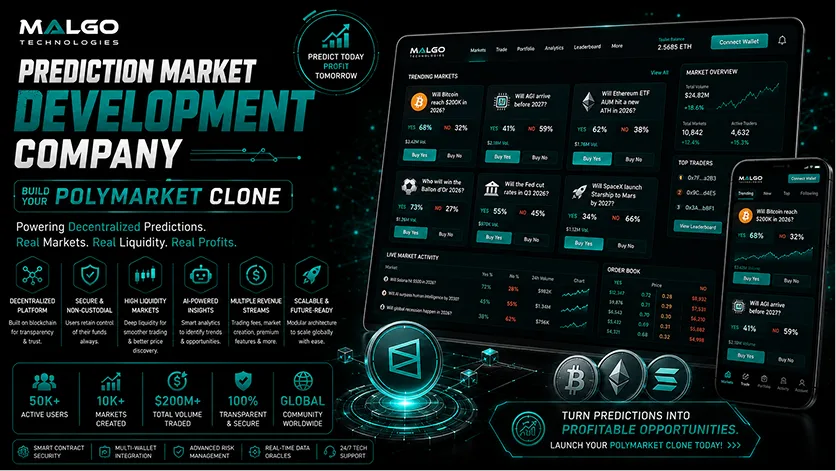
South Korea presents an interesting environment for entrepreneurs exploring blockchain-based prediction platforms. A prediction market allows users to trade positions around future outcomes, such as sports results, entertainment events, economic developments, or other clearly defined events. However, launching this type of platform in South Korea requires more than deploying a ready-made Polymarket clone script. Regulatory classification, payment infrastructure, user protection, market integrity, localization, and responsible platform design all need to be considered from the beginning
A clone script can provide the technical foundation, but the business model and legal structure must be adapted to the Korean market.
Understand South Korea’s Regulatory Environment First
The first step is determining how your proposed prediction market could be classified under South Korean law. This is particularly important when the platform involves real-money participation, digital assets, wagering, or outcomes that may resemble gambling.
South Korea has established regulatory frameworks covering virtual assets and speculative activities. The Virtual Asset User Protection Act has been effective since July 19, 2024, introducing requirements relating to user-asset protection and unfair trading activities for covered virtual asset businesses.
The regulatory environment is also evolving. In August 2026, South Korean authorities announced strengthened registration and anti-money-laundering requirements for virtual asset service providers, including enhanced customer due diligence and cybersecurity-related organizational expectations.
For a prediction-market operator, the key lesson is simple: do not assume that a Polymarket-style platform automatically fits within the existing virtual-asset framework. The actual classification can depend on how contracts, user funds, settlement, tokens, and markets are structured.
Before development begins, obtain advice from Korean legal professionals who understand fintech, virtual assets, gambling regulation, consumer protection, and financial services.
Choose the Right Prediction Market Model
A Polymarket clone script can generally be adapted to several market structures, but your chosen model should match the intended Korean business and compliance framework.
For example, the platform could use event-based contracts where participants trade positions representing possible outcomes. Alternatively, operators may consider simulated or educational prediction markets that do not involve redeemable monetary value.
This distinction matters because introducing real-money settlement can significantly change the regulatory considerations.
Define these elements before selecting or customizing the script:
- What users are predicting
- Whether participation involves monetary value
- How positions are created and traded
- How outcomes are verified
- Who resolves disputed results
- How settlements are processed
- Whether digital assets are involved
- Which jurisdictions users can access
- What activities are restricted
A clearly documented model makes subsequent technical and legal decisions much easier.
Localize the Polymarket Clone Script for Korean Users
Localization should go beyond translating buttons and menus.
A South Korean prediction platform should provide a natural Korean-language experience across registration, market descriptions, transaction notices, account settings, customer support, risk disclosures, and dispute procedures.
Date formats, currency displays, time zones, notification messages, and mobile usability should also be designed around Korean users.
Market descriptions deserve particular attention. Every event should have a precise question, defined resolution criteria, closing time, and authoritative source for determining the result. Ambiguous wording can quickly become a trust issue when real value is involved.
Build Strong KYC and AML Controls
If your business model falls within applicable financial or virtual-asset requirements, identity verification and anti-money-laundering controls should be considered core infrastructure rather than optional additions.
South Korean authorities have continued strengthening VASP registration and AML requirements. Recent changes include enhanced customer due diligence and additional controls around virtual-asset transfers.
Your platform architecture should therefore be capable of supporting:
- Customer identity verification
- Risk-based account monitoring
- Transaction monitoring
- Suspicious-activity controls
- Account restrictions and review workflows
- Secure record retention
- Geographic and jurisdictional controls
Compliance reporting where legally required
The exact obligations depend on the final structure of the business, so compliance requirements should be mapped before the production launch.
Prioritize Market Integrity
Prediction markets depend heavily on trustworthy information.
A technically impressive platform can still fail if users believe markets can be manipulated or outcomes can be changed arbitrarily.
Your Polymarket clone script should therefore support transparent market-resolution mechanisms. Consider using predefined resolution rules, multiple verification sources where appropriate, audit trails, administrator approval workflows, and clearly documented dispute procedures.
Market integrity should also address conflicts of interest. Administrators should not have unrestricted ability to modify market outcomes, balances, or settlement records without traceable controls.
South Korea's virtual-asset regulatory framework specifically addresses unfair trading activities, including manipulation and fraudulent transactions in covered markets.
Design Security Into the Platform
Security should be treated as a product feature rather than a final development task.
A prediction-market script should be reviewed for authentication weaknesses, authorization flaws, database vulnerabilities, API abuse, wallet-security risks, and manipulation of settlement logic.
If blockchain functionality is included, smart contracts should undergo independent security review before handling live transactions.
Administrative dashboards require special protection because an exploited admin account could potentially affect market creation, user balances, settlement decisions, or platform configuration.
Regular penetration testing, secure logging, encrypted sensitive information, multi-factor authentication, access controls, backup procedures, and incident-response planning can significantly strengthen the platform's security posture.
Create a Korean-Focused Market Strategy
Technology alone will not attract users.
Start with markets that are understandable to the intended audience and for which reliable outcome data is available. Categories could include carefully structured entertainment, economic, technology, or other permissible events, subject to applicable Korean law.
Avoid launching dozens of poorly defined markets simply to make the platform look active. A smaller collection of clearly documented markets can provide a better user experience and make moderation easier.
Search visibility also depends on useful content around those markets. Korean-language explanatory pages, market guides, FAQs, educational resources, and transparent resolution policies can help establish topical authority while answering the questions users are likely to search for.
Make Responsible Participation Part of the Product
If the platform involves real-money participation, responsible-use controls should be designed from the outset.
Features may include clear risk disclosures, account limits where appropriate, self-exclusion mechanisms, age restrictions, transaction monitoring, cooling-off options, and accessible customer-support channels.
The goal is not simply to add compliance language to a footer. Responsible participation should be reflected throughout registration, deposits, trading, withdrawals, and account management.
Launch in Phases Rather Than All at Once
A staged rollout can help identify technical, compliance, and user-experience problems before they become expensive operational issues.
A practical sequence is:
- Define the business and regulatory model.
- Validate the proposed market structure with Korean legal advisers.
- Select and audit the Polymarket clone script.
- Localize the user interface and operational workflows.
- Integrate identity, security, and compliance systems where required.
- Test market-resolution and settlement logic.
- Conduct security and performance testing.
- Launch a controlled pilot.
- Monitor user behavior, disputes, security events, and market integrity.
- Expand only after the operating model has been validated.
Final Thoughts
A Polymarket clone script can accelerate the technical development of a prediction-market platform, but the script itself is not the business. In South Korea, successful deployment requires careful attention to regulatory classification, user protection, AML controls, cybersecurity, market-resolution procedures, localization, and responsible participation.
The strongest approach is to treat the clone script as a customizable technology foundation rather than a turnkey legal or operational solution. Build the platform around the Korean regulatory environment, document every market rule clearly, protect users and platform data, and establish transparent settlement procedures before inviting broad participation.
Because South Korean rules affecting virtual assets and related digital-finance activities continue to evolve, regulatory review should be refreshed immediately before launch rather than relying solely on an earlier compliance assessment.