Market Overview
The Latin America home automation market size reached USD 5.6 Billion in 2025. Looking forward, IMARC Group expects the market to reach USD 10.1 Billion by 2034, exhibiting a growth rate (CAGR of 6.48%) during 2026-2034. The market is expanding rapidly, driven by rising consumer interest in smart home technologies, energy efficiency, and enhanced security. Moreover, increasing internet penetration and affordable smart devices further support adoption across residential spaces, fueling Latin America home automation market growth throughout the region.
Home automation refers to the use of technology to control and automate household functions, including lighting, HVAC, security, entertainment, and appliances, through centralized systems, smartphone applications, and voice commands. The Latin America home automation market encompasses products (security and safety, HVAC, wellness monitoring, smart appliances, smart entertainment, smart lighting, and others) and services (consulting, installation and implementation, and support and maintenance), delivered through wired, wireless, and power line-based network technologies across Brazil, Mexico, Argentina, Colombia, Chile, Peru, and other Latin American countries. The market is shaped by rising consumer interest in smart home technologies, energy efficiency demands, enhanced security concerns, increasing internet penetration, and the growing affordability of smart devices.
This market is strategically important to Latin America's residential technology and energy management sectors, supporting the region's growing adoption of connected living and sustainable home solutions. The market is shaped by increasing consumer focus on security, rising demand for energy-efficient smart devices, rapid expansion of voice-controlled home automation, and the availability of affordable smart devices from global tech leaders.
The Latin America home automation market is poised for sustained expansion, underpinned by magnifying demand for smart security solutions, rising adoption of energy-efficient smart devices, and the rapid expansion of voice-controlled home automation. With a projected CAGR of 6.48% through 2034, the market presents significant opportunities for providers focusing on smart security systems, energy-efficient devices, voice-controlled automation, AI-driven smart appliances, and affordable solutions across income levels.
LATIN AMERICA HOME AUTOMATION MARKET SUMMARY
The Latin America home automation market encompasses the development, distribution, and servicing of connected devices, systems, and platforms that automate and control household functions, serving residential consumers across diverse income levels throughout the region.
The ecosystem spans smart device manufacturers, network technology providers, software and platform developers, system integrators, installation and maintenance service providers, distributors, and retailers serving customers across residential security, HVAC, entertainment, lighting, and appliance segments throughout Latin America .
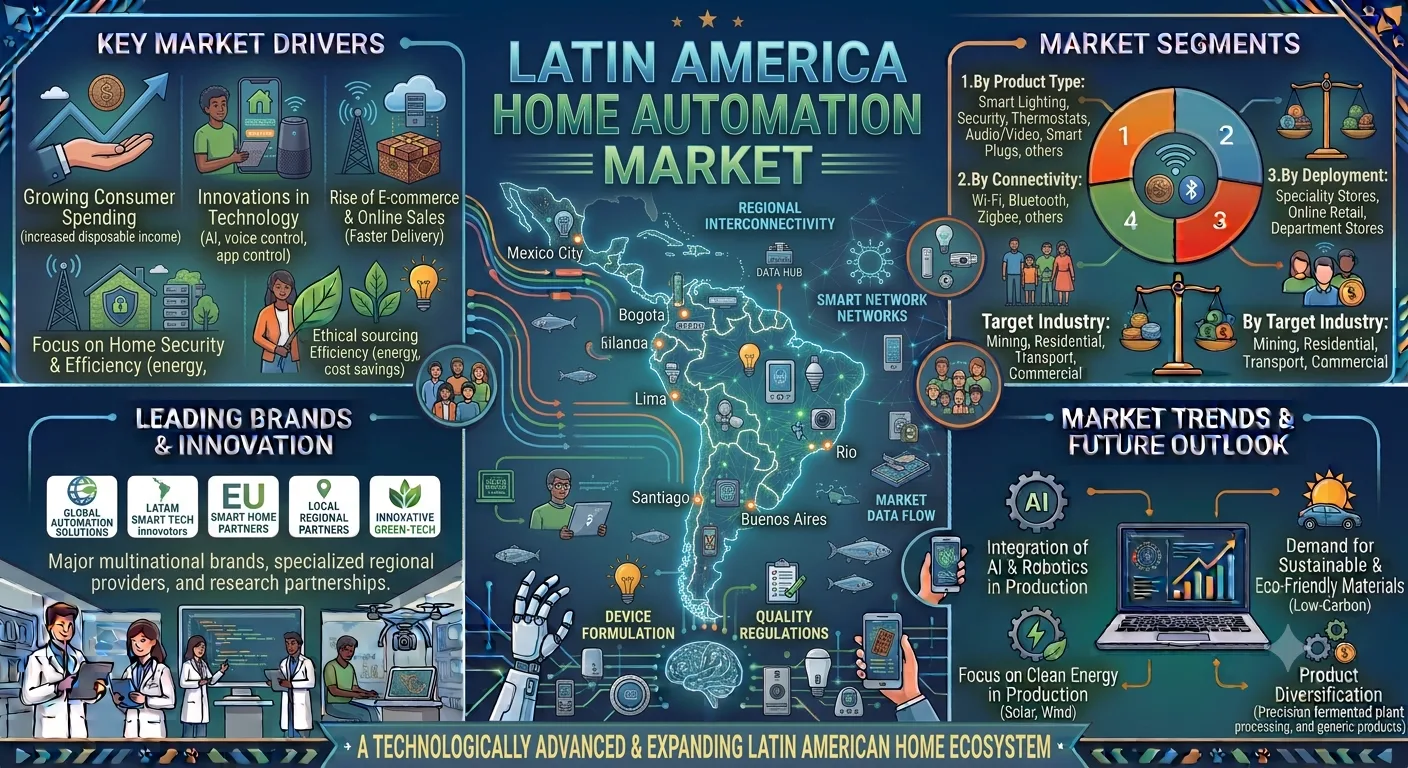
By Component, the market is segmented into Products (dominating, including Security and Safety, HVAC, Wellness Monitoring, Smart Appliances, Smart Entertainment, Smart Lighting, and Others) and Services (including Consulting, Installation and Implementation, and Support and Maintenance).
By Network Technology, the market serves Wireless (dominating), Wired, and Power Line-Based.
By Country, the market serves Brazil (dominating), Mexico, Argentina, Colombia, Chile, Peru, and Others.
Key trends shaping the market include magnifying demand for smart security solutions, rising adoption of energy-efficient smart devices, rapid expansion of voice-controlled home automation, and growing affordability of smart devices.
PORTER'S FIVE FORCES ANALYSIS – LATIN AMERICA HOME AUTOMATION MARKET
Competitive Rivalry: High. The market features intense competition among global tech giants (Samsung, Amazon, Google), regional smart device manufacturers, and emerging local brands. Competition centres on device compatibility, ecosystem integration, affordability, voice control capabilities, and local market presence. The market is moderately consolidated at the platform tier, with growing fragmentation among device manufacturers. Business implication: Companies must differentiate through ecosystem integration, affordability, and local market adaptation.
Supplier Power (Component and Chipset Providers): Moderate to High. Manufacturers rely on suppliers of semiconductors, sensors, chipsets, and electronic components. Global semiconductor supply constraints and concentration among a few chip manufacturers create significant supplier power. Business implication: Strategic partnerships with component suppliers and diversified sourcing can reduce long-term dependency and supply risk.
Buyer Power (Residential Consumers): Moderate to High. Consumers leverage choice across multiple brands, devices, and price points. Buyers increasingly demand affordability, ease of installation, voice control, and compatibility with existing ecosystems. Price sensitivity varies across income levels, with affordable smart devices driving broader adoption. Business implication: Providers must demonstrate affordability, ease of use, and ecosystem compatibility to win consumer adoption.
Threat of Substitutes: Low to Moderate. Traditional non-automated home systems and manual controls represent substitutes. However, home automation offers convenience, energy savings, security, and remote control that traditional alternatives cannot fully replicate. Within the market, competing ecosystems and protocols (Wi-Fi, Zigbee, Z-Wave) substitute for each other. Business implication: Demonstrating superior convenience, security, and energy savings is essential.
Threat of New Entrants: Moderate. Significant capital requirements for R&D, ecosystem development, and brand building create barriers. However, growth of affordable smart devices, e-commerce platforms, and open-source automation platforms has enabled new entrants focused on niche applications and budget-friendly solutions. Business implication: Incumbents must leverage ecosystem integration, brand trust, and distribution networks while monitoring emerging affordable and niche players.
KEY ASPECTS REQUIRED FOR THE LATIN AMERICA HOME AUTOMATION MARKET
Market Performance: USD 5.6 Billion in 2025, projected to reach USD 10.1 Billion by 2034, driven by smart home technology interest, energy efficiency, enhanced security, internet penetration, and affordable smart devices.
Market Outlook: A 6.48% CAGR through 2034 reflects strong growth led by security and safety products, wireless network technology, and Brazilian market dominance.
Growth Drivers: Rising consumer interest in smart home technologies; energy efficiency; enhanced security; increasing internet penetration; affordable smart devices; magnifying demand for smart security solutions; rising adoption of energy-efficient smart devices; rapid expansion of voice-controlled home automation; government programs encouraging energy efficiency; growing focus on sustainable living initiatives.
Competitive Landscape: A moderately consolidated market with global tech giants and regional manufacturers. Key players invest in ecosystem integration, affordable devices, and voice control capabilities.
Value Chain Analysis: From component and chipset sourcing through device manufacturing, software and platform development, distribution via retailers and e-commerce, to installation, support, and maintenance services for residential consumers.
Industry Trends: Smart security solutions (surveillance cameras, motion sensors, remote locks); energy-efficient smart devices (smart thermostats, energy-efficient lighting); voice-controlled home automation (smart speakers, digital assistants); AI-driven smart appliances (air fryers, dishwashers, coffee machines); affordable smart devices; ecosystem partnerships (Samsung SmartThings and Philips Hue).
Strategic Recommendations: Invest in smart security and safety solutions; develop energy-efficient smart devices; expand voice-controlled automation capabilities; pursue AI-driven smart appliance innovation; develop affordable solutions across income levels; pursue ecosystem partnerships and integrations; target Brazil, Mexico, and high-growth markets; enhance installation and support service networks.
Request for Sample Report: https://www.imarcgroup.com/latin-america-home-automation-market/requestsample
MARKET GROWTH DRIVERS
Magnifying Demand for Smart Security Solutions
Latin American consumers have shown an increased focus on security, resulting in greater demand for home automation systems that address safety concerns. Surveillance cameras, motion sensors, and remote locks are becoming increasingly popular, allowing homeowners to monitor and secure their homes from anywhere. Moreover, rising crime rates in certain neighborhoods only exacerbate this trend. As per industry reports, Venezuela currently holds the highest homicide rate in Latin America at 45.6 per 100,000 citizens, ranking among the highest globally. Additionally, the affordability and accessibility of smart security systems, combined with easy smartphone integration, make these solutions appealing across income levels, thereby expanding the market's reach and adoption rate.
Rising Adoption of Energy-Efficient Smart Devices
The rise in demand for energy-efficient smart home devices as consumers become more environmentally conscious and seek cost-saving solutions is creating a positive Latin America home automation market outlook. The Internet of Things smart tech also has a role to play, the popularity of smart thermostats, energy-efficient lighting, or automated energy management systems that offer users better control of energy consumption, resulting in lower utility bills. Additionally, the increasing electricity consumption by the residential sector increases the demand for efficient technologies, therefore increasing its adoption. According to the International Energy Agency, in 2023, the residential sector accounted for 29% of the total final electricity consumption in Brazil. Additionally, this trend is reinforced by government programs that encourage energy efficiency as well as a growing focus on sustainable living initiatives. With the continuous development of smart technology, consumers are learning that they can easily bring these devices into their daily lives, and automated energy efficiency has therefore become one of the key terms in the market.
Rapid Expansion of Voice-Controlled Home Automation
Voice-controlled devices, such as smart speakers and digital assistants, are rapidly gaining popularity in Latin American households as they simplify home automation. For instance, as per industry reports, in 2023, 70% of individuals in Brazil owned an Amazon Echo, a leading smart speaker brand. The convenience of voice commands allows users to control various functions, from lighting to climate settings, with minimal effort. In addition to this, easy integration with existing smart devices, coupled with increasing bilingual support, has made voice-activated technology more accessible and user-friendly. This trend is further bolstered by affordable options from global tech leaders, making voice-controlled automation a practical choice for homeowners across different income levels and contributing to the Latin America home automation market share.
Increasing Internet Penetration and Affordable Smart Devices
Increasing internet penetration and affordable smart devices further support adoption across residential spaces, fueling Latin America home automation market growth throughout the region. The growing availability of low-cost smart devices from global tech leaders has made home automation accessible to a broader consumer base across different income levels. Expanding internet infrastructure across urban and rural areas supports the adoption of connected home technologies. The growing integration of AI-driven features into affordable smart appliances, including air fryers, dishwashers, and coffee machines, is expanding the market's reach and appeal. These factors collectively support market growth and expand adoption across diverse consumer segments.
LATIN AMERICA HOME AUTOMATION MARKET SEGMENTATION
Segmentation analysis provides a detailed view of the Latin America home automation market by category:
Component Insights: The report has provided a detailed breakup and analysis of the market based on the component. This includes product (security and safety, HVAC, wellness monitoring, smart appliances, smart entertainment, smart lighting, and others), and services (consulting, installation and implementation, and support and maintenance). Security and safety products represent a leading segment, driven by strong consumer focus on home security, rising crime rates, and the affordability of smart surveillance cameras, motion sensors, and remote locks. HVAC represents a significant segment, driven by growing demand for energy-efficient climate control solutions and smart thermostats. Smart entertainment represents a growing segment, driven by rising demand for connected audio-visual systems and streaming integration. Smart lighting represents a growing segment, with voice control and energy efficiency driving adoption. Smart appliances, including AI-driven kitchen devices, represent a growing segment. Wellness monitoring and other product categories represent emerging segments. Services, including consulting, installation and implementation, and support and maintenance, represent a significant segment driven by the growing complexity of home automation systems and the need for professional installation and support.
Network Technology Insights: A detailed breakup and analysis of the market based on network technology has also been provided in the report. This includes wired, wireless, and power line-based. Wireless represents a leading segment, driven by ease of installation, affordability, and compatibility with smart devices and voice assistants. Wireless technologies including Wi-Fi, Zigbee, Z-Wave, and Bluetooth support flexible and scalable home automation deployments. Wired represents a significant segment, preferred for new construction and high-reliability applications requiring stable connectivity and security. Power line-based represents a growing segment, using existing electrical wiring for data transmission, suitable for retrofit applications.
Country Insights: The report has also provided a comprehensive analysis of all the major regional markets, which include Brazil, Mexico, Argentina, Colombia, Chile, Peru, and others. Brazil represents a leading market, driven by a large consumer base, high internet penetration, strong smart speaker adoption (70% of individuals owned an Amazon Echo in 2023), and growing energy efficiency awareness. The residential sector accounted for 29% of total final electricity consumption in Brazil in 2023, driving demand for smart energy management solutions. Mexico represents a significant market, with growing smart home adoption, expanding internet infrastructure, and increasing consumer interest in security and energy efficiency. Argentina, Colombia, Chile, Peru, and other markets represent growing segments with increasing smart home adoption and expanding availability of affordable devices.
COMPETITIVE LANDSCAPE
The market research report has also provided a comprehensive analysis of the competitive landscape. Competitive analysis such as market structure, key player positioning, top winning strategies, competitive dashboard, and company evaluation quadrant has been covered in the report. Also, detailed profiles of all major companies have been provided.
Major players include global tech giants (Samsung, Amazon, Google), regional smart device manufacturers, and emerging local brands investing in ecosystem integration, affordable devices, and voice control capabilities.
Recent Developments:
July 2024: Ecozy debuted its smart home kitchen lineup at the Latin American Electronics International Trade Show, marking its entry into the Brazilian market. The showcase includes AI-driven products including smart air fryers, dishwashers, and coffee machines with app control, aligning with Latin America's growing demand for advanced, affordable home automation solutions.
March 2024: Samsung's SmartThings platform announced the expansion of its partnership with Philips Hue, a global leader in smart lighting, to advance home automation and transform user interaction with home entertainment systems. This collaboration introduced exclusive updates for enhanced control of the Philips Hue Sync TV App via SmartThings, available for sale in additional markets, including Brazil.
Investment opportunities exist in smart security solutions, energy-efficient smart devices, voice-controlled automation, AI-driven smart appliances, and affordable solutions across income levels.
REGIONAL ANALYSIS
Brazil represents a leading market in the Latin America home automation market. Brazil benefits from a large consumer base, high internet penetration, strong smart speaker adoption (70% of individuals owned an Amazon Echo in 2023), and growing energy efficiency awareness. The residential sector accounted for 29% of total final electricity consumption in Brazil in 2023, driving demand for smart energy management solutions. The country's growing middle class and increasing adoption of affordable smart devices support market expansion. Brazil also serves as an entry point for global tech brands launching new smart home products in the region, including Ecozy's smart kitchen lineup and Samsung's SmartThings partnership with Philips Hue.
Mexico represents a significant market, with growing smart home adoption, expanding internet infrastructure, and increasing consumer interest in security and energy efficiency. Mexico's proximity to the United States and integration with North American supply chains support the availability of affordable smart devices. Growing urbanization and rising disposable incomes drive demand for smart security and energy-efficient solutions.
Argentina, Colombia, Chile, Peru, and other markets represent growing segments with increasing smart home adoption and expanding availability of affordable devices. Argentina's growing consumer interest in smart home technology and expanding internet infrastructure support market growth. Colombia and Chile benefit from growing urbanization and rising consumer awareness of energy efficiency and security. Peru represents an emerging market with increasing smart home adoption. These markets collectively contribute to the Latin America home automation market's growth trajectory, supported by expanding internet penetration, affordable devices, and growing consumer interest in connected living.
RECENT INDUSTRY DEVELOPMENTS
2026 Activity: The Latin America home automation market continued its growth trajectory from USD 5.6 Billion in 2025 toward USD 10.1 Billion by 2034 at a CAGR of 6.48%.
July 2024: Ecozy debuted its smart home kitchen lineup at the Latin American Electronics International Trade Show, marking its entry into the Brazilian market with AI-driven products including smart air fryers, dishwashers, and coffee machines with app control.
March 2024: Samsung's SmartThings platform announced the expansion of its partnership with Philips Hue to advance home automation and transform user interaction with home entertainment systems, with exclusive updates for enhanced control of the Philips Hue Sync TV App via SmartThings, available in additional markets including Brazil.
FREQUENTLY ASKED QUESTIONS
Q1: What is the current size of the Latin America home automation market?
A: The Latin America home automation market reached USD 5.6 Billion in 2025 and is projected to reach USD 10.1 Billion by 2034, exhibiting a CAGR of 6.48% from 2026-2034.
Q2: What are the key drivers of the Latin America home automation market?
A: The market is driven by: (i) rising consumer interest in smart home technologies; (ii) energy efficiency; (iii) enhanced security; (iv) increasing internet penetration; (v) affordable smart devices; (vi) magnifying demand for smart security solutions; (vii) rising adoption of energy-efficient smart devices; (viii) rapid expansion of voice-controlled home automation; (ix) government programs encouraging energy efficiency; and (x) growing focus on sustainable living initiatives.
Q3: What are the major components in the Latin America home automation market?
A: Major components include Products (dominating, including Security and Safety, HVAC, Wellness Monitoring, Smart Appliances, Smart Entertainment, Smart Lighting, and Others) and Services (including Consulting, Installation and Implementation, and Support and Maintenance).
Q4: What are the major network technologies in the Latin America home automation market?
A: Major network technologies include Wireless (dominating), Wired, and Power Line-Based.
Q5: Which country leads the Latin America home automation market?
A: Brazil represents a leading market, driven by a large consumer base, high internet penetration, strong smart speaker adoption (70% of individuals owned an Amazon Echo in 2023), and growing energy efficiency awareness. Mexico, Argentina, Colombia, Chile, and Peru represent significant growing markets.
Q6: What are the challenges facing the Latin America home automation market?
A: Key challenges include price sensitivity across income levels, limited internet infrastructure in rural areas, interoperability issues between different ecosystems, cybersecurity and privacy concerns, and the need for professional installation and support services.
Q7: What is the outlook for the Latin America home automation market?
A: The market is projected to grow at a 6.48% CAGR through 2034, with growth driven by smart home technology interest, energy efficiency, and enhanced security. The shift toward smart security solutions, energy-efficient smart devices, voice-controlled automation, AI-driven smart appliances, and affordable solutions across income levels are expected to shape the market's evolution.
Q8: Who are the key players in the Latin America home automation market?
A: Key players include global tech giants (Samsung, Amazon, Google), regional smart device manufacturers, and emerging local brands investing in ecosystem integration, affordable devices, and voice control capabilities.
Note: If you need any specific information that is not covered currently within the scope of the report, we will provide the same as a part of customization.
https://www.imarcgroup.com/request?type=report&id=28883&flag=E
Report Format, Delivery, and Customization Details
Report Format Mode: PPT, PDF, and Excel
Report Delivery Mode: Online Delivery, Physical Delivery
Report Delivery Time: Report Delivered Over Email within 24 to 48 hours. If requested by the client, a physical copy will be delivered within three to ten days.
Report Confirmation Mode: Yes via Email
Report Customization Mode: Yes via Email / Call
Report Table of Content: Yes
Report List of Figures: Yes
Report Methodology Mode: Yes
Request For Sample Report: Yes