Introduction
The grocery industry has rapidly moved toward digital shopping as customers increasingly use mobile apps to search for products, compare prices, place orders, and receive groceries at their preferred locations. A digital grocery marketplace brings these activities together through a single platform that connects customers, grocery stores, delivery partners, and administrators.
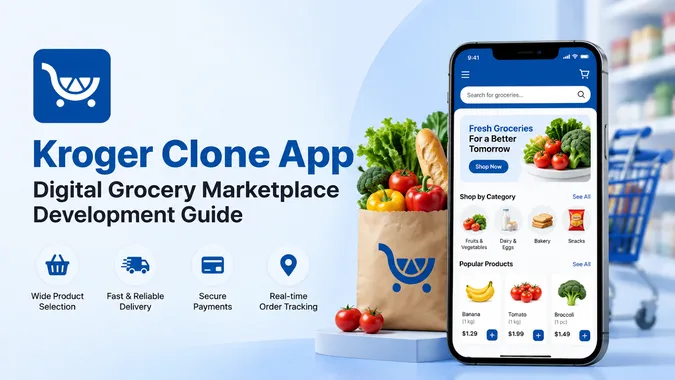
A Kroger Clone App is a customizable grocery marketplace solution inspired by the general digital grocery shopping model. It can help entrepreneurs build a platform where customers can browse grocery products, add items to a cart, choose delivery or pickup options, make secure payments, and track their orders.
For businesses, the platform can provide tools to manage products, inventory, stores, orders, customers, delivery operations, promotions, and payments. The solution can also be expanded with features such as personalized recommendations, recurring grocery orders, AI-assisted search, real-time delivery tracking, and analytics.
This guide explains the Kroger clone app concept, how a digital grocery marketplace works, essential features, customer and store functionality, admin capabilities, business models, AI opportunities, and the development process.
What Is a Kroger Clone App?
A Kroger Clone App is a digital grocery marketplace application that allows customers to purchase grocery products through a mobile or web platform.
The platform can connect multiple participants within the grocery ecosystem. Customers can discover products and place orders, stores or sellers can manage their catalogs and inventory, delivery partners can handle deliveries, and administrators can manage the overall marketplace.
A grocery clone app can be customized for different business models. An entrepreneur may build a single-store grocery ordering platform, a multi-store marketplace, or a broader grocery delivery marketplace that supports multiple merchants.
The platform can also support different fulfillment methods, including home delivery, scheduled delivery, and store pickup.
Businesses should use the term “Kroger Clone App” to describe a solution inspired by the general marketplace concept rather than suggesting that the application is officially affiliated with or endorsed by Kroger.
How Does a Kroger Clone App Work?
A digital grocery marketplace generally follows a straightforward ordering process.
1. Customer Registration
Customers create an account using supported registration methods and provide basic information such as their name, phone number, email address, and delivery details.
2. Location Selection
The customer enters a delivery address or selects a service location. The platform can then display stores and products available in that area.
3. Grocery Discovery
Customers browse product categories or search for specific items.
Common categories can include:
- Fruits and vegetables
- Dairy products
- Meat and seafood
- Bakery products
- Beverages
- Snacks
- Frozen foods
- Household products
- Personal care products
- Organic and specialty products
4. Product Selection
Customers review product information, prices, availability, quantities, and other relevant details before adding products to the shopping cart.
5. Cart and Checkout
The customer reviews the cart, applies an eligible promotional code, selects a delivery or pickup option, and confirms the order.
6. Payment
The platform processes payment through supported payment methods and generates the relevant order confirmation.
7. Order Processing
The store receives the order and begins picking and preparing the selected products.
8. Delivery or Pickup
Depending on the fulfillment option, a delivery partner can collect the order and deliver it to the customer, or the customer can collect the order from the selected store.
9. Order Tracking
Customers can view order status and, where supported, follow the delivery process in real time.
10. Review and Feedback
After receiving an order, customers can rate the experience, provide feedback, or report an issue through the platform.
Key Features of a Kroger Clone App
A digital grocery marketplace needs features that support product discovery, ordering, inventory management, payments, fulfillment, and customer engagement.
User Registration and Profile Management
Customers can create profiles and manage their account information from the app.
A customer profile may include:
- Personal information
- Saved addresses
- Order history
- Favorite products
- Saved payment methods
- Shopping preferences
- Active orders
- Rewards or loyalty information
A simple profile experience allows customers to manage their grocery activities from one place.
Grocery Product Search
Search is one of the most important features of a grocery marketplace.
Customers should be able to search by product name, category, brand, or relevant keyword. Advanced search can also support filters such as price, availability, dietary preferences, product type, and store.
Product Categories
Organized categories make it easier for customers to discover products.
Businesses can create categories and subcategories according to their catalog structure. Category navigation can also be combined with filters and sorting options.
Product Details
Each product can have a dedicated page containing:
- Product name
- Images
- Description
- Price
- Available quantity
- Brand
- Size or weight
- Ingredients where relevant
- Nutritional information where applicable
- Reviews
- Related products
Accurate product information helps customers make informed purchasing decisions.
Shopping Cart
Customers can add multiple products to their cart, adjust quantities, remove items, and review the estimated order total.
The cart can also display applicable discounts, delivery charges, taxes, and other relevant costs.
Wishlist and Favorites
Customers can save frequently purchased products for later.
A favorite feature can make repeat grocery shopping more convenient.
Multiple Delivery Options
A grocery marketplace can provide different fulfillment choices depending on its operational model.
These may include:
- Standard delivery
- Scheduled delivery
- Express delivery
- Store pickup
- Curbside pickup
Availability can depend on location, store capacity, inventory, and delivery operations.
Secure Online Payments
The platform can integrate supported payment gateways to allow customers to pay digitally.
Depending on the target market, payment options may include cards, digital wallets, bank-based payment methods, or other local payment methods.
Order Tracking
Customers can monitor the status of their orders after checkout.
Possible statuses include:
- Order placed
- Order confirmed
- Preparing order
- Ready for pickup
- Out for delivery
- Delivered
- Cancelled
For delivery orders, map-based tracking can provide additional visibility.
Push Notifications
Notifications can keep customers informed about important order events.
Notifications may cover:
- Order confirmation
- Payment confirmation
- Product availability
- Order preparation
- Delivery updates
- Promotional offers
- Order completion
Store and Grocery Partner Features
A multi-store grocery marketplace requires dedicated functionality for grocery stores and merchants.
Store Registration
Grocery businesses can create seller accounts and provide information required by the marketplace.
The platform can include an admin verification process before a store becomes active.
Store Profile
Each participating store can have a profile containing:
- Store name
- Address
- Operating hours
- Product categories
- Delivery availability
- Pickup availability
- Ratings
- Promotional information
Product Catalog Management
Store administrators can add and manage grocery products from their dashboard.
They can update:
- Product names
- Images
- Descriptions
- Prices
- Product sizes
- Stock levels
- Categories
- Availability
Inventory Management
Inventory functionality helps stores monitor product availability.
When a product becomes unavailable, the platform can update its status to prevent customers from placing orders for unavailable items.
Order Management
Stores can receive, accept, prepare, and update customer orders through their dashboard.
This helps coordinate order fulfillment and reduces the need for manual communication.
Store Promotions
Stores can create eligible discounts, promotional offers, bundles, or other marketplace-supported campaigns.
Promotional rules should be clearly defined so customers understand the applicable terms.
Sales Reports
Store partners can review order activity, sales information, popular products, and other marketplace metrics available through the platform.
Delivery Partner Features
If the business model includes a delivery network, delivery partners require a dedicated interface.
Delivery Partner Registration
Drivers or delivery partners can register and complete the required onboarding and verification process.
Delivery Request Management
Drivers can view available delivery requests and accept or receive assignments according to the marketplace's delivery model.
Route and Navigation Support
Map integration can help delivery partners navigate from the store to the customer's location.
Delivery Status Updates
Drivers can update order status during the delivery process.
For example:
- Pickup pending
- Order picked up
- On the way
- Delivered
Earnings Management
Delivery partners can view completed deliveries, earnings, applicable fees, and payout information.
Delivery History
Drivers can access previous delivery records through their accounts.
Admin Dashboard Features
The admin dashboard provides centralized control over the digital grocery marketplace.
Customer Management
Administrators can manage customer accounts, order history, support requests, and account activity.
Store Management
The admin can review store applications, manage seller profiles, approve products, configure service areas, and monitor marketplace activity.
Product and Category Management
Administrators can manage product categories, featured products, marketplace-wide settings, and catalog-related configurations.
Order Management
The admin dashboard can provide an overview of active and completed orders.
Administrators can monitor order statuses, cancellations, refunds, fulfillment issues, and customer support cases.
Delivery Management
For businesses operating their own delivery network, administrators can manage delivery partners, assignments, service areas, and delivery activity.
Payment and Commission Management
The platform can track transactions, marketplace commissions, service charges, refunds, and store or delivery-partner payouts.
Promotional Management
Administrators can manage platform-wide promotional campaigns, coupon codes, referral programs, and other marketing tools.
Analytics and Reporting
A centralized reporting system can help businesses understand marketplace performance.
Useful metrics can include:
- Total orders
- Gross sales
- Completed deliveries
- Cancelled orders
- Active customers
- Active stores
- Popular products
- Average order value
- Platform commissions
- Repeat purchases
Advanced Features of a Kroger Clone App
Advanced functionality can help differentiate a grocery marketplace and support long-term customer engagement.
Recurring Grocery Orders
Customers frequently purchase the same household essentials. Recurring order functionality can allow them to schedule repeat purchases based on the options offered by the platform.
Smart Reordering
The platform can identify previously purchased products and make them easier to reorder.
For example, customers can access a previous shopping list and quickly add selected items to a new cart.
Grocery Lists
Customers can create shopping lists for different purposes, such as weekly groceries, household supplies, or special occasions.
Substitution Preferences
If a selected product becomes unavailable, customers can specify whether an alternative product may be substituted.
The platform can allow customers to approve substitutions in advance or request confirmation depending on the business model.
Loyalty and Rewards
A grocery marketplace can offer loyalty functionality that rewards eligible purchases or customer engagement.
Possible rewards can include points, discounts, coupons, or other benefits defined by the business.
Multi-Store Shopping
If the marketplace supports multiple stores, customers can discover products from different participating merchants.
The exact checkout and fulfillment model can be configured according to operational requirements.
Store Pickup
Customers can select pickup instead of home delivery when participating stores support this option.
How AI Can Improve a Kroger Clone App
Artificial intelligence can support several areas of a digital grocery marketplace.
AI-Powered Product Recommendations
AI systems can analyze relevant shopping behavior and product interactions to suggest products that may be useful to customers.
Recommendations should be designed transparently and should not replace customer choice.
Intelligent Search
AI-assisted search can help customers find products even when their search query does not exactly match the catalog wording.
For example, a customer may search using a general description while the platform identifies relevant products in the catalog.
Personalized Shopping Experience
The platform can organize recommendations, frequently purchased products, and relevant categories based on customer activity.
Demand Forecasting
Historical order data can help businesses identify patterns in grocery demand.
This can support inventory planning and operational decisions.
AI Customer Support
AI-assisted support can answer common questions about orders, delivery status, payments, product availability, and account functionality.
More complicated issues can be transferred to human support teams.
Inventory Insights
AI-based analytics can help identify products that frequently go out of stock or experience changing demand.
Businesses can use these insights to support inventory planning.
Benefits of a Digital Grocery Marketplace
A grocery marketplace can create value for different participants within the grocery ecosystem.
Customer Convenience
Customers can search for groceries, compare available products, place orders, and manage deliveries through a digital platform.
Wider Product Discovery
A multi-store marketplace can give customers access to products from multiple participating businesses in supported areas.
Digital Storefront for Grocery Businesses
Stores can use the platform to establish an online presence and reach customers through digital ordering channels.
Centralized Operations
Businesses can manage products, orders, payments, customers, and delivery operations through integrated dashboards.
Scalable Business Model
A digital marketplace can expand by adding stores, products, customers, service areas, and fulfillment options.
Data-Driven Decision Making
Analytics can help businesses understand purchasing patterns, popular products, order activity, and operational performance.
Kroger Clone App Business Model
A grocery marketplace can use several revenue streams depending on its business structure.
Store Commission
The platform can charge participating grocery stores a commission on eligible orders.
The commission structure can vary according to store agreements and marketplace policies.
Customer Service Fees
A platform may charge customers a service or platform fee on eligible orders.
Delivery Fees
Delivery charges can be applied based on factors such as delivery distance, order size, delivery speed, or market conditions.
Subscription Plans
The business can offer subscription plans that provide defined benefits such as eligible delivery benefits, discounts, or other platform features.
Featured Store or Product Placement
Participating stores may pay for enhanced visibility where the marketplace offers promotional placement.
Such placements should be clearly managed and disclosed according to applicable policies.
Advertising Opportunities
The marketplace can provide advertising opportunities to eligible brands or sellers.
The platform can generate additional revenue while giving participating businesses tools to promote relevant products.
A combination of revenue models can be used depending on the marketplace's customer base, operating costs, and business strategy.
How to Build a Kroger Clone App
Developing a digital grocery marketplace requires careful planning across product functionality, operations, technology, and business requirements.
1. Define the Business Model
First, determine whether the platform will operate as:
- A single-store grocery app
- A multi-store marketplace
- A grocery delivery platform
- A grocery marketplace with delivery and pickup
The chosen model affects the required features and operational structure.
2. Identify the Target Market
Select the geographical market and customer segment the platform will serve.
Understanding local grocery shopping habits, payment preferences, delivery expectations, and regulatory requirements can help shape the platform.
3. Define User Roles
Determine the participants who will use the platform.
A typical marketplace may include:
- Customers
- Grocery stores
- Delivery partners
- Administrators
Each role should receive only the functionality necessary for its responsibilities.
4. Plan the Core Features
Prioritize essential functionality such as product discovery, cart, checkout, payments, inventory, order management, and delivery tracking.
Advanced features can be introduced after the core marketplace workflow is stable.
5. Design the User Experience
The interface should make grocery discovery and ordering straightforward.
Customers should be able to move from search to checkout with minimal unnecessary complexity.
Store and delivery dashboards should also be designed around their specific workflows.
6. Develop the Platform
The development process can include the customer application, store dashboard, delivery application, admin panel, backend infrastructure, APIs, payment integration, notification system, and location services.
7. Integrate Third-Party Services
Depending on requirements, the platform may integrate:
- Payment gateways
- Mapping services
- Push notification services
- SMS or communication providers
- Analytics tools
- Identity or verification services
The selected integrations should be compatible with the target market and platform requirements.
8. Test the Application
Testing should cover the complete grocery ordering journey.
Important areas include:
- Registration
- Product search
- Cart functionality
- Checkout
- Payment processing
- Inventory updates
- Store order management
- Delivery assignment
- Order tracking
- Notifications
- Cancellations
- Refund workflows
9. Launch and Improve
After launch, monitor customer feedback, store activity, order performance, and technical issues.
The platform can then be improved through iterative releases based on actual marketplace requirements.
Conclusion
A Kroger Clone App can provide a foundation for building a digital grocery marketplace that connects customers with grocery stores through online ordering and fulfillment services.
The platform can support product discovery, shopping carts, payments, store management, inventory, delivery tracking, customer accounts, promotions, analytics, and administrative controls. Advanced functionality such as recurring orders, smart reordering, AI-powered recommendations, intelligent search, loyalty programs, and demand forecasting can further expand the platform according to business needs.
For entrepreneurs, successful development starts with a clear business model and target market. The technology should then be designed around the actual grocery marketplace workflow rather than simply duplicating another company's implementation.
With the right combination of marketplace functionality, store management, customer convenience, delivery operations, and scalable technology, a grocery platform can be developed to support both initial market entry and future expansion.
Frequently Asked Questions (FAQs)
1. What is a Kroger Clone App?
A Kroger Clone App is a customizable digital grocery marketplace solution inspired by the general online grocery shopping model. It can connect customers with grocery stores and support product browsing, ordering, payments, delivery, and pickup.
2. What features should a Kroger Clone App include?
Important features include customer registration, product search, categories, product details, shopping cart, checkout, online payments, order tracking, store management, inventory management, delivery management, notifications, reviews, and an admin dashboard.
3. How does a Kroger Clone App make money?
A grocery marketplace can generate revenue through store commissions, customer service fees, delivery charges, subscriptions, promotional placements, and advertising opportunities.
4. Can a Kroger Clone App support multiple grocery stores?
Yes. The platform can be developed as a multi-store grocery marketplace where different grocery businesses manage their own catalogs, inventory, orders, and store information through dedicated dashboards.
5. Can AI be integrated into a Kroger Clone App?
Yes. AI can support product recommendations, intelligent search, personalized shopping experiences, demand forecasting, customer support, and inventory insights, depending on the platform's requirements.