
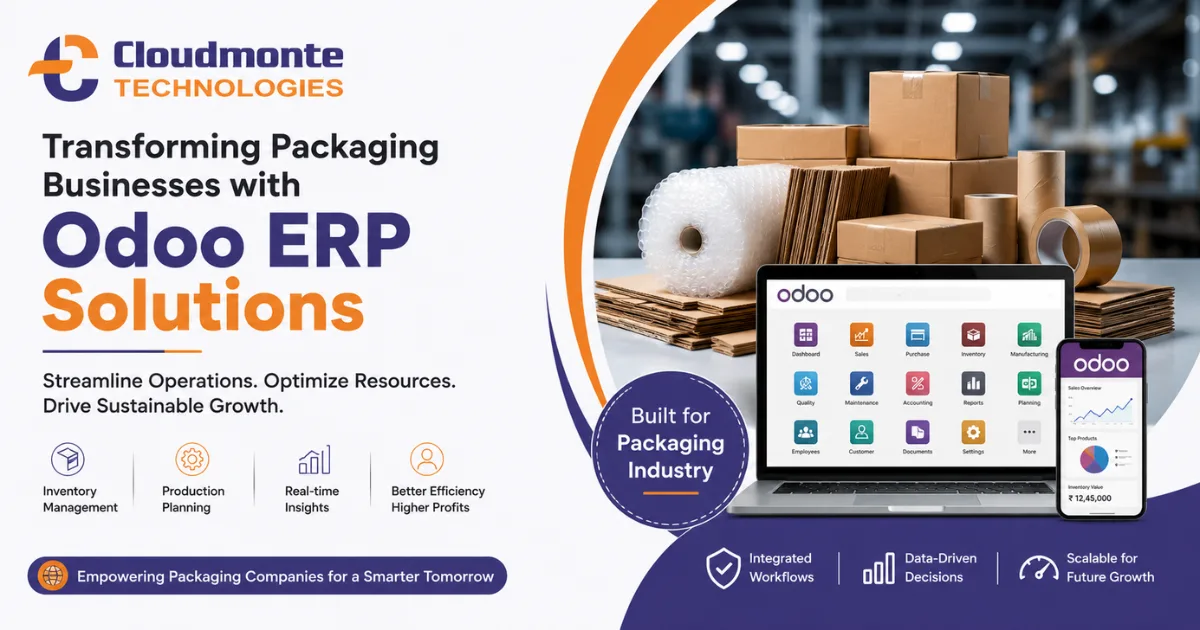
The packaging industry in India is experiencing a significant transformation. Rising customer expectations, increasing regulatory requirements, fluctuating raw material costs, and the demand for faster production cycles are forcing packaging manufacturers to rethink how they manage their operations.
Traditional methods of managing inventory, production schedules, procurement, sales, and finance through disconnected systems are no longer sufficient. As competition intensifies, packaging companies are increasingly investing in integrated digital solutions that provide visibility, efficiency, and control across the entire business.
One technology that has gained considerable attention is Odoo ERP for Packaging Industry. By bringing multiple business functions into a single platform, ERP systems help packaging manufacturers streamline operations, reduce waste, improve decision-making, and achieve sustainable growth.
This article explores the key reasons why modern packaging companies are adopting ERP solutions and how digital transformation is becoming a necessity rather than a choice.
Understanding ERP in the Packaging Industry
Enterprise Resource Planning (ERP) is a centralized software system that integrates various business processes, including procurement, inventory management, production planning, sales, quality control, finance, and customer relationship management.
For packaging manufacturers, ERP acts as a single source of truth that enables real-time tracking of materials, production activities, costs, and deliveries.
Modern packaging industry ERP software helps organizations eliminate information silos and create seamless collaboration between departments.
What Makes ERP Essential for Packaging Manufacturers?
Packaging businesses face unique operational challenges, such as:
- Managing multiple product variations
- Handling complex production schedules
- Tracking raw materials and finished goods
- Maintaining quality standards
- Managing supply chain disruptions
- Meeting tight delivery timelines
- Controlling production costs
ERP systems address these challenges by automating workflows and providing real-time visibility into business operations.
The Growing Need for Digital Transformation in Packaging
The Indian packaging market continues to grow rapidly due to increasing demand from industries such as the following:
- Food & Beverage
- Pharmaceuticals
- E-commerce
- Consumer Goods
- Retail
- Personal Care Products
As production volumes increase, manual processes become difficult to manage.
Businesses that rely on spreadsheets or standalone software often struggle with:
- Data inaccuracies
- Inventory mismatches
- Production delays
- Poor forecasting
- Higher operational costs
This is where Odoo ERP for Packaging Companies offers a significant advantage by connecting every business process through a unified digital platform.
1. Improved Inventory Management and Material Tracking
Inventory management is one of the biggest challenges in the packaging industry.
Packaging manufacturers work with various raw materials, such as:
- Paperboard
- Corrugated sheets
- Plastic films
- Adhesives
- Inks
- Labels
- Foils
Even minor inventory inaccuracies can lead to production delays or excess stock accumulation.
How ERP Solves This Challenge
With advanced Odoo inventory management, companies can:
- Track inventory in real time
- Monitor stock levels across warehouses
- Automate replenishment processes
- Reduce stock shortages
- Minimize excess inventory
Real-time inventory visibility ensures that production teams always have the required materials available without overstocking.
Business Impact
Companies adopting ERP often experience:
- Lower carrying costs
- Reduced material waste
- Improved warehouse efficiency
- Better inventory accuracy
2. Better Production Planning and Scheduling
Packaging manufacturing involves multiple production stages, including design, printing, cutting, laminating, folding, and finishing.
Without proper planning, bottlenecks can quickly disrupt production schedules.
ERP Enables Intelligent Production Planning
Modern Odoo Production Planning Software helps manufacturers:
- Create optimized production schedules
- Allocate resources efficiently
- Track machine utilization
- Monitor work orders in real time
- Identify bottlenecks before they become major issues
Production managers gain complete visibility into manufacturing activities, allowing them to make faster and more informed decisions.
Real-World Example
Consider a packaging company producing cartons for multiple FMCG brands.
If one production line experiences downtime, ERP software can automatically adjust schedules and redirect workloads to maintain delivery commitments.
This level of agility is difficult to achieve with manual planning systems.
3. Enhanced Operational Visibility
One of the primary reasons packaging companies adopt ERP is the need for complete operational transparency.
Many businesses struggle because critical information is scattered across different departments.
ERP centralizes data from:
- Sales
- Procurement
- Manufacturing
- Inventory
- Quality Control
- Finance
Benefits of Real-Time Visibility
Decision-makers can instantly access:
- Production status
- Inventory levels
- Purchase orders
- Customer orders
- Financial reports
This visibility enables proactive management rather than reactive problem-solving.
Companies can identify issues early and take corrective action before they impact customers or profitability.
4. Reduced Production Costs
Cost control is a major concern for packaging manufacturers.
Factors affecting profitability include:
- Raw material prices
- Labor costs
- Machine downtime
- Waste generation
- Energy consumption
ERP systems provide detailed insights into production costs at every stage.
Cost Optimization Through ERP
With Odoo Manufacturing ERP, companies can:
- Track actual versus planned costs
- Monitor resource utilization
- Analyze production efficiency
- Identify waste sources
- Improve labor productivity
This data-driven approach helps manufacturers make smarter operational decisions and improve margins.
5. Improved Quality Control and Compliance
Packaging companies serving industries such as pharmaceuticals and food processing must adhere to strict quality and regulatory standards.
Quality issues can result in:
- Product recalls
- Customer complaints
- Compliance penalties
- Brand reputation damage
ERP Supports Quality Management
ERP systems help maintain quality standards through:
- Automated quality checkpoints
- Inspection tracking
- Batch traceability
- Documentation management
- Non-conformance reporting
By digitizing quality processes, manufacturers reduce the risk of human error and improve consistency.
Traceability Advantages
If a defect is identified, ERP enables companies to quickly trace affected batches and identify root causes.
This significantly reduces response time and minimizes business risks.
6. Stronger Supply Chain Management
Supply chain disruptions have become a major concern for manufacturers worldwide.
Packaging companies depend on a continuous flow of materials from suppliers to maintain production schedules.
ERP Improves Supply Chain Coordination
An integrated ERP system enables businesses to:
- Track supplier performance
- Manage procurement efficiently
- Forecast material requirements
- Reduce procurement delays
- Improve vendor collaboration
With accurate demand forecasting, companies can better prepare for market fluctuations and supply chain uncertainties.
7. Faster Decision-Making Through Data Analytics
In today's competitive environment, successful companies rely on data rather than assumptions.
ERP systems provide comprehensive dashboards and reports that support strategic decision-making.
Key Metrics Available Through ERP
Packaging companies can monitor:
- Production efficiency
- Inventory turnover
- Order fulfillment rates
- Profit margins
- Machine utilization
- Customer demand trends
Access to real-time analytics empowers leaders to make informed decisions that improve performance and profitability.
8. Better Customer Service and Order Management
Customer expectations continue to rise.
Clients expect:
- Faster deliveries
- Accurate order fulfillment
- Real-time order updates
- Consistent product quality
Meeting these expectations requires seamless coordination between departments.
ERP Improves Customer Satisfaction
With Odoo ERP for Packaging Industry, companies can:
- Track orders from quotation to delivery
- Monitor production progress
- Provide accurate delivery timelines
- Improve communication with customers
This results in higher customer trust and stronger long-term relationships.
9. Scalability for Future Growth
As packaging businesses expand, operational complexity increases.
What works for a small manufacturer may become inefficient as production volumes and customer requirements grow.
ERP Supports Business Expansion
ERP systems are designed to scale with organizational growth.
Whether a company adds:
- New production facilities
- Additional warehouses
- New product lines
- International operations
ERP can support expansion without requiring entirely new systems.
This flexibility makes ERP a long-term investment rather than a short-term solution.
10. Automation of Repetitive Processes
Manual processes consume valuable time and increase the likelihood of errors.
Common repetitive tasks include:
- Data entry
- Purchase order creation
- Inventory updates
- Invoice generation
- Reporting
Automation Benefits
ERP automates these activities, allowing employees to focus on higher-value work.
Benefits include:
- Increased productivity
- Reduced administrative workload
- Improved accuracy
- Faster business processes
Automation also ensures consistency across departments and minimizes operational inefficiencies.
Why Odoo ERP Is Gaining Popularity Among Packaging Companies
Among various ERP solutions available today, Odoo has emerged as a preferred choice for many packaging manufacturers.
Key Advantages of Odoo ERP
Modular Architecture
Companies can implement only the modules they need and expand gradually.
Integrated Operations
All business functions operate on a unified platform.
User-Friendly Interface
Employees can adopt the system more quickly compared to traditional ERP platforms.
Cost Efficiency
Odoo offers flexibility and scalability that appeal to both mid-sized and large packaging manufacturers.
Industry-Specific Customization
The platform can be tailored to support unique packaging workflows and manufacturing requirements.
These benefits make Odoo ERP for Packaging Companies an increasingly popular choice for organizations pursuing digital transformation.
Best Practices for Successful ERP Adoption
Implementing ERP is not simply a software project—it is a business transformation initiative.
Packaging companies should consider the following best practices:
Define Clear Objectives
Identify specific goals such as inventory optimization, cost reduction, or production efficiency improvements.
Involve Key Stakeholders
Engage department leaders early to ensure successful adoption.
Clean Existing Data
Accurate data is essential for ERP success.
Train Employees Thoroughly
Proper training increases user adoption and maximizes return on investment.
Monitor Performance Continuously
Track KPIs regularly to measure ERP effectiveness and identify opportunities for improvement.
Conclusion
The packaging industry is becoming increasingly competitive, data-driven, and customer-focused. Companies that continue relying on fragmented systems and manual processes risk falling behind in efficiency, profitability, and customer satisfaction.
Modern ERP solutions provide the visibility, automation, and operational control needed to thrive in this evolving landscape. From inventory optimization and production planning to quality management and supply chain coordination, ERP enables packaging manufacturers to streamline operations and make smarter business decisions.
As digital transformation accelerates across India's manufacturing sector, solutions like Odoo ERP for Packaging Industry are helping businesses build resilient, scalable, and future-ready operations.
For packaging companies looking to improve efficiency, reduce costs, and support sustainable growth, ERP adoption is no longer just an option—it has become a strategic necessity.
Actionable Takeaways
- Evaluate current operational bottlenecks and identify areas where ERP can create value.
- Prioritize inventory visibility and production planning for immediate efficiency gains.
- Invest in employee training to maximize ERP adoption success.
- Use real-time analytics to drive data-backed decisions.
- Choose a scalable ERP platform that can support long-term business growth and evolving industry demands.
Ready to modernize your packaging operations? Explore how Odoo ERP can help streamline production, optimize inventory, improve quality control, and support sustainable business growth in today's competitive manufacturing environment.