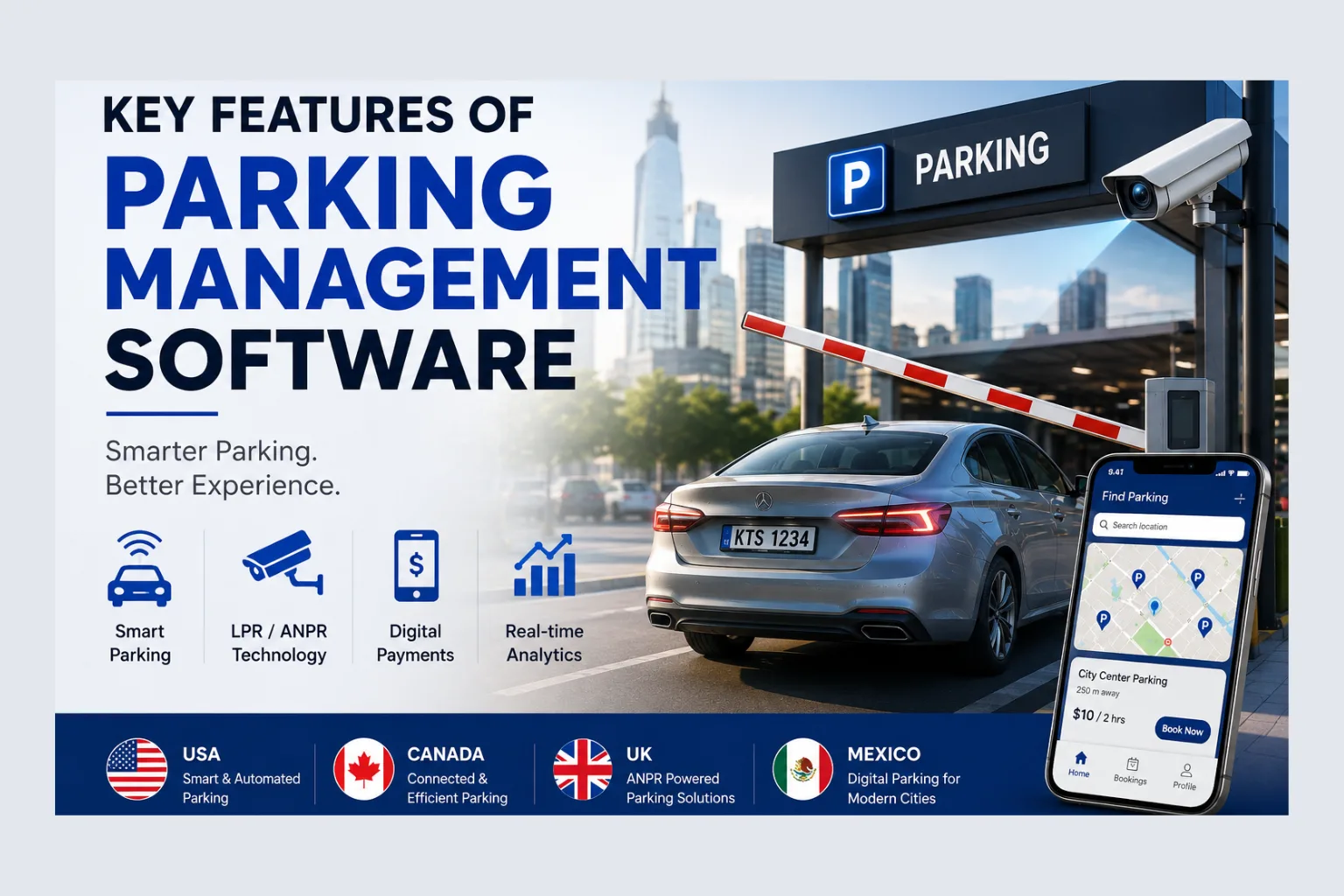
Parking operations are becoming increasingly digital across the USA, Canada, UK, and Mexico. Traditional parking systems that depend on paper tickets, manual payments, and physical monitoring can make it difficult to manage large parking facilities efficiently.
Modern parking management software helps businesses manage parking spaces, vehicle entry and exit, reservations, payments, enforcement, and customer data from a centralized platform.
With technologies such as LPR software, ANPR, smart parking sensors, mobile applications, digital payments, IoT, and AI, parking operators can automate many everyday processes and provide a better experience for drivers.
What Is Parking Management Software?
Parking management software is a digital solution that helps parking operators manage their facilities and day-to-day operations.
Depending on the business requirements, the system can include:
- Parking space management
- Real-time parking availability
- Vehicle entry and exit tracking
- Online reservations
- Digital payments
- LPR and ANPR integration
- Parking enforcement
- Customer management
- Parking analytics
- Digital permits
- EV charging integration
- Multi-location management
The features can be customized for parking garages, airports, hospitals, hotels, shopping centers, universities, residential communities, and municipal parking facilities.
Key Features of Parking Management Software
1. Real-Time Parking Availability
Real-time parking availability helps drivers know which spaces are available before entering a parking facility.
The system can display:
- Available spaces
- Occupied spaces
- Reserved spaces
- Accessible spaces
- EV charging spaces
Sensors, cameras, or other connected devices can update parking availability automatically.
This can be especially useful in busy cities across the USA, Canada, UK, and Mexico, where drivers may spend significant time searching for parking.
2. Parking Space Management
Parking operators can organize and manage spaces digitally based on different categories.
Spaces can be divided by:
- Floor
- Zone
- Parking type
- Vehicle type
- Price
- Availability
- Customer category
For example, a parking facility can have separate spaces for regular vehicles, EVs, disabled parking, employees, residents, and VIP customers.
This makes it easier for administrators to monitor parking capacity and manage space allocation.
3. LPR and ANPR Integration
License plate recognition software is one of the most useful technologies for automated parking.
In the USA, Canada, and Mexico, the technology is commonly referred to as LPR, or License Plate Recognition. In the UK, the term ANPR, or Automatic Number Plate Recognition, is commonly used.
An LPR/ANPR system can:
- Capture the vehicle's license plate.
- Identify the vehicle.
- Record entry time.
- Validate parking access.
- Track the parking session.
- Identify the vehicle during exit.
- Connect the session with payment information.
This can reduce the need for paper tickets and manual vehicle verification.
4. LPR Parking System
An LPR parking system can connect cameras with parking management software, access barriers, payment systems, and parking databases.
A typical workflow looks like:
Vehicle Arrives → LPR Camera → Plate Recognition → Database Verification → Gate Opens
At exit:
Vehicle Leaves → LPR Camera → Parking Session Identified → Payment Verified → Gate Opens
This creates a more automated and convenient parking experience.
For UK-focused solutions, the same concept can be described as an ANPR parking system.
5. Online Parking Reservations
Parking management software can allow drivers to reserve parking spaces before arriving.
Customers can:
- Select a parking location
- Choose a date
- Select a time
- Reserve a space
- Enter vehicle details
- Pay online
- Receive confirmation
- Cancel or modify reservations
This feature can be useful for airports, hotels, hospitals, shopping centers, stadiums, and event venues.
6. Mobile Parking Application
A mobile parking application can give customers access to parking services directly from their smartphones.
Users can:
- Search for nearby parking
- Check availability
- Reserve parking
- Get directions
- Make payments
- Extend parking sessions
- View parking history
- Manage parking permits
- Receive notifications
A mobile-first parking experience can make it easier for customers to manage the complete parking process without relying on physical parking machines.
7. Digital and Contactless Payments
Digital payment functionality is an important feature of modern parking software.
Depending on the target market, the system can support:
- Credit and debit cards
- Digital wallets
- Mobile payments
- QR payments
- Online payment gateways
- Prepaid balances
- Subscription payments
Contactless payments can help reduce queues at parking exits and make transactions faster.
8. Automated Parking Fee Calculation
The system can automatically calculate parking fees based on predefined pricing rules.
Charges can depend on:
- Parking duration
- Parking location
- Vehicle type
- Parking zone
- Peak hours
- Special events
- Customer type
- Reservation type
For example, an operator can set different prices for hourly, daily, monthly, or event-based parking.
Automation reduces manual calculations and helps maintain consistent pricing.
9. Dynamic Parking Pricing
Advanced parking platforms can support dynamic pricing based on demand and occupancy.
Prices can be adjusted according to:
- Parking demand
- Time of day
- Day of week
- Occupancy
- Events
- Location
For example, a parking facility near a stadium could use different pricing during major events compared with regular days.
This can help operators improve both parking utilization and revenue.
10. Parking Access Control
Access control determines which vehicles and users can enter a parking facility or specific parking areas.
A parking system can support:
- LPR/ANPR
- QR codes
- RFID
- Access cards
- Digital permits
- Mobile credentials
For example, an office building could provide employees with automatic access while visitors receive temporary digital parking passes.
11. Digital Parking Tickets
Digital tickets can replace traditional paper parking tickets.
A digital parking record can include:
- Vehicle number
- Entry time
- Parking location
- Reservation details
- Payment status
- Exit time
This can reduce paper usage and make parking records easier to access.
12. Parking Enforcement
Parking enforcement features help operators identify vehicles that do not follow parking rules.
The system can help detect:
- Unauthorized parking
- Expired parking
- Overstaying
- Unpaid parking
- Restricted parking
LPR/ANPR technology can automatically compare vehicle information with parking records and help enforcement teams identify potential violations.
13. Parking Permits and Subscriptions
Businesses offering long-term parking can manage permits and subscriptions through the software.
The system can support:
- Monthly parking
- Annual permits
- Employee parking
- Resident parking
- Corporate parking
- VIP parking
It can also automate renewal reminders, expiration alerts, payment collection, and vehicle changes.
14. Multi-Location Parking Management
Large parking operators may manage several parking facilities across different cities.
A centralized system can allow administrators to monitor:
- Parking occupancy
- Revenue
- Reservations
- Vehicle activity
- Payments
- Parking violations
- Facility performance
This can be particularly useful for parking companies operating across multiple locations in the USA, Canada, UK, or Mexico.
15. Parking Dashboard and Analytics
A parking management dashboard gives operators a centralized view of facility performance.
Important metrics can include:
- Current occupancy
- Available spaces
- Daily revenue
- Monthly revenue
- Parking sessions
- Average parking duration
- Peak parking hours
- Reservations
- Payment activity
Analytics can help operators understand parking demand and make better operational decisions.
16. IoT and Smart Parking Sensors
Smart parking sensors can detect whether individual parking spaces are occupied.
The basic process is:
Available Space → Vehicle Arrives → Sensor Detects Vehicle → System Updates → Space Occupied
The information can then be displayed in the parking application or administrator dashboard.
IoT integration is particularly useful for large facilities where manually monitoring every parking space would be difficult.
17. QR Code Parking
QR codes can simplify parking access and payments.
Drivers can scan a QR code to:
- Access parking information
- Open a reservation
- Make a payment
- View parking instructions
- Access digital parking tickets
QR codes can work alongside LPR, ANPR, RFID, and other parking technologies.
18. Notifications and Alerts
Parking software can automatically send notifications through:
- Push notifications
- SMS
- In-app alerts
Notifications can include:
- Reservation confirmation
- Payment confirmation
- Parking expiry
- Permit expiration
- Parking availability
- Violation alerts
For example, a customer can receive a reminder before their parking session expires.
19. Customer Management
The software can maintain customer profiles with information such as:
- Name
- Contact details
- Vehicle details
- License plate
- Parking history
- Reservations
- Payments
- Parking permits
This allows parking operators to provide better customer support and maintain organized records.
20. Role-Based Administration
Different employees may require different levels of access.
For example:
Super Admin: Complete system access
Parking Manager: Facility and operational management
Parking Attendant: Entry, exit, and enforcement
Finance Manager: Payments and revenue
Customer Support: Customer and reservation management
Role-based access helps prevent unauthorized users from accessing sensitive information.
21. EV Parking and Charging Integration
As electric vehicles become more common, parking platforms can integrate EV charging functionality.
The system can show:
- Available charging spaces
- Charging station status
- Charging sessions
- Parking fees
- Charging fees
- Reservations
This allows customers to find parking and charging services through the same platform.
AI and Computer Vision in Parking Management
AI can make parking operations more automated and efficient.
AI Occupancy Prediction
AI can analyze historical parking data to predict future occupancy.
Computer Vision
Computer vision can help detect:
- Vehicles
- Parking occupancy
- License plates
- Parking violations
- Vehicle types
Dynamic Pricing
AI can analyze parking demand and help operators determine appropriate pricing.
Predictive Maintenance
AI can identify unusual patterns in parking equipment and help operators detect potential maintenance issues.
Parking Management Software for USA, Canada, UK & Mexico
USA
Parking operators in the USA can benefit from:
- LPR parking systems
- Mobile parking applications
- Digital payments
- Parking reservations
- Automated enforcement
- Parking analytics
- EV charging integration
These features can support airports, hospitals, universities, shopping centers, offices, and municipal parking facilities.
Canada
Canadian parking solutions can focus on:
- Smart parking
- Digital payments
- LPR
- Mobile applications
- EV charging
- Accessibility
- Multi-location management
Parking operators can use real-time occupancy and digital payments to improve the parking experience.
UK
UK parking software can use ANPR parking systems for automated vehicle recognition and enforcement.
Important features include:
- ANPR
- Cashless payments
- Digital permits
- Mobile parking
- Automated enforcement
- Parking analytics
Mexico
Parking operators in Mexico can benefit from:
- Mobile parking applications
- Digital payments
- LPR
- Automated access
- Reservations
- Parking enforcement
- Real-time availability
These features can support shopping centers, hotels, airports, commercial buildings, and urban parking facilities.
How to Build Parking Management Software
Developing a parking platform typically involves several stages.
Step 1: Define Requirements
Identify the parking facility type, number of spaces, users, pricing model, and required integrations.
Step 2: Plan the MVP
Start with essential features such as availability, reservations, payments, user accounts, and an admin dashboard.
Step 3: Design UI/UX
Create simple interfaces for drivers, administrators, parking managers, and enforcement teams.
Step 4: Develop the Platform
Build the web application, mobile application, backend, database, and APIs.
Step 5: Integrate Parking Technology
Add LPR/ANPR cameras, sensors, RFID, QR codes, payment gateways, and automated barriers as required.
Step 6: Test and Deploy
Test payments, parking workflows, hardware integrations, security, and system performance before deployment.
Step 7: Add Advanced Features
Once the core system is stable, businesses can add AI, predictive analytics, dynamic pricing, and other advanced capabilities.
How Much Does Parking Management Software Cost?
The cost of developing parking management software depends on the complexity of the platform.
A basic solution may include:
- Parking availability
- Reservations
- Payments
- User accounts
- Admin dashboard
An advanced platform may include:
- LPR/ANPR
- IoT sensors
- Automated gates
- AI
- Computer vision
- Dynamic pricing
- EV charging
- Multi-location management
- Mobile applications
Development cost can also change based on the number of platforms, third-party integrations, hardware requirements, and target markets.
Benefits of Parking Management Software
A well-designed parking management system can provide:
Better Space Utilization
Real-time occupancy data helps operators understand how parking spaces are being used.
Faster Entry and Exit
LPR, ANPR, QR codes, and automated barriers can reduce manual processing.
Better Customer Experience
Drivers can find, reserve, and pay for parking digitally.
Reduced Manual Work
Automation reduces repetitive administrative tasks.
Better Revenue Management
Analytics provide visibility into parking revenue and demand.
Improved Enforcement
Digital records and vehicle recognition can help identify parking violations.
Data-Driven Decisions
Operators can use parking data to improve pricing, capacity, and operations.
Conclusion
Modern parking management software brings together parking availability, reservations, payments, access control, LPR/ANPR, enforcement, analytics, IoT, and mobile applications in one platform.
For businesses in the USA, Canada, UK, and Mexico, the ideal system should be flexible enough to support different payment methods, parking workflows, technologies, and local requirements.
Starting with a focused MVP and gradually adding features such as LPR software, smart parking sensors, AI, computer vision, dynamic pricing, and EV charging integration can help businesses build a scalable parking solution.