The nature of manufacturing has fundamentally changed. Today's most sophisticated products are no longer purely mechanical assemblies. Instead, they are smart, connected ecosystems driven by complex software networks, embedded sensors, and advanced microprocessors. This rapid technological evolution creates a unique challenge for modern engineering teams.
To manage these sophisticated products, organizations often find themselves caught between two distinct management philosophies: Application Lifecycle Management (ALM) and Product Lifecycle Management (PLM). While some organizations mistakenly view these platforms as redundant, high-performing engineering teams recognize them as complementary pillars. Understanding the boundaries between these systems is essential for deploying modern enterprise strategies.
Distinguishing the Core Philosophies of ALM and PLM
At their core, ALM and PLM are designed to manage entirely different types of assets. They operate at different velocities, utilize distinct tracking workflows, and serve separate engineering disciplines.
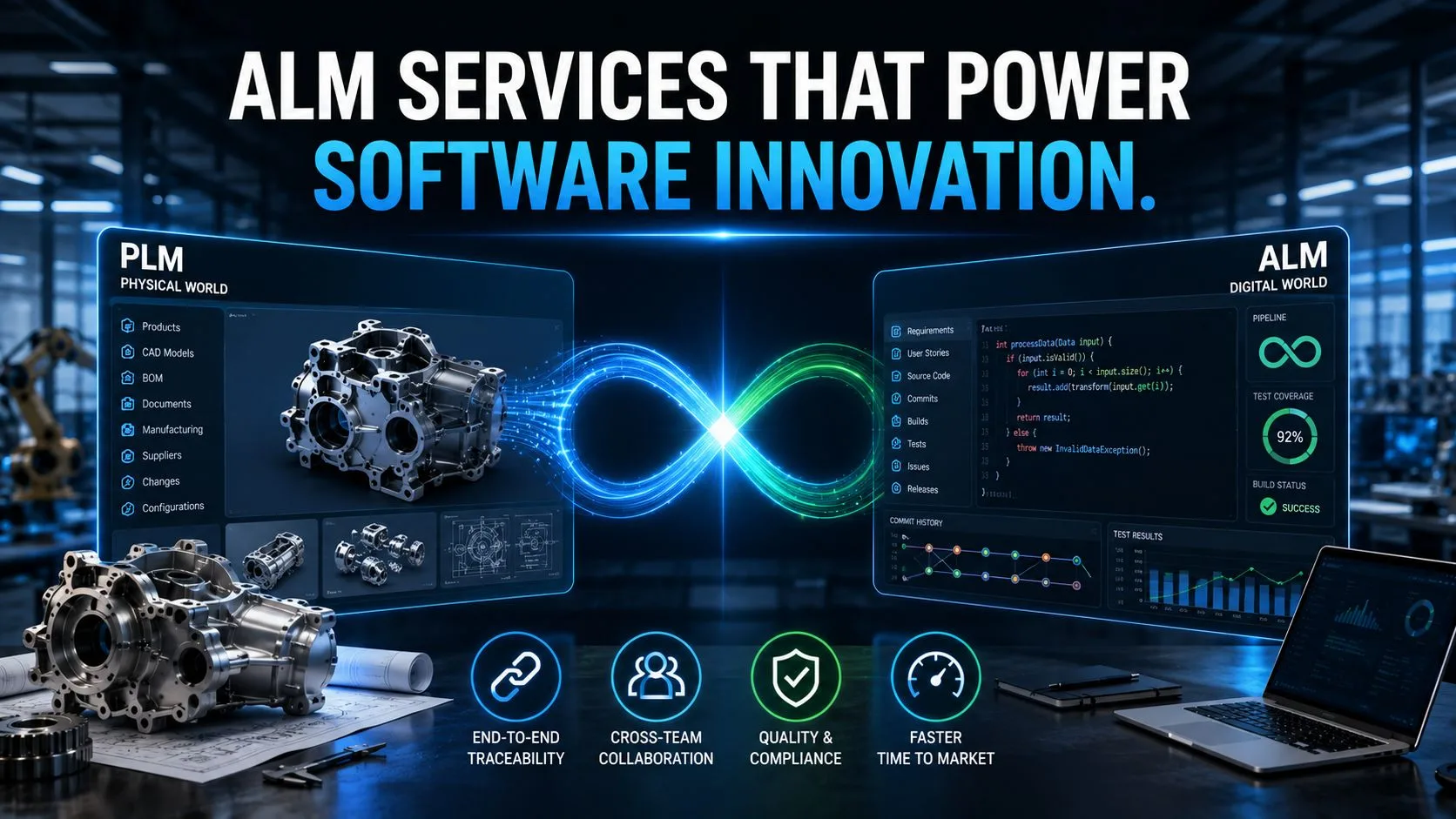
PLM systems are built for the physical world. They focus on the design, manufacturing, and maintenance of physical components. PLM governs computer-aided design (CAD) models, manages complex bills of materials (BOMs), controls supplier data, and tracks physical configurations through sequential, gate-based lifecycles. The main goal of PLM is to manage physical constraints, ensuring structural components are manufactured accurately, cost-effectively, and repeatably.
Conversely, ALM environments exist entirely in the digital realm. ALM handles the development, tracking, and deployment of software assets. This system governs raw requirements, source code branches, testing suites, bug tracking, and release packages. Because software iteration moves significantly faster than physical prototyping, ALM is designed to support continuous integration and continuous deployment (CI/CD) pipelines. It manages the abstract complexity of code behavior rather than physical tolerances.
Expanding Enterprise Capabilities with Dedicated ALM Services
Trying to force software development assets into a legacy PLM platform is an expensive operational mistake. Software assets lack physical dimensions, yet they contain thousands of logical dependencies that traditional manufacturing tools cannot track. Deploying professional ALM services gives software engineering teams the dedicated infrastructure they need to thrive.
With specialized ALM services, organizations can easily implement robust agile development frameworks, manage complex code branching models, and automate system verification testing. These specialized solutions ensure that every line of embedded code can be traced directly back to its original customer requirement.
Furthermore, investing in expert ALM services helps enterprises maintain strict compliance with rigorous software security standards without slowing down development timelines. This targeted infrastructure empowers developers to focus on feature innovation rather than fighting mismatched configuration tools.
Bridging the Structural Silo with Consulting
When these systems operate as isolated information silos, critical engineering data inevitably falls through the cracks. A hardware team might modify a mechanical casing in the PLM system without realizing the change blocks a software sensor managed in the ALM environment. These disconnects lead to costly late-stage engineering changes, delayed product launches, and product quality issues.
The Role of Digital Transformation Consulting Services
Overcoming these communication gaps requires a unified enterprise architecture. Engaging with professional digital transformation consulting services allows organizations to design a cohesive digital thread that links both ecosystems together.
Experienced consultants help companies analyze their unique workflows to establish clean, automated data pipelines between platforms. By leveraging specialized digital transformation consulting services, businesses can transition away from fragile, custom-built scripts. Instead, they can adopt robust integration standards that keep hardware and software developers working in perfect harmony.
Key Integration Focal Areas
- Unified Requirement Cascading: System-level requirements originate in a centralized space and automatically distribute tasks across hardware and software engineering tools.
- Bi-Directional Change Orchestration: An engineering change notice initiated in the physical workspace automatically triggers a corresponding code impact analysis inside software repositories.
- Cross-Domain Verification: Hardware test results and software validation logs are compiled into a comprehensive compliance overview for external regulatory auditors.
Why Modern Product Development Solutions Demand Both Systems
True operational efficiency is achieved when an organization unifies these platforms into a comprehensive architecture. Modern product development solutions rely on the tight integration of physical and digital lifecycles to accelerate market delivery times.
When ALM and PLM platforms are connected, engineers no longer have to waste valuable time manually copying information across databases. Instead, a hardware engineer working within a PLM workspace can see real-time software milestone statuses via direct reference links. Simultaneously, software developers can instantly verify whether their compiled code matches the latest physical prototype layout.
Ultimately, combining specialized ALM services with your existing PLM platform builds an agile, resilient engineering engine. This integrated ecosystem gives your workforce full visibility into every phase of a product’s lifecycle, from the first conceptual sketch to the final software update pushed over the cloud.
Securing a Connected Engineering Future
The boundary between physical manufacturing and software development has permanently dissolved. To build the smart, connected products of tomorrow, organizations must eliminate outdated internal silos today. Rather than trying to choose between ALM and PLM, forward-thinking leadership teams must recognize that both platforms are required to build a complete digital thread. By pairing robust physical asset management with specialized software workflows, enterprises ensure their engineering teams can deliver high-quality, compliant innovations with total confidence.
Frequently Asked Questions
What is the main difference between ALM and PLM?
PLM manages physical assets, CAD models, manufacturing workflows, and bills of materials. ALM manages digital assets, software requirements, code repositories, continuous integration pipelines, and verification testing suites throughout the development lifecycle.
Why can't a PLM system manage software development?
PLM systems are built for linear, gate-based physical production. They lack the specialized tools required to manage abstract software complexities, such as rapid code branching, continuous automated testing, and iterative agile deployment schedules.
How do ALM services improve product quality?
Dedicated ALM services provide automated testing, strict requirement tracking, and clear bug management workflows. This structured approach ensures every software component is fully verified against user requirements, preventing code defects from reaching production models.
What do digital transformation consulting services do during an integration?
These consulting services design a secure, automated data pipeline between your distinct platforms. Experts eliminate manual data duplication, align cross-functional engineering workflows, and establish an unbroken digital thread across your entire enterprise.
Can small engineering teams benefit from deploying both systems?
Yes. Even small teams experience severe communication friction when hardware and software workflows are disconnected. Utilizing targeted product development solutions prevents expensive late-stage design errors and accelerates time-to-market for growing organizations.
How does integrating ALM and PLM simplify compliance audits?
Integration creates an automated, cross-domain traceability matrix. Regulatory auditors can seamlessly follow a path from a physical component to its governing embedded software and corresponding validation tests, eliminating manual documentation errors.
What role do modern product development solutions play in manufacturing?
These comprehensive solutions unify disparate engineering tools into a single source of truth. They foster seamless collaboration between hardware and software teams, resulting in reduced operational waste and higher product innovation.