
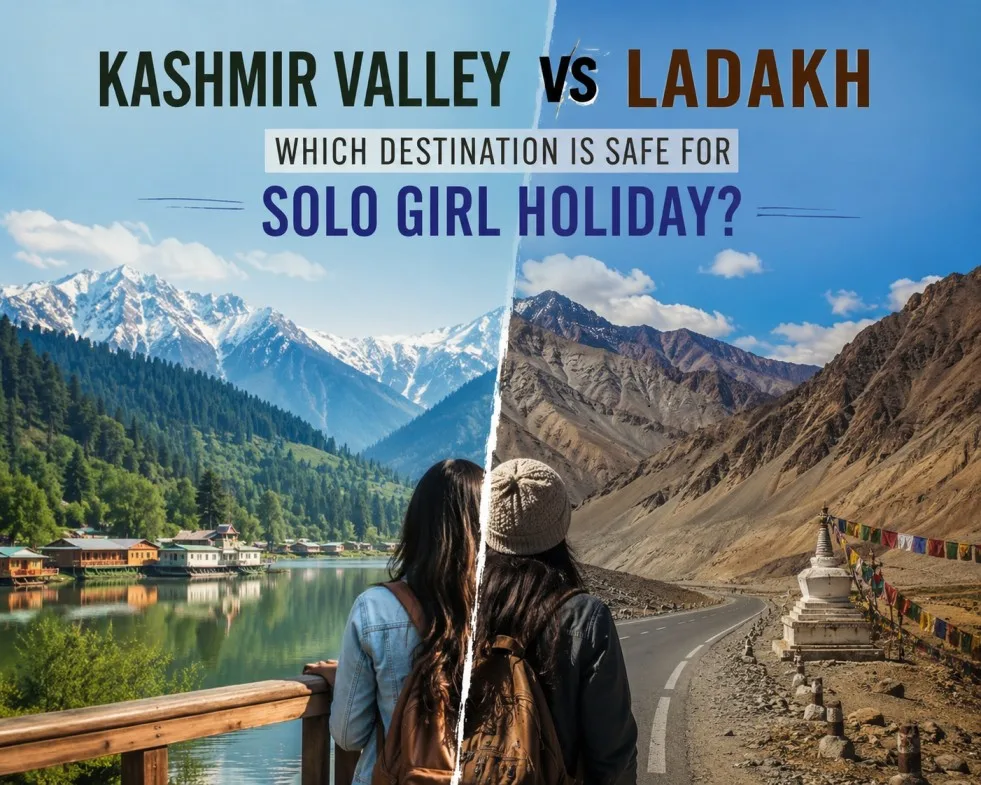
You’ve got 2 tabs open. One says “Kashmir Valley tour”. The other says “Ladakh itinerary”. And your brain keeps looping on the same line: “Which one is actually safe if I go alone?”
Safety in the mountains is never one simple yes or no. It’s a bundle of things: people, roads, weather, health, connectivity, and how quickly help shows up when plans go sideways.
What “safe” really means on a solo girl trip
Most blogs talk about safety like it’s one thing. It’s not. Use this checklist mindset:
1) Social safety (people + behaviour)
- How do locals treat tourists, especially women?
- Do you have to deal with persistent staring, comments, or follow-along behaviour?
2) Transport safety (roads + timing)
- Are you forced into late-night travel?
- Are roads prone to landslides, black ice, or long stretches without fuel?
3) Medical safety (hospitals + response time)
- Can you reach a decent hospital fast?
- Does the destination have a common trip-ruiner (altitude sickness in Ladakh, for example)?
4) Digital safety (network + payments)
- Can you call for help, book a cab, pay, or share location?
You want a destination that scores “good enough” across all 4, based on your comfort level.
Kashmir Valley tour: what feels safe, what needs planning
Kashmir is one of India’s most visited mountain regions. Tourist circuits are busy in season, and that crowds factor helps many solo women feel less “exposed”.
Where solo women usually feel most comfortable in Kashmir
- Srinagar (Boulevard Road / Dal Lake tourist zone): lots of hotels, taxis, cafes, police presence around main areas.
- Gulmarg: compact tourist zone, day activities, family crowds.
- Pahalgam: calmer, good for walks in daytime, plenty of stays.
- Sonmarg: mainly day trip vibe, plan return before evening.
Stick to these, and your trip tends to stay predictable.
What can genuinely disrupt Kashmir plans
- Weather closures: rain, snow, and landslides can mess with road movement.
- Occasional shutdowns/restrictions: they aren’t daily life for tourists, but they can happen. Your plan needs buffers.
- Network quirks: phone connectivity can be patchy in pockets, and roaming rules change over time. Many travellers still prefer arranging a local SIM (often postpaid) if they’ll be there for several days.
Solo-girl practical rules that work well in Kashmir
- Keep daylight travel as a hard rule between towns (Srinagar to Pahalgam, Gulmarg, Sonamarg).
- Use hotel-arranged taxis or verified taxi stands for intercity rides. Random lift-style choices sound adventurous until they aren’t.
- Choose stays with 24-hour reception and real reviews that mention cleanliness and staff behaviour (read the low reviews, they tell you more).
- If you want a houseboat, pick one that has a clear check-in process and a fixed tariff. Confirm whether it’s moored in the main area and how you’ll move at night.
If you’re comparing Kashmir Tour Packages, ask one blunt question: “Who is my on-ground point of contact after 7 pm?” A package is only as good as the support when your cab is late.
Ladakh: safety is strong socially, tougher physically
Ladakh often feels comfortable for solo women because the social environment in Leh and nearby villages is generally respectful, and tourism has been part of local income for years.
But Ladakh can punish casual planning.
Ladakh’s real safety risks
Altitude is the big one. Leh sits around 3,500 m. People underestimate it, then end up with headaches, nausea, breathlessness, and poor sleep.
And the roads are long. Very long.
- Leh to Nubra: usually 5 to 6 hours depending on route and road.
- Leh to Pangong: often 5 to 6 hours.
- Fuel pumps and medical help thin out once you leave Leh.
Where solo women usually feel most comfortable in Ladakh
- Leh market area: walkable, lots of cafes, hostels, shops.
- Nubra (Diskit, Hunder): homestays, family travellers.
- Pangong side: quiet, but keep expectations realistic about network and facilities.
Permits and connectivity (small things that become big later)
- Many areas need an Inner Line Permit (ILP) for Indian citizens (routes like Nubra, Pangong, Tso Moriri). You can usually apply online or through an agent. Carry a few photocopies.
- Network: Leh town has reasonable coverage on major networks, but outside it drops fast. Plan like you’ll be offline for hours.
If your family needs peace, share a simple plan: “I’ll call from Leh at night, and I’ll message when we reach Nubra/Pangong.” Set expectations early.
So which is safer for a solo girl: Kashmir or Ladakh?
Here’s the decision logic I use when someone is stuck choosing:
Choose Kashmir if you relate to these
- You want more people around, more hotels, and shorter day trips.
- You get anxious when you can’t access pharmacies, ATMs, or a proper market.
- You prefer scenery with meadows, lakes, gardens, and comfortable pacing.
Kashmir holiday Package for solo girls works best when the itinerary stays tight and central, with Srinagar as the base.
Choose Ladakh if you relate to these
- You prefer quieter places, and you don’t mind basic facilities.
- You’re comfortable saying “no” and sticking to your routine, even when you’re far from towns.
- You can follow altitude rules properly (rest day in Leh, slow ascent, hydration, no sprinting around on day 1).
If you have asthma, heart issues, or you’re very anxious about health, talk to a clinician before locking Ladakh. That one step saves many trips.
If you’re still unsure, here are more best mountain destinations in India to visit in 2026 you can consider.
Costs: Kashmir vs Ladakh (what you’ll actually pay for)
Prices swing wildly by month, hotel type, and vehicle choice. Still, you can sanity-check quotes.
Kashmir tour package price: what changes the total
- Season (peak summer and snow season often cost more)
- Houseboat vs hotel
- Private cab vs shared
- Gulmarg gondola day (activities add up)
A 3 Nights & 4 Days Kashmir Package is usually priced around mid-range budgets when it includes Srinagar stay, local sightseeing, and day trips. If a quote looks too cheap, it often skips permits, entry tickets, or gives you far stays that eat time and money.
Ladakh costs: why it can climb fast
- Longer distances mean higher vehicle costs.
- Camps near Pangong can be expensive in peak months.
- Permits and environmental fees add a little.
- You might need a buffer day for altitude or weather, which adds hotel nights.
One practical tip: in Ladakh, paying more for a reliable driver and a well-maintained vehicle is genuine safety spending.
Itineraries that keep solo travel safer (and less chaotic)
A safer 4-day Kashmir plan (easy pacing)
Day 1: Arrive Srinagar, Dal Lake area, local markets, early night.
Day 2: Gulmarg day trip, return before dark.
Day 3: Pahalgam day trip (or stay 1 night if you want it slower).
Day 4: Srinagar gardens + depart.
This style keeps you close to support and avoids late highway runs.
A safer 4-day Ladakh plan (altitude-respect plan)
Day 1: Arrive Leh, rest, short walks only.
Day 2: Local Leh sightseeing (Shanti Stupa, Hall of Fame), early night.
Day 3: Nubra Valley day (or overnight), start early morning.
Day 4: Return to Leh and depart (or add 1 extra day for Pangong if you can).
If a Ladakh itinerary pushes Pangong on Day 2 right after landing, treat it as a red flag.
Booking a package as a solo woman: questions that actually protect you
When you compare Kashmir Tour Packages, don’t get distracted by the list of “inclusions”. Ask questions that reduce risk:
- Hotel location: “How far is it from the main tourist area?”
- Driver details: “Will I get the driver’s name and number a day before?”
- Daily start time: “What time do we leave each day, and what time do we return?”
- Support: “Who answers if I call at 9 pm?”
- Plan B: “If Gulmarg road closes, what’s the alternate plan?”
If an operator gets irritated by these questions, imagine how helpful they’ll be during a real problem.
(If you’re browsing itineraries online, you’ll see brands like Maujitrip listing common circuits. Use any itinerary like a template, then apply the questions above before you lock it.)
Solo-girl safety checklist (small habits, big difference)
- Share a live location with 1 trusted person when you’re on the highway.
- Keep screenshots of hotel bookings, driver number, permits, and ID on your phone.
- Carry basic meds, sanitary supplies, a small torch, and a power bank.
- Avoid announcing “I’m alone” casually. Keep it vague; “I’m meeting friends later” works.
- Use the official emergency number 112 in India if you need help fast. For women’s helpline, 1091 works in many states, and local help desks can guide you.
Conclusion
For many solo women, Kashmir feels safer through structure: more hotels, more people, shorter hops, and strong tourist circuits if you stick to day travel. For others, Ladakh feels safer socially, especially around Leh, but it demands serious respect for altitude and distance.
If you want the simplest, lower-effort trip, choose Kashmir and book one of the well-planned Kashmir Tour Packages for solo girls that keeps you in Srinagar plus day trips. If you’re fit, patient with long drives, and disciplined about acclimatisation, Ladakh can be calm and comfortable.
Either way, your safety improves sharply when your itinerary is boring in the right places: daytime travel, reliable stay, reliable driver, and buffer time.
FAQ’s
1) Is Kashmir safe for a solo female traveller in 2026?
Srinagar, Gulmarg, and Pahalgam are tourist areas that come under Kashmir. A solo female traveller can move safely there if the day is kept for travel.
2) Is Ladakh safe for a solo girl?
Ladakh and its tourist circuits are places where most people feel comfortable. For a girl, the main worry is altitude sickness. Long stretches of road have medical facilities.
3) Which destination is safer at night: Srinagar or Leh?
Both Srinagar and Leh are calmer in market areas during the night. A solo traveller should keep nights simple.
4) Which is cheaper: a Kashmir trip or a Ladakh trip?
A trip to Kashmir is often cheaper for the number of days. The reason is that distances are shorter and a traveller can stay in Srinagar.
5) What’s a sensible minimum trip length for Ladakh for first-timers?
For first‑timers, a minimum of 5 to 7 days is perfect. This time allows a traveller to acclimatise in Leh properly and still do one or two excursions without rushing.