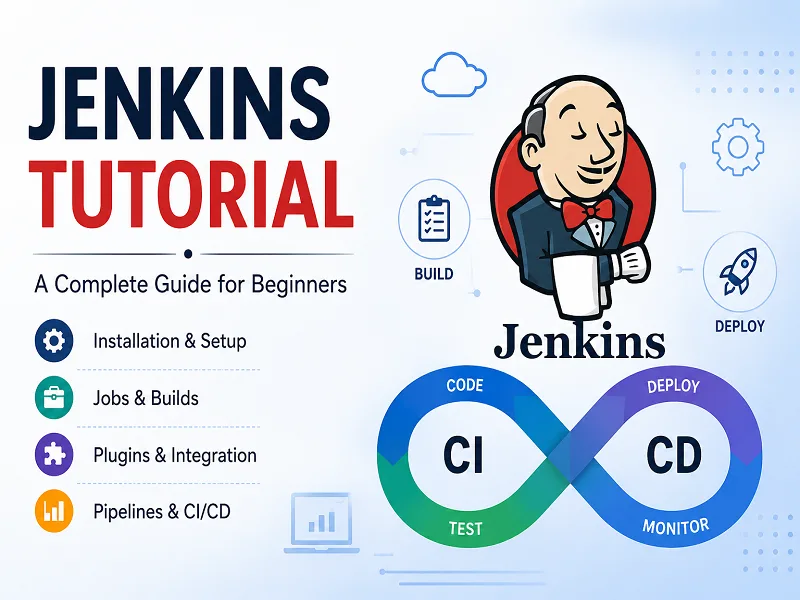
Jenkins is a popular automation server that helps developers build, test, and deliver software more efficiently. It is widely used in DevOps because it can automate many repetitive tasks in the software development process. By using Jenkins, teams can save time, reduce manual work, and improve the quality of their applications.
Learning Jenkins is useful for beginners, students, software developers, testers, and DevOps professionals. It helps users understand how software projects can move smoothly from development to testing and then toward deployment. Jenkins can work with different development tools and supports many types of software projects, making it a flexible choice for modern development teams.
A good Jenkins learning guide introduces important concepts such as continuous integration, continuous delivery, automation, jobs, pipelines, plugins, builds, and project management. These concepts help learners understand how Jenkins fits into the software development lifecycle. Jenkins can automatically perform tasks when changes are made to a project, which helps teams identify problems earlier and deliver updates more quickly.
One of the main benefits of Jenkins is its plugin system. Plugins allow Jenkins to connect with many development, testing, version control, cloud, and deployment tools. This flexibility makes Jenkins suitable for different development environments. Teams can create automated workflows according to their project requirements without performing every task manually.
Jenkins is also helpful for continuous integration. In a continuous integration environment, developers regularly add changes to a shared project. Jenkins can automatically build and test these changes, helping teams find errors at an early stage. This process improves collaboration and makes software delivery more reliable.
Another important area of Jenkins is pipeline management. Jenkins pipelines provide a structured way to organize different stages of software delivery. Teams can manage activities such as building, testing, and deployment through an automated workflow. This approach makes development processes more consistent and easier to monitor.
Jenkins is widely used in DevOps environments because automation is an important part of modern software development. It can help organizations release software faster while reducing repetitive manual tasks. Learning Jenkins can therefore be valuable for anyone interested in DevOps and software automation.
Beginners can start by understanding the basic Jenkins concepts and gradually move toward advanced topics. Regular practice and learning how different Jenkins features work can help users become more confident. A clear Jenkins learning path can also prepare learners for practical projects and professional opportunities.
If you want to understand Jenkins from the basics and explore its important concepts, a structured learning resource can make the process easier. The Jenkins Tutorial provides useful information for learners who want to develop their knowledge of Jenkins and software automation.
Learn more with the Jenkins Tutorial