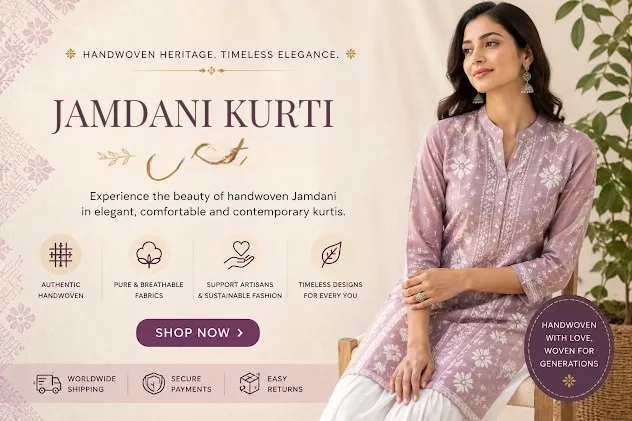
A Jamdani mul cotton kurti brings together two things Indian textile lovers rarely get in one garment: the intricate, hand-loomed artistry of Jamdani weaving and the featherlight, breathable feel of mul cotton. The result is a kurti that looks dressed-up without ever feeling heavy, stiff, or hot to wear — which is exactly why it has become a go-to choice for daily wear, office hours, and festive gatherings alike.
This guide answers the questions people actually search before buying: what makes this fabric combination special, how it differs from regular cotton kurtis, how to check authenticity, how to care for it, and how to style it across seasons and occasions.
What Makes Jamdani Weaving Different From Other Handloom Techniques?
Jamdani is a supplementary weft technique where extra threads are woven into the base fabric by hand, on the loom itself, to create motifs — rather than embroidering or printing them on afterward. Every motif is placed thread by thread as the fabric is woven, which is why genuine Jamdani work has a slightly raised, textured feel when you run your fingers over the pattern, and why the design looks identical on both sides of the fabric.
This technique has deep roots in Bengal and has been practiced for centuries. Jamdani weaving from West Bengal and Bangladesh is recognized as a Geographical Indication (GI), a status that protects and documents the craft's regional origin and traditional method. You can read more about how GI protection works for Indian handloom products on the Government of India's Intellectual Property India portal.
Because each motif is hand-inserted, no two Jamdani pieces are ever perfectly identical — a detail that traditional buyers specifically look for as a mark of authenticity.
Why Pair Jamdani Weaving With Mul Cotton Specifically?
Mul cotton (also called mulmul) is one of the finest, sheerest cotton weaves made — light enough to feel almost weightless, yet breathable enough to stay comfortable through humid days and long working hours. When Jamdani motifs are woven into mul cotton instead of a heavier cotton or silk base, the kurti gets:
- Better airflow — ideal for hot and humid climates common across most of India.
- A softer drape that moves with the body instead of holding a stiff shape.
- A lighter overall weight, so the garment doesn't feel like "occasion wear" even when the weaving is intricate.
- A refined, almost translucent finish that looks premium without added embellishment.
This is the main reason kurtis in jamdani weaving mul-cotton fabric are marketed as both everyday-friendly and festive-appropriate — the base fabric keeps it casual, while the weaving elevates it.
How Is a Jamdani Kurti Different From a Regular Cotton Kurti?
This is one of the most common comparison questions buyers ask before purchasing. Here's a side-by-side breakdown:
FeatureJamdani Mul Cotton KurtiRegular Printed/Plain Cotton KurtiMotif techniqueHand-woven into the fabric during weavingUsually screen-printed, block-printed, or plainFabric weightVery light (mul cotton base)Varies — often medium-weight cottonTextureSlightly raised motif areas, felt on touchFlat, smooth surfaceDesign visibilitySame design visible on both sidesPrint visible on front, faded/absent on reverseProduction timeLonger — handloom, skill-intensiveFaster — machine printing or dyeingUniquenessSlight variations, handmade characterIdentical repeat patterns across piecesTypical price rangeHigher, reflecting handloom laborMore affordable, mass-producibleBest suited forSemi-formal, festive-casual, giftingDaily casual wearIf you're choosing between the two, the deciding factor usually comes down to whether you value the handloom craftsmanship and breathability trade-off, or simply need a low-maintenance daily kurti.
How Do You Check If a Jamdani Kurti Is Genuine?
Buyers frequently ask how to avoid printed imitations sold as "Jamdani style." Here's a practical checklist:
- Touch the motif. Genuine handwoven Jamdani has a slight ridge or raised texture where the extra weft thread sits. Printed designs feel completely flat.
- Check both sides of the fabric. True Jamdani motifs appear equally clear on the reverse side. Prints only show on one side.
- Look for minor irregularities. Small variations in spacing or motif alignment are normal in handloom work and are actually a good sign, not a flaw.
- Ask about the fabric composition. A genuine mul cotton base should feel sheer, soft, and lightweight — not starchy or plastic-like.
- Request GI or handloom certification details where available, especially for higher-value purchases.
Is a Jamdani Mul Cotton Kurti Good for Everyday Wear?
Yes, and this is one of the biggest reasons this fabric combination has gained popularity. Mul cotton's breathability makes it suitable for long wear hours — office days, travel, or daily errands — without the heat retention issue that heavier fabrics like silk or thick cotton can cause. The Jamdani weaving adds visual interest, so a single kurti can transition from a regular workday to a casual evening outing simply by changing the accessories or footwear.
It is generally not the most practical choice for heavy manual work or rough daily wear, since fine handloom weaves need slightly more careful handling than mass-market fabrics — but for most everyday and semi-formal use cases, it performs very well.
How Should You Style a Jamdani Mul Cotton Kurti?
- For office wear: Pair with straight-fit pants or churidar and minimal jewelry to let the weave stand out.
- For festive-casual occasions: Add a contrast dupatta, juttis, and statement earrings.
- For summer daily wear: Wear with cotton palazzos and flat sandals for maximum breathability.
- For layering in cooler months: Add a solid-colored jacket or shrug without covering the front motif work.
- For gifting: Choose neutral or pastel shades, which tend to suit a wider range of preferences and skin tones.
How Do You Wash and Care for a Jamdani Mul Cotton Kurti?
Handloom cotton needs gentler handling than regular printed cotton to preserve both the fabric and the weaving:
- Hand-wash in cold or lukewarm water for the first few washes; machine wash only on a gentle cycle afterward.
- Use a mild detergent — harsh chemicals can weaken the extra weft threads used in the motifs.
- Avoid wringing; gently squeeze out excess water instead.
- Dry in shade rather than direct harsh sunlight to prevent color fading.
- Iron on the reverse side, on a low-to-medium setting, to protect the raised motif texture.
- Store folded rather than hung for long periods, to avoid stress on the woven areas.
What Should You Look for Before Buying a Jamdani Mul Cotton Kurti Online?
Since much of this category is now purchased online, a few practical checks help avoid disappointment:
- Fabric details in the listing — confirm it specifies mul cotton, not a cotton blend labeled loosely as "cotton."
- Close-up images of the weave, not just styled photography, so you can judge motif texture before buying.
- Size and fit guide, since handloom fabric can behave slightly differently from machine-woven cotton in terms of stretch and drape.
- Return or exchange policy, especially important for a first-time purchase of a specific brand or weaver.
- Care instructions provided by the seller, which should align with standard handloom cotton care.
Several Indian ethnic wear labels, including Indeloom, list Jamdani mul cotton kurtis alongside detailed fabric and care information, which is worth reviewing before purchase regardless of which brand you choose.
Jamdani Mul Cotton Kurti vs. Chikankari or Bagh Print Cotton Kurti — Which One to Pick?
Buyers comparing handloom options often ask how Jamdani stacks up against other popular Indian cotton kurti techniques:
- Jamdani — motifs woven into the fabric; best for a textured, structured look with a subtle sheen from mul cotton.
- Chikankari — hand-embroidered after weaving; delicate, thread-based floral detailing, generally more intricate on the surface.
- Bagh/Block print — hand block-printed motifs; bolder, more graphic patterns, usually more affordable.
If you prefer a woven, dimensional texture over surface embroidery or print, Jamdani is the better fit. If you want intricate floral embroidery, chikankari suits that need better.
Final Thoughts
A Jamdani mul cotton kurti works well precisely because it doesn't force a choice between comfort and craftsmanship. The mul cotton base keeps it light and wearable through long days, while the Jamdani weaving gives it a level of detail that's hard to replicate with printing or embroidery alone. Whether you're buying for daily wear, festive-casual occasions, or as a thoughtful gift, checking the weave texture, fabric composition, and care instructions before purchase will help you pick a genuinely well-made piece — from Indeloom or any other handloom-focused label.