
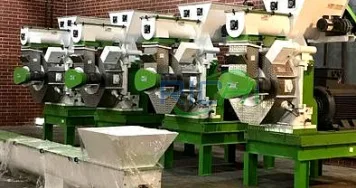
An italian pellet machine is a type of pelletizing equipment used to compress prepared biomass or other granular materials into cylindrical pellets. The term may refer to pelletizing equipment manufactured in Italy or machines designed for pellet production in the Italian market. Depending on the raw material and intended application, such equipment can be used to produce biomass fuel pellets, animal feed pellets, bedding pellets, and other densified products.
Pellet machines are generally installed as individual units or as part of a complete pellet production system.
History and Development
Pelletizing technology developed alongside the demand for densified agricultural and biomass materials. Early pellet mills were primarily associated with animal feed production. Later, the technology became increasingly important in biomass fuel production as wood residues, agricultural waste, and other renewable materials were processed into standardized solid fuels.
Modern pellet machines incorporate mechanical transmission systems, automatic feeding, lubrication systems, control panels, and different die configurations. Equipment design varies according to production capacity and the physical properties of the material being processed.
Structure
A conventional pellet machine consists of several main components:
- Feeding system
- Pelletizing chamber
- Die
- Rollers
- Main drive system
- Transmission components
- Lubrication system
- Discharge system
- Control system
The die contains multiple holes through which compressed material passes. Rollers rotate against the die surface and apply pressure to the prepared material. The diameter and geometry of the die holes influence the size and shape of the resulting pellets.
For materials such as straw, grass, and other fibrous biomass, equipment similar to a straw pellet mill may use reinforced feeding and compression components to accommodate the physical characteristics of these materials.
Working Principle
Pellet production generally begins with preparation of the raw material. Large particles may be crushed or ground, while materials with excessive moisture may require drying.
The prepared material enters the feeding system and is distributed into the pelletizing chamber. Inside the chamber, rotating rollers compress the material against the die. Pressure and friction increase the density of the material, allowing it to pass through the die openings.
After extrusion, knives positioned outside the die cut the continuous material into pellets of a predetermined length. Newly produced pellets normally have a higher temperature than the incoming material and may therefore pass through a cooling system before screening and packaging.
Types of Pellet Machines
Pellet machines can be classified according to their structure, application, or die arrangement.
Flat Die Pellet Machines
Flat die machines generally use a horizontal die and rotating rollers. They are commonly associated with small-scale pellet production because of their relatively simple construction and maintenance requirements.
Ring Die Pellet Machines
Ring die machines use a circular die surrounding the rollers. They are widely used for continuous industrial production and are available in different capacity ranges.
Feed Pellet Machines
Feed pellet machines are configured for materials such as corn, soybean meal, wheat bran, grass, and other feed ingredients. Their design is generally selected according to animal species, formulation, pellet diameter, and required capacity.
Biomass Pellet Machines
Biomass pellet machines process materials such as sawdust, wood chips, straw, rice husks, and agricultural residues. Compared with many feed applications, biomass materials can require greater attention to fiber length, moisture, and compression characteristics.
Applications
Pellets produced by these machines have several applications.
In the biomass sector, pellets can be used as solid fuel in residential heating systems, industrial boilers, and other combustion equipment. In agriculture, pelletized feed provides a uniform form for handling, storage, and transportation. Certain biomass materials can also be processed into animal bedding pellets.
The final application determines the required raw material preparation, pellet diameter, density, and equipment configuration.
Factors Affecting Pellet Quality
Pellet quality is influenced by several variables rather than by the pellet machine alone. Important factors include:
- Raw material composition
- Moisture content
- Particle size
- Fiber characteristics
- Die hole diameter
- Compression ratio
- Roller condition
- Operating speed
- Cooling efficiency
Moisture is particularly important because insufficient or excessive moisture can affect pellet formation and mechanical durability.
For commercial applications, the pellet machine is normally integrated with crushers, dryers, coolers, screens, conveyors, and other equipment. A complete pellet production line allows these stages to operate as a coordinated process.
Manufacturers and Equipment Selection
Pellet machine manufacturers differ in their machine designs, production capacities, materials of construction, control systems, and service arrangements. Buyers commonly compare equipment according to rated capacity, motor power, die specifications, spare-parts availability, energy consumption, and maintenance requirements.
pellet machine for sale listings may include both individual machines and complete production systems. When comparing equipment, the rated capacity should be considered together with the characteristics of the actual raw material, because laboratory or reference capacities may differ from practical production output.
Maintenance
Routine maintenance is required to maintain stable pellet production. Typical maintenance work includes inspection of rollers and dies, lubrication of bearings and transmission components, cleaning of the pelletizing chamber, and checking of electrical and feeding systems.
Worn dies and rollers can reduce production efficiency and affect pellet quality. Regular inspection can help identify excessive wear before it causes significant production problems.
Role in Modern Pellet Production
Pellet machines remain a central component of densification technology for both agricultural and biomass materials. Their development has been associated with increasing automation, improved energy efficiency, larger production capacities, and greater adaptation to difficult raw materials.
The choice of machine depends primarily on the material being processed, the required production capacity, the desired pellet specifications, and the intended application. As a result, there is no single pellet machine configuration suitable for every pellet production project.
For technical information about pelletizing equipment and its applications, click to read additional reference material.