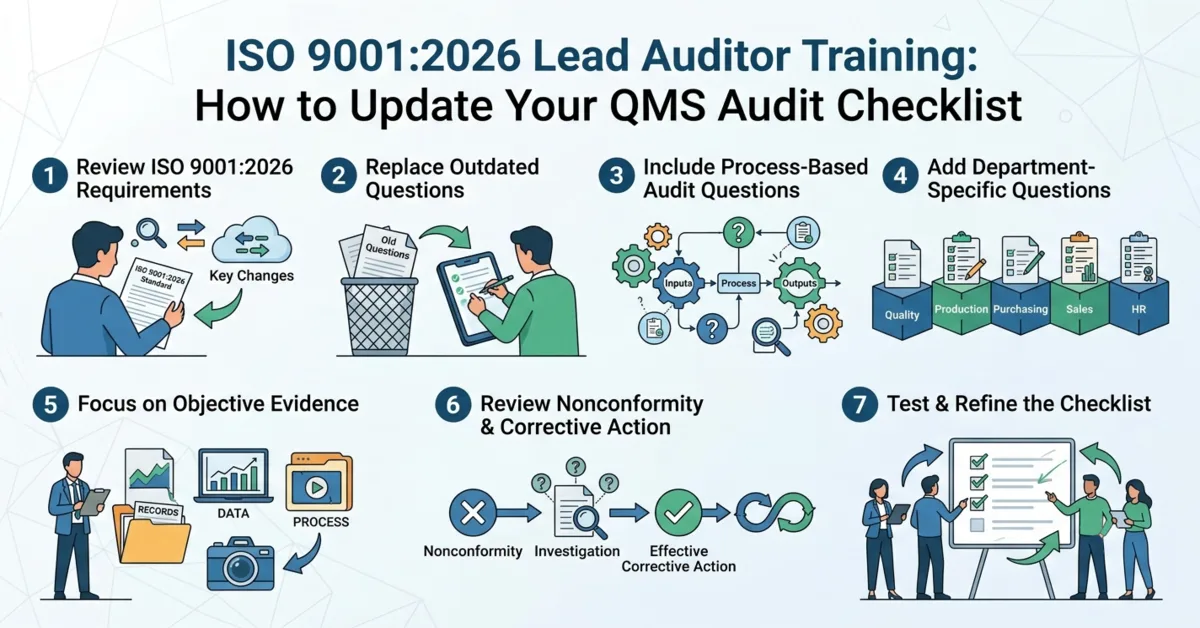
An audit checklist is more than a list of questions. It helps auditors plan an audit, maintain consistent coverage of requirements, collect objective evidence, and determine whether a Quality Management System (QMS) is effectively implemented. With the release of ISO 9001:2026, organizations and auditors should review existing checklists and update them to reflect the current requirements.
A well-structured ISO 9001:2026 audit checklist can make audits more organized while helping auditors avoid overlooking important areas.
1. Review the ISO 9001:2026 Requirements
Begin by reviewing the requirements of ISO 9001:2026 rather than simply editing the previous version's questions. Understanding the key ISO 9001:2026 changes for auditors can help you determine which audit questions, evidence requirements, and evaluation points need to be revised.
Map each applicable requirement to one or more audit questions. This creates a clear connection between the standard and the evidence that an auditor needs to examine.
2. Replace Outdated Audit Questions
Older questions may no longer provide meaningful evidence of conformity. Review your existing ISO 9001 audit checklist and remove questions that refer to outdated requirements, terminology, or processes.
Rewrite questions so they encourage auditors to verify how requirements are actually implemented. For example, instead of asking only whether a procedure exists, consider what evidence demonstrates that the relevant process is implemented and maintained.
3. Include Process-Based Audit Questions
A useful ISO 9001:2026 QMS audit checklist should not rely only on clause-by-clause questions. Include process-oriented questions that help auditors examine how activities interact and produce intended results.
Questions can address inputs, outputs, responsibilities, controls, risks and opportunities, performance measures, and improvement activities. This makes the checklist more useful during interviews and process audits.
4. Add Department-Specific Questions
Different departments interact with the QMS in different ways. Quality, production, purchasing, sales, human resources, maintenance, and other functions may require different audit questions.
Department-specific questions can help an ISO 9001:2026 auditor examine whether relevant requirements are being applied consistently across the organization.
5. Focus on Objective Evidence
Checklist questions should guide the auditor toward verifiable evidence. Depending on the process, this may include records, documented information, performance results, monitoring data, communication records, customer-related information, or evidence of corrective action.
The goal is not to collect documents simply for the sake of the audit. Evidence should help determine whether the process meets applicable requirements and is working as intended.
6. Review Nonconformity and Corrective Action Questions
Include questions that help auditors evaluate how nonconformities are identified, investigated, corrected, and followed up. The checklist should support consistent evaluation of root causes, corrective actions, and evidence demonstrating whether actions were effective.
7. Test and Refine the Checklist
Before using the revised checklist for an important audit, test it during an internal audit or review. Note questions that are unclear, repetitive, too general, or difficult to verify.
For professionals who want to strengthen their auditing skills alongside practical checklist use, ISO 9001:2026 lead auditor training can provide structured guidance on audit planning, evidence collection, nonconformity identification, and conducting QMS audits.
Make Your ISO 9001:2026 Audit Checklist Practical
Updating a checklist should ultimately make auditing easier, not create additional paperwork. A practical QMS audit checklist should connect requirements with processes, departments, objective evidence, and audit findings.
For effective ISO 9001:2026 audit preparation, review the checklist regularly as your QMS changes. Keeping audit questions aligned with current requirements and actual organizational processes can help auditors conduct more consistent and meaningful audits.
Conclusion
A practical ISO 9001:2026 audit checklist should reflect current requirements, actual QMS processes, and the objective evidence auditors need to verify. For professionals preparing to audit against the revised standard, ISO 9001:2026 lead auditor training can help build the knowledge and practical auditing skills needed for effective QMS audits.