Introduction: When Your Business Grows, Can Your Learning Strategy Keep Up?
Imagine your organization is expanding into new markets, hiring rapidly, and introducing new technologies. Teams need new skills, managers want faster training delivery, and leadership expects measurable returns from learning investments.
But your L&D function is struggling to keep pace.
Training requests pile up. Different departments create similar courses. Employees receive inconsistent learning experiences, while leaders find it difficult to determine whether training is improving performance.
Sound familiar?
These challenges often indicate that your learning and development strategy needs more than additional resources. It needs an operating model designed to support the way your business actually works.
A scalable model clarifies ownership, streamlines decision-making, connects learning with business priorities, and helps teams deliver training without unnecessary complexity.
The good news? You don't need to rebuild everything at once. With the right structure and a clear implementation plan, you can transform L&D from a reactive service into a strategic business partner.
Here's how to get started.
What Makes an L&D Operating Model Scalable?
An L&D operating model describes how learning responsibilities, people, processes, governance, budgets, and technology work together.
Scalability means these elements can accommodate growing learner populations, changing skill requirements, and expanding business operations without creating disproportionate costs or administrative work.
A scalable structure should make it easier to answer questions such as:
- Who decides which skills the organization needs to develop?
- Which learning activities should be shared across the business?
- When should departments design their own training?
- How will employees access learning opportunities?
- Which metrics demonstrate whether learning investments are working?
When these responsibilities are clearly defined, the L&D team can spend less time resolving ownership issues and more time improving workforce capabilities.
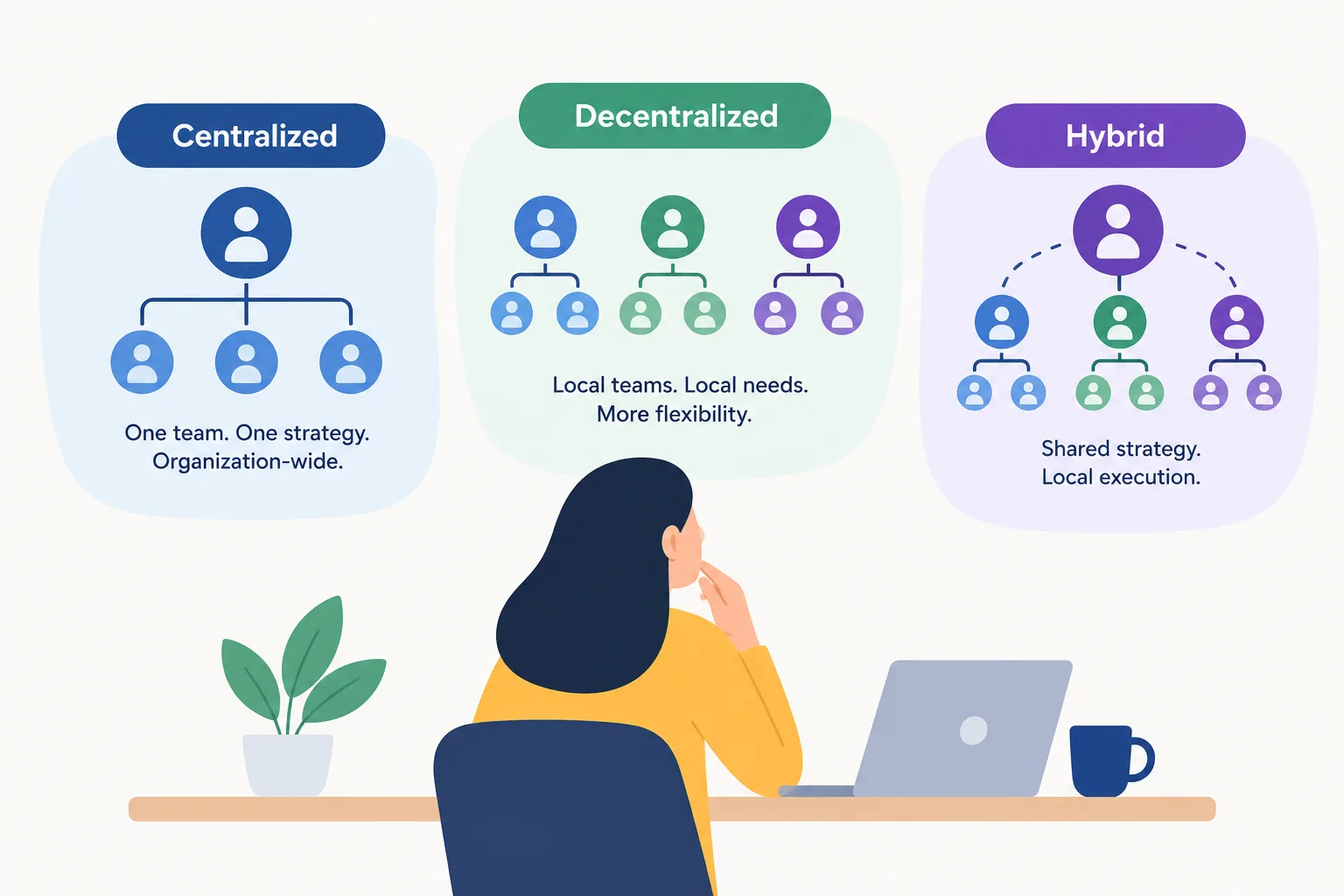
The Three Operating Models Every L&D Leader Should Understand
Before redesigning your structure, understand the advantages and trade-offs of the three most common approaches.
1. Centralized: Create Consistency at Scale
In a centralized model, one core L&D team manages the majority of learning strategy, standards, budgets, and delivery processes.
This approach can work well when an organization needs consistent onboarding, leadership development, compliance training, and enterprise-wide reporting.
Why it works:
- Consolidated budgets can improve purchasing power and reduce duplicated investments.
- Shared content standards help maintain quality.
- Central governance supports consistent compliance processes.
- Enterprise reporting provides a unified view of learning activity.
However, centralized teams can become overwhelmed when every department depends on them for every training request.
Make it scalable: Establish clear service levels, prioritize requests according to business impact, and create reusable learning resources. Allow departments to handle approved, low-risk activities independently.
2. Decentralized: Put Expertise Closer to the Learner
A decentralized structure gives individual business units greater responsibility for learning decisions and execution.
This can be valuable when teams operate in different markets or require highly specialized technical, operational, or customer-facing training.
Why it works:
- Departments can respond quickly to emerging skill gaps.
- Subject-matter experts contribute directly to learning design.
- Local teams can adapt content to their workflows.
- Business leaders gain greater ownership of employee development.
The challenge is maintaining visibility and avoiding duplicated work. Without shared standards, departments may adopt different tools, inconsistent evaluation methods, or conflicting training priorities.
Make it scalable: Set enterprise-wide requirements for reporting, accessibility, information security, and mandatory learning while preserving local flexibility where it adds genuine value.
3. Federated: Balance Enterprise Direction With Local Freedom
A federated model combines a central L&D function with learning representatives or specialist teams embedded in business units.
The central function manages shared priorities, governance, standards, and infrastructure. Local teams identify role-specific needs, develop specialized content, and deliver learning suited to their employees.
This approach can be especially useful for large or geographically distributed organizations.
Why it works:
- Central teams protect consistency and coordinate investment.
- Business units respond to local challenges.
- Shared resources reduce unnecessary duplication.
- Distributed expertise increases the capacity to deliver training.
The model does require disciplined collaboration. Leaders must define who owns decisions, how funding is allocated, and how disagreements are resolved.
Make it scalable: Create a responsibility matrix, establish regular planning meetings, and maintain a shared learning roadmap.
Seven Ways to Design an Operating Model That Delivers Results
Choosing a structure is only the beginning. The real value comes from how you implement it.
1. Start With Business Priorities, Not Training Requests
Ask what the organization needs to achieve over the next 12–24 months.
Is the priority faster onboarding, better customer service, digital transformation, leadership development, or regulatory readiness?
Map these goals to the skills employees need. This helps L&D prioritize initiatives based on business importance rather than simply responding to whoever requests training first.
2. Map Your Existing Learning Activities
Before introducing new processes, understand what already exists.
Review course libraries, vendors, budgets, approval workflows, internal trainers, and reporting practices. Identify duplicated content, underused resources, and unnecessary administrative steps.
Speak with department leaders and learners to uncover problems that reports alone may not reveal.
The result should be a practical picture of where the current structure supports performance and where it creates friction.
3. Separate Shared Responsibilities From Specialized Needs
Not every learning activity requires the same level of control.
Shared activities may include enterprise onboarding standards, compliance requirements, learning technology, and common leadership principles.
Specialized activities may include product training, advanced technical instruction, and department-specific operational procedures.
Assign each responsibility to the team best equipped to manage it. This simple distinction helps prevent both excessive centralization and uncontrolled decentralization.
4. Build Clear Governance Into Everyday Work
Governance should make decisions easier, not introduce layers of bureaucracy.
Define who approves learning investments, who owns content, which standards apply, and how performance will be evaluated.
For example, a central team might approve major platform purchases, while business units can update approved role-specific resources without seeking repeated permission.
Document decision rights and escalation paths so that teams know how to move work forward.
5. Choose Technology That Supports Your Operating Model
Technology should make learning easier to deliver, manage, and measure.
A suitable Learning Management System (LMS) can centralize course administration, learner records, completion tracking, assessments, and reporting. Depending on its capabilities, it may also support role-based access and delegated administration.
If employees need a mix of digital courses, live workshops, and collaborative activities, a Blended Learning Platform may help coordinate these learning experiences.
Before selecting technology, assess integration requirements, accessibility, reporting, security, user experience, and the administrative workload associated with different configurations.
Avoid purchasing a platform simply because it offers the largest feature set. Prioritize capabilities that address documented business needs.
6. Measure Performance Beyond Course Completion
Completion rates can help monitor participation, particularly for mandatory training. However, they rarely tell the entire story.
Combine participation data with measures such as assessment results, observed skill improvement, time to proficiency, learner feedback, and relevant operational outcomes.
For example, if a customer service training initiative aims to improve issue resolution, examine whether resolution quality changes after employees complete the program.
Be careful when interpreting results. Improvements may have multiple causes, so use suitable comparisons and additional evidence before attributing business changes entirely to training.
7. Pilot, Learn, and Expand
Do not assume that a new operating model will work perfectly across every department.
Test it with a business unit that represents a meaningful challenge but is manageable in scope.
Define success criteria before the pilot begins. Monitor decision-making speed, delivery costs, stakeholder satisfaction, reporting quality, and learning outcomes.
Use the findings to refine responsibilities and workflows before expanding to other teams.
How Do You Know Your Operating Model Is Working?
A successful model should improve both the learner experience and the organization's ability to deliver learning efficiently.
Track a focused set of indicators:
Performance areaWhat to measureEfficiencyTime from training request to launchCostCost per learner or programQualityLearner feedback and assessment performanceCapabilityDemonstrated improvement in job-related skillsBusiness impactRelevant operational or performance indicatorsGovernanceCompliance with agreed standards and reporting requirementsEstablish a baseline before implementation and review results at regular intervals. The objective is not to maximize every metric independently but to understand whether the operating model supports better decisions and meaningful outcomes.
Common Mistakes That Prevent L&D From Scaling
Expanding without clear ownership: More people and tools will not solve overlapping responsibilities. Define accountability before increasing capacity.
Standardizing everything: Enterprise-wide consistency is valuable, but specialist training may require local expertise and flexibility.
Giving every department a separate technology stack: Independent purchasing can increase costs and fragment reporting. Establish shared technology principles and evaluate exceptions carefully.
Treating governance as paperwork: Effective governance clarifies decisions, reduces risk, and enables teams to act confidently.
Ignoring employee feedback: A technically efficient structure can still fail if learners cannot find relevant content or managers struggle to support development.
The Future of L&D Starts With Better Design
As organizations evolve, their learning functions must become more responsive, connected, and outcome-focused.
John F. Kennedy captured the relationship between leadership and development in a concise statement:
“Leadership and learning are indispensable to each other.”
A strong operating model turns that principle into practice by connecting leadership priorities, employee capabilities, and everyday learning decisions.
Whether you choose a centralized, decentralized, or federated structure, focus on clear ownership, practical governance, appropriate technology, and measurable outcomes.
Start small, evaluate honestly, and improve continuously. The goal is not simply to deliver more training. It is to build a learning function that can grow alongside your business.
Frequently Asked Questions
1. What are the main components of an L&D operating model?
The main components are strategy, organizational structure, roles and responsibilities, governance, workflows, funding, technology, and performance measurement. Together, they determine how learning is planned, delivered, and evaluated.
2. Which operating model is best for a large organization?
A federated model is worth considering when a large organization needs consistent enterprise standards alongside specialized learning across departments or regions. The best fit depends on its complexity, resources, and governance requirements.
3. How can L&D reduce duplicated training efforts?
Maintain a searchable shared content library, coordinate learning plans across departments, clarify ownership, and review existing resources before commissioning new programs. Shared standards can also help teams reuse suitable content.
4. What role does technology play in scalability?
Technology can automate routine administration, support consistent learner access, improve reporting, and make shared resources easier to distribute. Its value depends on suitable configuration, integration, and adoption.
5. How long does it take to implement a new operating model?
There is no universal timeline. A limited pilot may be completed faster than an organization-wide transformation involving new governance, technology, and reporting processes. Scope, organizational readiness, and stakeholder alignment determine the effort required.
6. When should an organization redesign its L&D structure?
Consider a review when learning delivery becomes slow, duplicated spending increases, reporting becomes fragmented, business priorities change, or the existing structure can no longer support workforce growth.
Editorial note: Add an author biography, expert review, relevant internal links, and original examples from your organization before publication. Follow Google's people-first content guidance and avoid making unsupported claims about performance improvements.