Introduction
Apple’s April 2027 App Store submission deadline may look like a routine annual update, but businesses with legacy iPhone apps, custom navigation, or outdated development frameworks have more to prepare for than simply installing a new version of Xcode. The requirement coincides with the arrival of iPhone Duo, making application compatibility, responsive layouts, and release planning important considerations for product teams in 2026.
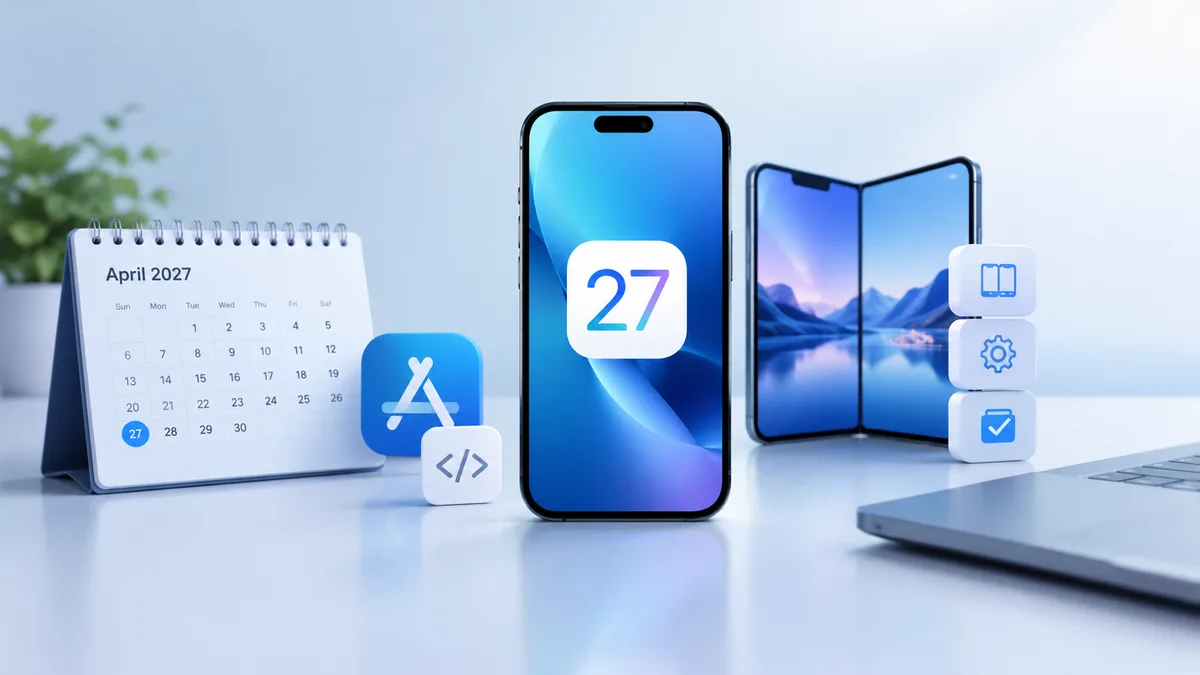
Starting in April 2027, iOS and iPadOS apps uploaded to App Store Connect must be built using the iOS 27 and iPadOS 27 SDKs or later. Apple has also introduced specific preparation requirements for iPhone Duo, including device screenshots for submissions from April 2027.
For businesses working with an iphone mobile application development company, the immediate priority is to determine whether their existing applications can migrate without disrupting critical functionality, customer access, or planned releases.
1. The April 2027 Deadline Is More Than an Xcode Upgrade
Businesses currently maintaining production apps should distinguish between an existing application continuing to run and a new version being eligible for submission.
Apple’s current submission requirements took effect in April 2026, when apps had to be built using Xcode 26 or later with the relevant iOS 26 SDK. The next requirement raises that baseline to the iOS 27 SDK in April 2027. Existing published versions are not automatically removed simply because they were built using an older SDK, but subsequent updates must meet the applicable submission requirements.
This distinction matters for companies that depend on regular releases for payment fixes, security patches, authentication changes, or operational improvements.
An experienced iPhone mobile application development company should begin by opening the existing project in the currently supported Xcode environment, checking build compatibility, and identifying blockers before scheduling a production release.
Older applications may require more extensive work if they depend on deprecated APIs, outdated dependencies, or an application lifecycle that needs migration to the scene-based architecture required by the latest SDK.
2. iPhone Duo Makes Fixed-Size Interfaces a Business Risk
The iPhone Duo launch introduces another practical consideration: an application must adapt to different display configurations rather than assume every iPhone has the same usable screen area.
Apple explains that apps built with the iOS 27 SDK resize to use most of iPhone Duo’s inner display. Apps built with iOS 27.1 or later can provide a more complete experience, including layouts that accommodate vertically positioned toolbars and tab bars. Older builds can still run, but may appear inside a smaller, centered window with unused space around them.
For businesses, the risk is particularly relevant to applications with custom-designed dashboards, data visualizations, booking flows, financial charts, or field-service interfaces.
For example, a logistics application may display delivery status, route information, and proof-of-delivery controls on one screen. If the layout assumes a fixed device width, expanding the interface can cause buttons to move, information to become difficult to read, or important controls to overlap.
An iphone mobile application development company should therefore test actual interface behavior across supported display configurations instead of treating a successful compilation as proof of compatibility.
3. Audit Custom Navigation and Screen-Size Assumptions
The most useful technical work in 2026 is identifying layout decisions that will not scale reliably.
Start with these areas:
- Hardcoded dimensions: Replace fixed screen-width assumptions with container-based sizing and adaptive layouts.
- Custom navigation bars: Check whether navigation controls can accommodate vertical toolbar and tab-bar arrangements.
- Charts and media: Test whether charts, maps, video players, and full-screen images remain usable when the available display area changes.
- Reserved display regions: Check whether important controls or content collide with camera cutouts or other unavailable screen areas.
- App lifecycle and integrations: Validate launch behavior, deep links, push notifications, authentication, and SDK initialization after migrating to the new lifecycle architecture.
Standard SwiftUI and Auto Layout components can handle many layout changes automatically. However, applications with extensive custom UI or older UIKit implementations may need targeted refactoring.
A capable iphone mobile application development company should prioritize these higher-risk components before investing time in cosmetic improvements.
4. Check Dependencies Before They Block a Release
A common migration problem is discovering that the application itself builds correctly, but one of its dependencies does not.
Businesses should audit analytics tools, payment libraries, crash-reporting SDKs, authentication providers, mapping integrations, and native modules. Each dependency should have a verified compatibility path for the intended Xcode and SDK versions.
Cross-platform applications need particular attention. React Native, Flutter, and other frameworks may require specific framework versions, native project changes, or updated plugins before an iOS 27 build succeeds.
Teams should also review abandoned packages and undocumented modifications left by previous development vendors.
Working with an iphone mobile application development company can help businesses separate mandatory migration work from optional modernization. Replacing the entire application is rarely the right starting point when a targeted framework upgrade and limited refactoring can preserve existing functionality.
5. Plan for iPhone Duo Screenshots and App Store Metadata
Technical compatibility is only one part of release readiness. Apple has stated that applications submitted from April 2027 must include iPhone Duo screenshots.
This creates a release-management task for marketing, product, and engineering teams. Screenshots should reflect the actual application experience on the supported device configuration, rather than simply stretching existing iPhone images.
Businesses should review their App Store assets, confirm who can access App Store Connect, and allocate time for capturing, reviewing, and publishing the correct screenshots.
They should also check the updated age-rating questionnaire and social media capability declarations applicable to their submissions. Apps that distribute or amplify user-generated content through feeds, comments, or discovery features may require closer product-level review. These declarations should be assessed accurately rather than left until an urgent update is waiting for submission.
An iphone mobile application development company should coordinate these tasks with the release team so that technical readiness and store listing readiness progress together.
6. A Practical Migration Timeline for Businesses in 2026
A phased plan reduces the risk of discovering critical compatibility issues just before the deadline.
- October–November 2026: Assess the application. Inventory all iOS applications, identify the original codebase and current framework versions, inspect dependencies, and attempt an initial build using the new toolchain.
- December 2026–January 2027: Resolve technical blockers. Address lifecycle migration, replace unsupported packages, update custom navigation, and correct fixed-size layout assumptions.
- February 2027: Run regression testing. Test login, payments, subscriptions, push notifications, deep links, offline workflows, and core business processes. Include iPhone Duo simulator testing and physical-device checks where available.
- March 2027: Prepare the production release. Complete user acceptance testing, validate App Store metadata and screenshots, submit the updated build, and leave sufficient time to address review feedback.
- April 2027: Maintain a compliant release process. Verify that subsequent uploads continue to meet Apple’s SDK requirements and that emergency fixes can be delivered without an avoidable toolchain upgrade.
7. Choosing the Right Development Partner
The deadline is also an opportunity to review how an application is maintained. Businesses should look for an iphone mobile application development company that can demonstrate experience with legacy codebases, native iOS architecture, dependency upgrades, automated testing, and App Store release management.
Debut Infotech can be considered when evaluating development and modernization support for business-critical mobile applications. Before committing to a project, establish a clear scope covering SDK migration, device compatibility, dependency updates, regression testing, release ownership, and post-release support.
Businesses evaluating a mobile app development company should also ask whether the proposed approach preserves the existing backend and customer workflows wherever possible. For broader modernization requirements, iOS App Development Solutions should address maintainability, security, and future operating-system updates—not just the immediate submission deadline.
Conclusion
April 2027 is a submission deadline, but the work required to meet it should begin well before the new SDK becomes mandatory. Businesses that identify lifecycle issues, outdated dependencies, fixed-size interfaces, and missing App Store assets in 2026 will have more flexibility to resolve them without disrupting planned releases.
The goal is not to rebuild every iPhone application. It is to establish a reliable, testable upgrade path that protects current functionality while preparing for new device experiences. Partnering with the right iphone mobile application development company can help turn the deadline into a planned engineering milestone rather than an emergency release project.